
WDIG
Efficient Rare Earth Plus Strategic Metals Fund

Published July 24, 2026

Global Head of Research
Ask most investors what they know about rare earth metals and, in mid 2026, you will likely get some version of some version of the following:
All of that is true. What tends to get skipped is the harder question:
Why is government involvement necessary in the first place, and what does that involvement actually look like?
The answers matter enormously, because not all government activity in this space is the same. A loan guarantee is a different animal from an equity stake. A permitting fast-track is different from a 10-year offtake contract. Understanding the instrument is the beginning of understanding the investment.
The first thing to understand about rare earth economics is that the money is not in the ground. Mining and early-stage processing of rare earth elements, which means such activities as separating the ore and producing oxide concentrates, have been structurally unprofitable for Western companies for decades. The reason is not geological but competitive.
China's state-owned rare earth enterprises have operated for years at prices designed to suppress competition rather than generate returns, a strategy documented by the House Select Committee on the Chinese Communist Party (CCP) and made concrete by the bankruptcy of Molycorp in 2015, which followed directly from China dropping prices in response to Western investment activity attracted by temporarily higher prices.1
Price discipline imposed from above effectively killed Western competitors one by one, leaving China with roughly 91% of global separation capacity by the time the strategic implications became undeniable.2
Travel downstream, however, and the economics change entirely. A neodymium-iron-boron permanent magnet, which is the kind that goes into the motor of an F-35, a wind turbine generator, or an EV drivetrain, commands a price that reflects its criticality, not its commodity inputs. More importantly, the buyers at that end of the chain frequently do not optimize on price at all. A defense prime contractor building guidance systems for the U.S. military does not haggle over the rare earth content. The Department of Defense does not run a procurement auction for the magnet in a submarine's sonar array. What those buyers care about is qualified supply, supply chain security, and the assurance that the material will be available in volume when they need it, regardless of what Beijing decides to do with export controls on any given Tuesday.
This is the structural truth that makes government involvement not just plausible but logical, as the supply chain that produces these materials cannot be built or sustained on mining economics alone. The margin is too thin and the geopolitical competition too asymmetric. Without intervention at multiple points along the value chain, which means not merely at the mine, but at separation, alloying, magnet manufacturing, and the demand side, the economics do not close. This is why governments entered the rare earth business. It is not a distortion of the market. In important ways, it is the market.
Once you accept that government involvement is structural rather than incidental, the next step is to distinguish between the forms it takes. The policy landscape looks like a single blob from a distance, but up close it resolves into at least five distinct instruments, each with different implications for a company's risk profile and investment case.
The most consequential, and most unusual, form of government involvement is direct equity ownership. The U.S. Department of Defense's arrangement with MP Materials is the clearest example in the rare earth space. The DoD has positioned itself as one of the company's largest strategic shareholders through a $400 million convertible preferred equity investment and warrants to purchase up to approximately 11.2 million additional shares, representing approximately 15% of outstanding common stock on a fully converted and exercised basis, alongside a direct $150 million loan, a 10-year magnet offtake agreement, and a neodymium-praseodymium (NdPr) price floor of $110 per kilogram.3
This is no longer industrial policy in any traditional sense. It is the federal government functioning as a strategic capital partner, backstopping the economics of a mine-to-magnet supply chain that it has decided must exist domestically regardless of what market pricing would otherwise dictate. USA Rare Earth completed definitive agreements with the Department of Commerce's CHIPS Program in June 2026, receiving up to $277 million in direct federal funding alongside a $1.3 billion senior secured loan facility, with the Department of Commerce receiving 16.1 million shares and approximately 17.6 million warrants as part of the arrangement. The State of Texas had separately awarded the company a $14.2 million grant from the Texas Semiconductor Innovation Fund in May 2026 for its Round Top Mountain heavy rare earth project.4
Across multiple allied jurisdictions, the more common instrument is long-duration public lending.
In each case, the logic is the same: these are long-duration, capital-intensive projects with payback periods that commercial lenders find difficult to underwrite, especially when Chinese pricing can swing against them at any moment.
Smaller in dollar terms but revealing in their targeting are direct grants and Defense Production Act awards. These tend to flow toward the separation and processing bottleneck, the stage where Chinese dominance is most concentrated and where the technical expertise to build competing capacity is scarcest.
These awards effectively say that we’ll pay to build the infrastructure of a non-Chinese supply chain, even before that infrastructure is commercially viable on its own terms.
Perhaps the most underappreciated instrument is the government as buyer.
Antimony is not a rare earth, but the logic is identical and illustrative, as China dominates supply, controls are an ever-present risk, and the U.S. government has decided to rebuild stockpile levels by procuring from a domestic supplier at terms that make the supplier's business case work. The government, in this role, is not subsidizing production, and instead, it is acting as the customer that commercial buyers cannot yet replace.
Finally, government can create value without writing a check at all.
What is happening in rare earths and adjacent critical minerals is not a conventional subsidy story, and it is not likely to be a short-term one. Governments across the allied world have concluded that supply chains for the materials underlying defense systems, clean energy infrastructure, and advanced manufacturing cannot be left entirely to market forces when the dominant supplier has demonstrated a willingness to weaponize supply as a geopolitical tool. They have responded by becoming capital allocators, strategic buyers, loan providers, and shareholders, not because this is the most efficient solution, but because they have decided that the alternative, a China-dependent supply chain for materials essential to national security, is a risk they are no longer willing to accept.
The WisdomTree Efficient Rare Earth Plus Strategic Metals Fund (WDIG) is an actively managed strategy focused primarily on equity exposures to companies involved in building the rare earth, strategic metals and magnet supply chain outside China.
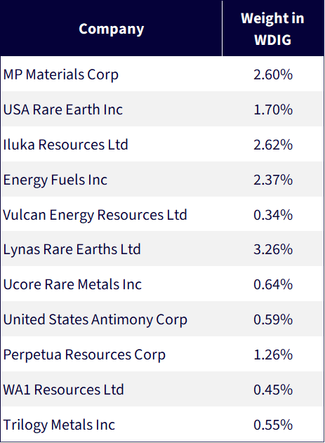
Source: WisdomTree, specifically the WDIG fund page, with holdings and weights as of June 18, 2026. For current holdings of WDIG, please click here. Holdings are subject to risk and change.
1 Source: U.S. House of Representatives Select Committee on Strategic Competition between the United States and the Chinese Communist Party. (2025, November 12). Predatory pricing: How the Chinese Communist Party manipulates global minerals prices to maintain its dominance (Interim report).
2 Source: International Energy Agency. (2025). Rare earth elements.
3 Sources: MP Materials Corp. (2025, July 10). MP Materials announces transformational public-private partnership with the Department of Defense to accelerate U.S. rare earth magnet independence [Press release]; MP Materials Corp. (2025, July 9). Current report on Form 8-K (Filed July 10, 2025). U.S. Securities and Exchange Commission.
4 Sources: USA Rare Earth, Inc. (2026, June 3). USA Rare Earth finalizes definitive agreements with U.S. Department of Commerce, unlocking access to up to $1.6 billion to advance the leading rare earth value chain [Press release]. GlobeNewswire; USA Rare Earth, Inc. (2026, May 12). USA Rare Earth awarded $14.2 million Texas Semiconductor Innovation Fund grant to accelerate Round Top Mountain heavy rare earth project [Press release]. GlobeNewswire.
5 Source: Iluka Resources. (2024, December 6). Eneabba rare earths refinery: Positive outcome of funding discussions [ASX announcement].
6 Source: Energy Fuels Inc. (2026, June 18). Energy Fuels receives conditional U.S. government support to accelerate growth in rare earths and critical materials [Press release].
7 Source: European Investment Bank. (2025, December 3). Germany: Vulcan Energy secures €250 million EIB financing for landmark lithium project [Press release].
8 Sources: Lynas Rare Earths Ltd. (2023, August 1). U.S. DoD strengthens support for Lynas U.S. facility [ASX announcement]; Lacaze, A. (2025, August 28). Quoted in: Hurst, L. Lynas flags uncertainty over Texas rare earths plant, posts profit slump. CNBC.
9 Source: Ucore Rare Metals Inc. (2025, June 2). Ucore executes US$18.4M award with U.S. DoD for rare earth processing [Press release].
10 Source: United States Antimony Corporation. (2025, September 23). United States Antimony Corporation awarded $245 million sole-source five-year contract by the U.S. Defense Logistics Agency for the purchase of antimony ingots to replenish the U.S. National Defense Stockpile [Press release]. Access Newswire.
11 Sources: Perpetua Resources Corp. (2025, May 23). Perpetua Resources submits formal application to Export-Import Bank of the United States to finance the Stibnite Gold Project [Press release]; Perpetua Resources Corp. (2026, May 21). Export Import Bank of the United States approves $2.9 billion loan for development of Perpetua Resources' Stibnite Gold Project [Press release].
12 Source: WA1 Resources Ltd. (2025, November 20). Luni niobium project — Major Project Status [ASX announcement].
13 Source: Trilogy Metals Inc. (2025, October 24). Trilogy Metals provides update on the issuance of federal right-of-way permits for the Ambler Access Project in Alaska [Press release].
There are risks associated with investing, including possible loss of principal. The Fund is actively managed and invests in commodity metals futures contracts from an eligible exchange, and equity securities issued by global companies primarily involved in strategic metals and rare earths mining activities.
The value of metal commodities, such as various mined metals and commodity-linked derivative instruments, such as commodity metals futures contracts, typically is based upon the price movements of the physical commodity or an economic variable linked to such price movements. Price movements in metals and commodity metals futures contracts may fluctuate quickly and dramatically, have a historically low correlation with the returns of the stock and bond markets, and may not correlate to price movements in other asset classes.
By investing in the equity securities of metal miners, the Fund may be susceptible to financial, economic, political, or market events that impact the metal mining industry. Derivatives are used by the Fund to gain exposure to strategic metals and rare earth mining activities. Derivative investments can be volatile and may be less liquid than other investments. As a result, the value of an investment in the Fund may change quickly and without warning you may lose money. A fund that has a portfolio that is concentrated in the securities of issuers in a particular industry or group of related industries, may be adversely affected by the performance of those securities, and more susceptible to adverse economic, market, political, or regulatory occurrences affecting that industry or group of related industries.
While the Fund is actively managed, the Fund’s investment process is heavily dependent on quantitative models and the models may not perform as intended. Please read the Fund’s prospectus for specific details regarding the Fund’s risk profile.
Efficient Rare Earth Plus Strategic Metals Fund

Global Head of Research
Christopher Gannatti began at WisdomTree as a Research Analyst in December 2010, working directly with Jeremy Schwartz, CFA®, Director of Research. In January of 2014, he was promoted to Associate Director of Research where he was responsible to lead different groups of analysts and strategists within the broader Research team at WisdomTree. In February of 2018, Christopher was promoted to Head of Research, Europe, where he was based out of WisdomTree’s London office and was responsible for the full WisdomTree research effort within the European market, as well as supporting the UCITs platform globally. In November 2021, Christopher was promoted to Global Head of Research, now responsible for numerous communications on investment strategy globally, particularly in the thematic equity space. Christopher came to WisdomTree from Lord Abbett, where he worked for four and a half years as a Regional Consultant. He received his MBA in Quantitative Finance, Accounting, and Economics from NYU’s Stern School of Business in 2010, and he received his bachelor’s degree from Colgate University in Economics in 2006. Christopher is a holder of the Chartered Financial Analyst Designation.


