
WQTM
Quantum Computing Fund

Published November 20, 2026

Global Head of Research

Justin Call
CEO of Modovolo

Abhi Chopra
CEO and Co-Founder of BQP
This is a story of a cat, propellers and two Syracuse-area start-ups. One is BQP, a group of some of the world’s biggest nerds building the future of quantum computing and artificial intelligence. The other is Modovolo, another group of big-time nerds building the future of drones.
When two groups of nerds get together, lots of impressive things happen (and, let’s be honest, lots of other things don’t happen, such as discussions about sports, fashion or any pop culture references whatsoever).
One of those impressive things is thinking about cats in new ways. Oh, another is thinking about propellers.
As it turns out, not much has changed with propellers since the Wright brothers and World War II. There are a couple of reasons for this. First, the end of WWII saw the dawn of the jet age, so research into standard propellers faded away. Well, research didn’t disappear entirely, but in general it’s nothing compared to the research and development that has gone into jet engines.
So someone needed to come along with a nerdery and do something about that. Something impressive.
But before we talk about that, we need to first talk about cats. Specifically this guy Schrödinger’s cat. You see, in the early 20th century Schrödinger was one of the top theoretical physicists developing the new science of quantum mechanics, aka, the science of very small things (like quarks and other parts of atoms).1 Because, it turns out, quarks do some pretty strange things. One of those strange things is called “quantum superposition,” aka the universe’s ultimate “two-fer.” You can think of quantum superposition as flipping a quarter and, instead of getting a head or tail, you get a head and tail at the same time.
Or, if you want a more morbid metaphor, you can think of quantum superposition as Schrödinger explained it:
A cat is placed in a sealed opaque box that has a vial of poison, a hammer on a spring-loaded hinge and a radioactive decaying atom as a trigger. At any given time, there is a 50% chance that the radioactive atom trigger has decayed to the point where the spring-loaded hinge brings the hammer down, smashing the vial of poison. Or a 50% chance that the radioactive atom trigger hasn’t decayed. So the cat is dead and alive at the same time.
Of course, that is, until one opens the box and takes a measurement of the cat’s actual health.
For computer nerds, quantum superposition is the best thing to happen to computers since Alan Turing (the guy who invented modern computing).2
While not so great for cats, a computer that leverages quantum superposition (aka a “quantum computer”) can calculate many, many variables all at once. Why is that a big deal?
Well, modern computers are great. They’re very fast and can do many things. But they are limited to only calculating a few variables.
Suppose an engineer wants to know whether a jet-engine part will hold up under stress. The standard tool is finite element analysis, which cuts the part into thousands of tiny pieces and calculates how force flows from piece to piece. One run of that simulation, at a modest level of detail, might take about half an hour on a powerful computer.
But no one wants a single run. They want to know how the answer changes as they turn the design’s dials, meaning things like wall thickness, alloy and operating temperature. Each dial is a variable. Say you test each variable at just five settings and try every combination.
Each added variable multiplies the number of runs by five:
That is assuming things are run at modest detail. Cutting the part into finer pieces to catch small cracks or hot spots makes every one of those runs slower, so the cost multiplies a second time.
You get the problem. Let’s now think about a propeller, and a propeller is a crazy complicated thing. Crazy complicated things have many variables. Why is that?
There are millions of points along a propeller blade, and each point of the blade is spinning at different velocities, which is made visually apparent in Figure 1:
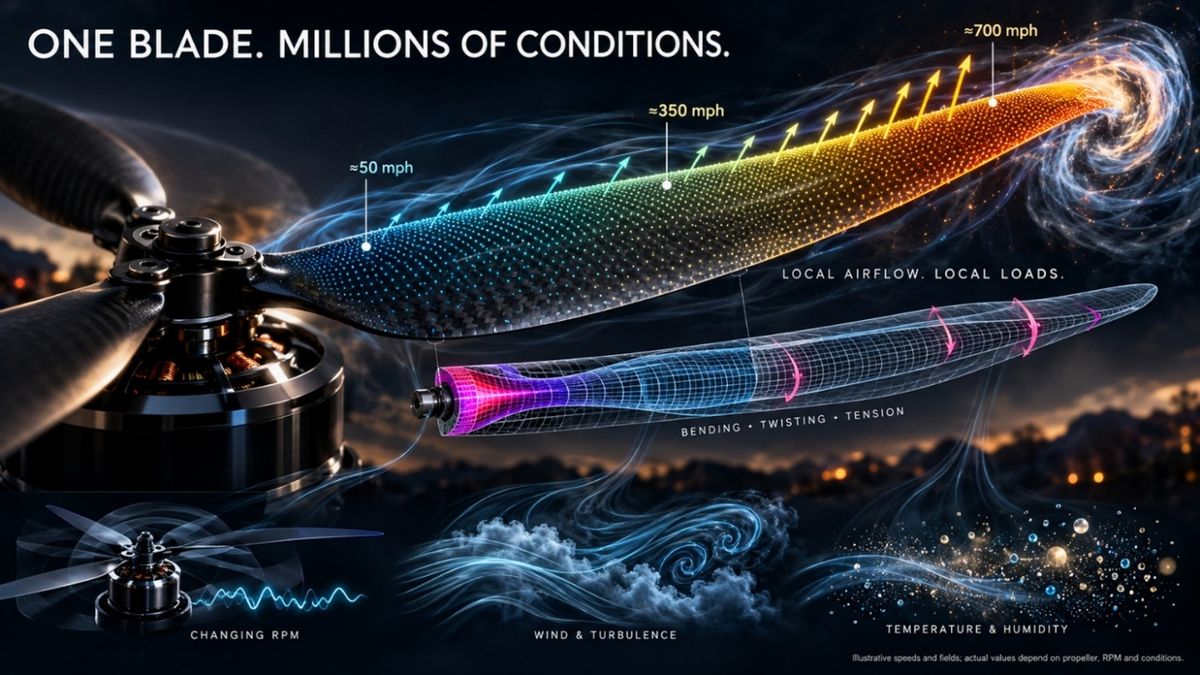
Sources: Federal Aviation Administration. (2005, September 9). Aircraft propeller maintenance (Advisory Circular No. 20-37E); National Aeronautics and Space Administration. (2021, May 13). Propeller propulsion. Glenn Research Center; Seewald, F. (1932). Determination of stresses and deformations of aircraft propellers (Technical Memorandum No. 670). National Advisory Committee for Aeronautics.
The net/net: all of those millions of points of airflow, propeller structural stresses, RPM changes and environmental factors are each a variable. And, because current computers can only handle a few variables, they can only create a very crude simulation of a propeller design.
Why are today’s computers so limited? It isn’t that the software runs one calculation at a time. Standard computational fluid dynamics (CFD) solvers carve the air around a part into chunks and hand each chunk to a different processor, and one NASA-style code held 91% efficiency scaling from 256 to 3,072 processors.3 The trouble is that the processors spend most of their time waiting. In this kind of calculation, each number fetched from memory feeds only a few arithmetic operations, so the speed of the data delivery, not the speed of the arithmetic, sets the pace. Picture a factory with very fast machines fed through one narrow loading dock. In the same study, tuned code reached roughly 8% to 25% of the processors’ theoretical peak speed, depending on the chip, and untuned code 1% to 6%. That ceiling is why engineers can afford to test only so many design variables: every added variable multiplies the number of simulations.
This brings us to BQP and their groundbreaking platform, BQPhy. If classical computing is trapped, BQPhy is the unlock key that opens things up. BQP acts as the “AWS of Quantum Computing,” a software infrastructure layer that enables today’s high-performance graphics processing unit (GPU) clusters to execute quantum-inspired math in parallel threads. Instead of a 10x slow crawl, you get 10x GPU performance today.
So let’s talk about propellers again. Specifically, beefy propellers.
Because BQP’s BQPhy platform unlocks an impressive amount of computational power, Modovolo no longer has to settle for one-size-fits-all propellers.
Instead, Modovolo can dynamically design and manufacture optimized propellers for whatever the mission demands. A few examples:
Once BQPhy determines the ideal design, Modovolo uses its patent-pending 3D-printing process to turn that digital twin into physical prop hardware in record time at the tactical edge.
But propellers are just the beginning. The next frontier for BQP and Modovolo is to design entire airframes, motor systems and other components—all in real time, i.e., as new information and mission parameters change, so will the airframe, motor systems and other components.
So BQP and Modovolo opened the box, found Schrödinger’s cat, and proved that when you unlock the missing amount of modern computing power, you never have to settle for compromised, static drone components ever again.
Today, we’re printing mission-customized beefy propellers at the tactical edge, and tomorrow, as BQP’s quantum-inspired algorithms evolve alongside Modovolo’s rapid manufacturing, every single piece of an aircraft will morph in real time to meet the mission.
The era of off-the-shelf, one-size-fits-all aviation is officially over; the future belongs to dynamic, physics-AI-driven hardware.
1 Source: Schrödinger, E. (1935). Die gegenwärtige Situation in der Quantenmechanik [The present situation in quantum mechanics]. Die Naturwissenschaften, 23(48), 807–812.
2 Source: Turing, A. M. (1937). On computable numbers, with an application to the Entscheidungsproblem. Proceedings of the London Mathematical Society, s2-42(1), 230–265.
3 Source: Gropp, W. D., Kaushik, D. K., Keyes, D. E., & Smith, B. F. (2001). High-performance parallel implicit CFD. Parallel Computing, 27(4), 337–362.
Quantum Computing Fund


Global Head of Research
Christopher Gannatti began at WisdomTree as a Research Analyst in December 2010, working directly with Jeremy Schwartz, CFA®, Director of Research. In January of 2014, he was promoted to Associate Director of Research where he was responsible to lead different groups of analysts and strategists within the broader Research team at WisdomTree. In February of 2018, Christopher was promoted to Head of Research, Europe, where he was based out of WisdomTree’s London office and was responsible for the full WisdomTree research effort within the European market, as well as supporting the UCITs platform globally. In November 2021, Christopher was promoted to Global Head of Research, now responsible for numerous communications on investment strategy globally, particularly in the thematic equity space. Christopher came to WisdomTree from Lord Abbett, where he worked for four and a half years as a Regional Consultant. He received his MBA in Quantitative Finance, Accounting, and Economics from NYU’s Stern School of Business in 2010, and he received his bachelor’s degree from Colgate University in Economics in 2006. Christopher is a holder of the Chartered Financial Analyst Designation.

CEO of Modovolo

CEO and Co-Founder of BQP