


Unsure about Duration? Use the Barbell
Published June 1, 2022

Kevin Flanagan
Head of Investment and Fixed Income Strategy
The overarching trend of rising rates thus far in 2022 has dominated investment discussions. Indeed, with the Fed finally implementing its rate hike policy and providing guidance for an “expeditious” move to “neutral” for the Fed Funds Rate, the U.S. Treasury (UST) market has been discounting what potentially lies ahead for monetary policy. With UST yields already rising, investors are now contemplating whether the increase in the UST 10-Year yield has run its course and should they reposition their bond portfolios accordingly. My answer is, rather than trying to “time the market,” utilize a time-tested fixed income approach instead: the barbell.
Let’s go to the videotape and review where we are on the rate front. There’s little doubt the Fed is “playing catch-up” to the money and bond markets at this juncture. However, last week’s May FOMC minutes underscored the Fed’s commitment to “front-load” its rate hike approach, which should result in the policy maker making up ground relatively quickly. And don’t forget the role of quantitative tightening, or QT, in helping the process.
U.S. 10-Year Treasury Yield
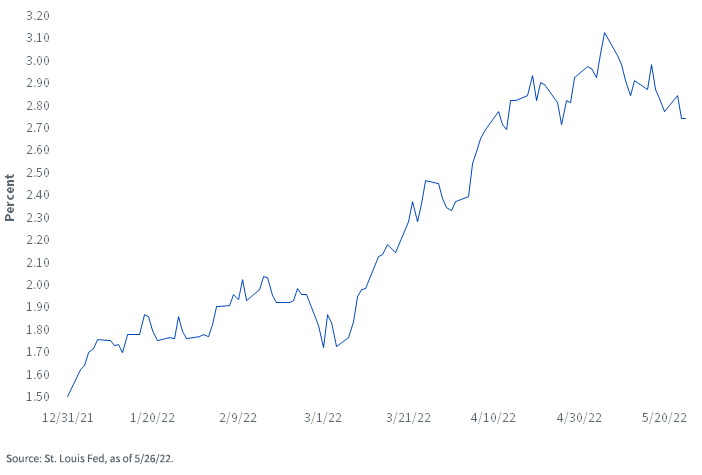
Back to the UST market and the benchmark 10-Year note. Thus far in 2022, the yield has risen roughly +125 basis points (bps) to 2.75%, as of this writing. However, this latest posting doesn’t quite tell the whole story. As recently as a few weeks ago, the UST 10-Year yield hit 3.20% on an intraday basis, only 5 bps away from its recent 2018 peak. Since then, sentiment has begun to shift away from inflation and the Fed to concerns about whether Powell & Co. will tighten too much and eventually push the economy into a recession. In fact, there seems to be a new report every day quoting the odds of a recession occurring over the next two years as anywhere from 15% to 35%. Against this “risk-off” backdrop, the UST 10-Year yield has fallen a rather noteworthy 45 bps–50 bps since early May to its current level. Even Fed Funds Futures have pulled back the reins on rate hike expectations. Just go back about a month ago, and the implied probability was heading toward a 3% Fed Funds Rate by year-end, but now the target is being pegged at just over 2.60%.
A Solution
The current debate among bond investors is trying to decide if it is now time to go longer duration because rates, such as the UST 10-Year yield, may have already risen as high as they are going to in this cycle. But I ask, what if the May rally was just a short-term consolidation? For the record, our base case does not see a recession over the next 12 months but, rather, a slowing in economic activity to more of a +2% type of scenario for real GDP. As a result, we see the UST 10-Year yield making another “run” at the 2018 peak of 3.25% and possibly even overshooting this target.
That brings us to the barbell solution. This time-tested strategy is designed to take rate forecasting out of the equation, allowing investors to toggle between short and intermediate/longer duration to suit their investment needs without making a definitive rate call. Our “in-house” barbell consists of the WisdomTree Yield Enhanced U.S. Aggregate Bond Fund (AGGY) at one end and the WisdomTree Floating Rate Treasury Fund (USFR) as the other “weight.” This barbell offers a core strategic solution designed to help fixed income investors navigate the uncharted waters ahead without making a high-conviction bet on where Treasury yields may ultimately be headed.
Important Risks Related to this Article
USFR: There are risks associated with investing, including the possible loss of principal. Securities with floating rates can be less sensitive to interest rate changes than securities with fixed interest rates, but may decline in value. The issuance of floating rate notes by the U.S. Treasury is new, and the amount of supply will be limited. Fixed income securities will normally decline in value as interest rates rise. The value of an investment in the Fund may change quickly and without warning in response to issuer or counterparty defaults and changes in the credit ratings of the Fund’s portfolio investments. Due to the investment strategy of this Fund, it may make higher capital gain distributions than other ETFs. Please read the Fund’s prospectus for specific details regarding the Fund’s risk profile.
AGGY: There are risks associated with investing, including the possible loss of principal. Fixed income investments are subject to interest rate risk; their value will normally decline as interest rates rise. Fixed income investments are also subject to credit risk, the risk that the issuer of a bond will fail to pay interest and principal in a timely manner, or that negative perceptions of the issuer’s ability to make such payments will cause the price of that bond to decline. Investing in mortgage- and asset-backed securities involves interest rate, credit, valuation, extension and liquidity risks and the risk that payments on the underlying assets are delayed, prepaid, subordinated or defaulted on. Due to the investment strategy of the Fund, it may make higher capital gain distributions than other ETFs. Please read the Fund’s prospectus for specific details regarding the Fund’s risk profile.
Categories
Related articles
A ‘Warsh’ Out at the Fed

Fed Watch: The Changing of the Guard Finally Arrives
Private Credit Beyond the Headlines: Why Diversification and Liquidity Matter More Than Ever
Are Bessent’s Hands Tied?
‘Warsh’ and Dry

What’s ‘Under the Hood’ of Your Core Bond Position?

Powell Stays…Should the Dot Plot?

Fed Watch: Powell’s Last Stand & What Comes Next?
Inflation’s First Official Debut
About the contributor

Kevin Flanagan
Head of Investment and Fixed Income Strategy
Kevin serves as the Head of Investment and Fixed Income Strategy. In this role, he writes macro and fixed income-related content and works closely with the sales, research and marketing teams. In addition, Kevin conducts client-facing webinars and meetings, providing expertise on WisdomTree’s existing and future bond ETFs. Prior to joining WisdomTree, Kevin spent 30 years at Morgan Stanley, where he was Managing Director and Chief Fixed Income Strategist for Wealth Management. He was responsible for tactical and strategic recommendations and created asset allocation models for fixed income securities. He was a contributor to the Morgan Stanley Wealth Management Global Investment Committee, primary author of Morgan Stanley Wealth Management’s monthly and weekly fixed income publications, and collaborated with the firm’s Research and Consulting Group Divisions to build ETF and fund manager asset allocation models. Kevin has an MBA from Pace University’s Lubin Graduate School of Business, and a B.S. in Finance from Fairfield University.