


Powell Stays…Should the Dot Plot?
Published May 6, 2026

Kevin Flanagan
Head of Investment and Fixed Income Strategy

Maggie Lucier
Senior Associate, Investment Strategy
Key Takeaways
- The April FOMC meeting’s four dissents and resistance to maintaining an easing bias signal a higher bar for rate cuts under incoming Chair Warsh, suggesting investors may favor Treasury floating-rate strategies to navigate a prolonged “higher-for-longer” environment.
- Despite market expectations for a policy pivot, Powell’s decision to remain on the board and the data-dependent stance of both him and Warsh reinforce that labor and inflation—not leadership changes—will drive policy, supporting a neutral-to-defensive positioning in core bond allocations.
- With the Fed’s dot plot historically misjudging rate paths by as much as 140–180 basis points (bps) and still projecting cuts in 2026, investors should be cautious in relying on forward guidance and consider actively managed or laddered Treasury strategies to hedge policy uncertainty.
While the Federal Open Market Committee (FOMC) keeping the fed funds rate unchanged at the April meeting was widely expected, there were other notable headlines. From a policy perspective, there were four dissenters of the outcome, the most since 1992. Fed Governor Miran’s dissent for a rate cut was certainly not a surprise, but the other three members on this list were newsworthy. These three regional Fed bank presidents did not dissent on the rate decision, but instead disagreed with retaining an easing bias in the policy statement.
Why is this noteworthy? It sets the tone for when the new Fed Chairman, Kevin Warsh, takes over the reins at the June FOMC meeting. In other words, for those investors expecting ‘rubber-stamp’ rate cuts with the new Fed Chair, unless the labor data collapses, they will be disappointed.
That brings us to perhaps the most headline-grabbing news from ‘Fed Day’: current Chairman Powell will be staying on as a Fed governor “for a period of time” once his term as Fed leader expires on May 15. There are two important takeaways from this announcement.
Since the Fed Chair must be a governor, Warsh cannot just slide into Powell’s slot which has typically been the case in the past. Indeed, for the first time in 75 years, a Fed Chair is not leaving the central bank, but instead, is staying on as a Fed governor. While we don’t know how long Powell will actually remain in the role as governor, his term does run until January 2028. As a result, Warsh will be using current Fed Governor Miran’s expiring slot to rejoin the Fed. The interesting aspect to this ‘Fed 101’ lesson is that as long as Powell stays on as governor, President Trump will not have vacancies on the Fed board to fill, unless another current member were to leave.
While Powell’s decision to stay falls under ‘palace intrigue’, we do not believe his presence will impact the FOMC’s decision-making process when it comes to the fed funds rate. Warsh and Powell will follow the data and cast their ’votes’ on monetary policy based on the labor market/inflation data, and nothing else.
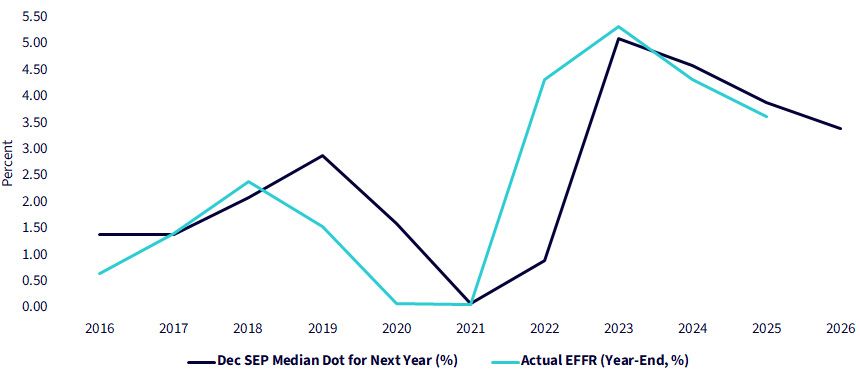
Figure 1: Dot Plot Projections vs. Effective Fed Funds Rate
Source: Federal Reserve, as of 4/29/2026.
This leads to other potential shifts Chairman Warsh may pursue. Perhaps the most noteworthy shift could involve the Fed’s dot-plots, or the members’ projections for fed funds over time. Against this backdrop, let’s take a look at some history, or better yet, the dot-plots’ track record.
Over the last 10 years, the Fed’s dot-plot projections for upcoming years have left something to be desired. To provide perspective, during 2019 and into 2020, projections consistently overestimated the path of rates, running more than 140 bps on average above the actual effective federal funds rate (EFFR) throughout the period. While 2019 reflected a ‘normal policy cycle’; obviously, 2020 was impacted by the pandemic. In 2022, the situation flipped. Projections significantly underestimated the actual pace of tightening by roughly 180 bps. It was during this timeframe that the Fed had catch-up work to do to combat post-Covid inflation.
Since 2024, projections have been much closer to actual outcomes, but the dot plot has still not been 100% on the mark. For the record, the most recent dot plot, released at the March 2026 FOMC meeting, still includes one additional rate cut for this year.
Conclusion
Unless upcoming data proves otherwise, it appears as if the bar for further rate cuts has been raised, with the more likely outcome being a Fed that stays on hold in the months ahead, if not for the rest of 2026.
Categories

About the contributors

Kevin Flanagan
Head of Investment and Fixed Income Strategy
Kevin serves as the Head of Investment and Fixed Income Strategy. In this role, he writes macro and fixed income-related content and works closely with the sales, research and marketing teams. In addition, Kevin conducts client-facing webinars and meetings, providing expertise on WisdomTree’s existing and future bond ETFs. Prior to joining WisdomTree, Kevin spent 30 years at Morgan Stanley, where he was Managing Director and Chief Fixed Income Strategist for Wealth Management. He was responsible for tactical and strategic recommendations and created asset allocation models for fixed income securities. He was a contributor to the Morgan Stanley Wealth Management Global Investment Committee, primary author of Morgan Stanley Wealth Management’s monthly and weekly fixed income publications, and collaborated with the firm’s Research and Consulting Group Divisions to build ETF and fund manager asset allocation models. Kevin has an MBA from Pace University’s Lubin Graduate School of Business, and a B.S. in Finance from Fairfield University.
