
QGRW
U.S. Quality Growth Fund

Published May 7, 2025

Global Head of Research
Growth strategies, focusing on rapidly expanding companies, often excel in low-interest, liquidity-rich environments. Value strategies, emphasizing undervalued companies with strong fundamentals, shine during recoveries or corrections. Predicting which will lead remains uncertain.
But why choose? A hybrid approach blending value and growth could offer a versatile strategy for today's complex markets. By combining disciplined valuation with innovation-driven growth, investors can seize opportunities across diverse scenarios—whether inflation shifts, geopolitical tensions evolve or economic trends fluctuate.
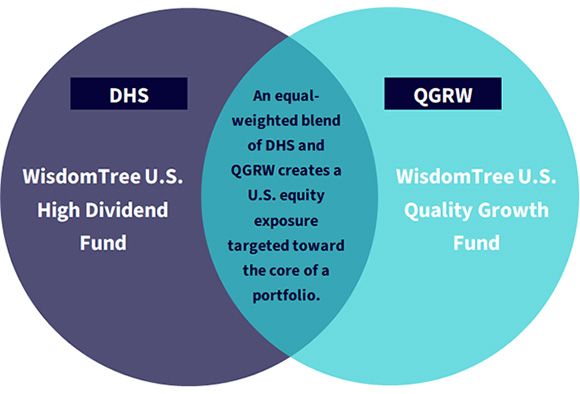
To create the 50/50 defensive core blend, we look to two specific WisdomTree strategies:
The combination of these two strategies leads to a strong balance of sector exposures, attractive fundamental metrics and, while limited, a nice performance history.
Source: WisdomTree.
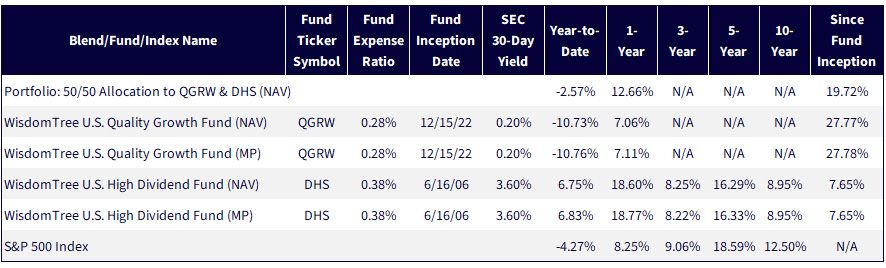
Source: WisdomTree, specifically data from the Fund Comparison Tool in the PATH suite of tools, accessed 4/24/25 with returns as of 3/31/25. SEC 30-Day Yield as of 3/31/25. NAV denotes total return performance at net asset value. MP denotes market price performance. The performance data quoted represents past performance. Past performance is not indicative of future results. Investment return and principal value of an investment will fluctuate so that an investor's shares, when redeemed, may be worth more or less than their original cost. Current performance may be lower or higher than the performance data quoted. For the most recent month-end and standardized performance and to download the respective Fund prospectuses, click the relevant ticker: QGRW, DHS.
The 2024 equity market environment was very similar to 2023—putting more focus on larger companies paid off.
A drawback of simply following the momentum of large growth is that ultimately valuation matters. Valuation may not drive the market downwards in the near term, but long-term investors know risk builds as valuation multiples rise and set a higher hurdle to clear with each earnings report.
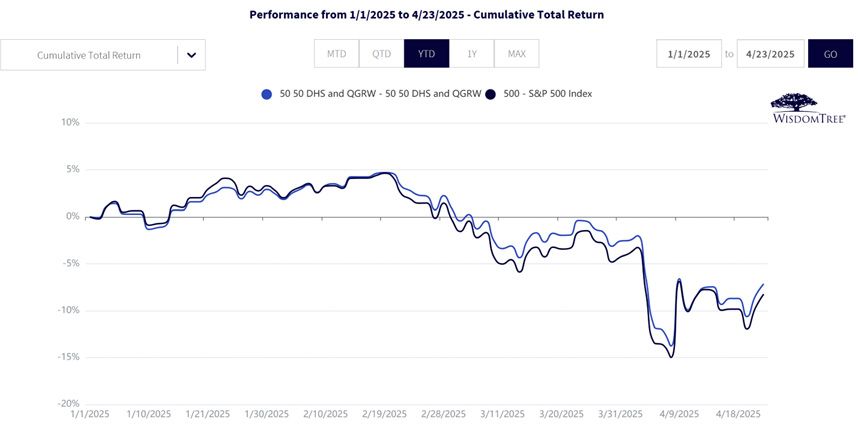
Also, after experiencing April 2025, we know that conditions can shift quickly and certain stocks leading the market higher in one period can drive it lower in another. It's critical for a core strategy to have flexibility in both upward and downward market trends, as well as during periods of volatility.
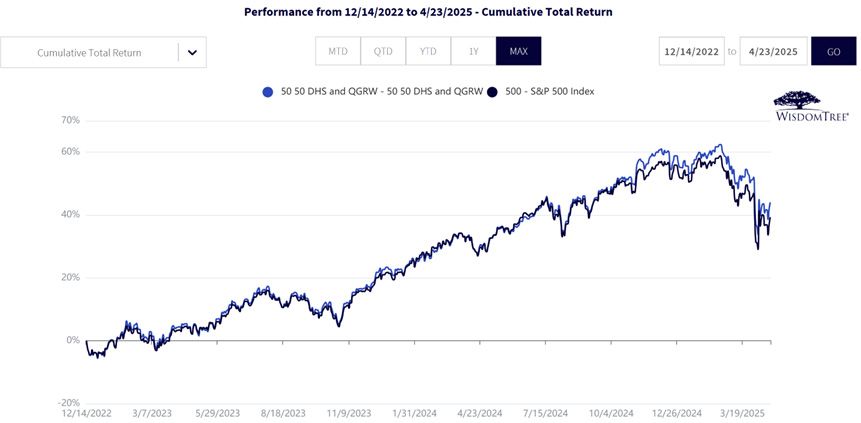
Source: WisdomTree, specifically data from the Fund Comparison Tool in the PATH suite of tools, accessed 4/24/25. NAV denotes total return performance at net asset value. MP denotes market price performance. Past performance is not indicative of future results. Investment return and principal value of an investment will fluctuate so that an investor's shares, when redeemed, may be worth more or less than their original cost. Current performance may be lower or higher than the performance data quoted. For the most recent month-end and standardized performance and to download the respective Fund prospectuses, click the relevant ticker: QGRW, DHS.
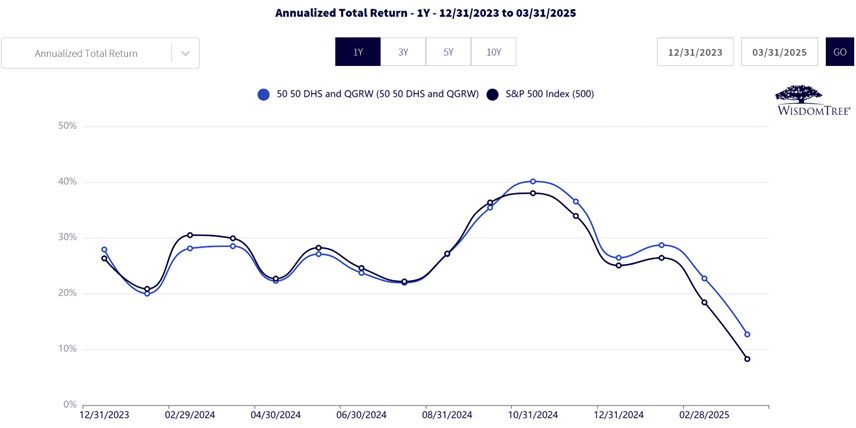
In figure 4, we show that for rolling one-year periods, the 50/50 allocation to QGRW and DHS offered stronger performance than the S&P 500 Index during the more recent horizons as volatility was increasing and conditions were becoming less certain. In the stronger market environments earlier in the time series, the blend lagged the S&P 500 Index's return, but not by a large margin.
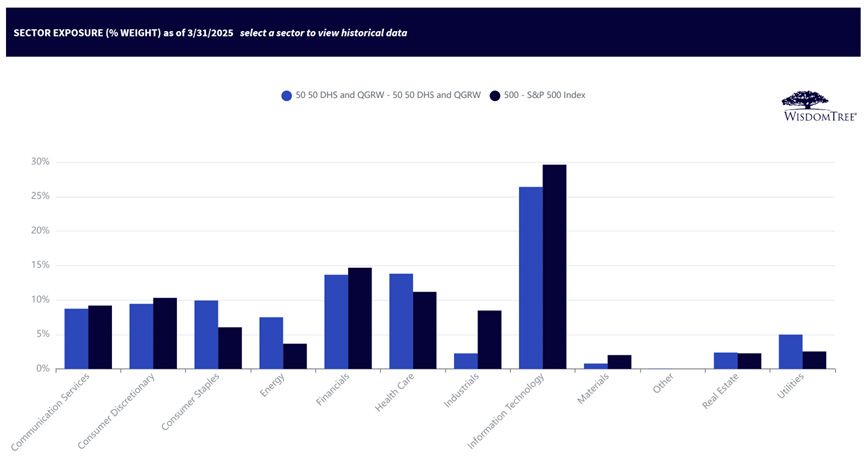
The 50/50 QGRW/DHS combination delivered outperformance without being too different from the market on a sector perspective.
Figure 5 compares the sector exposures in the 50/50 QGRW/DHS portfolio to the S&P 500 Index. There are differences, but the 50/50 blend is not making massive sector bets versus the benchmark.
Source: WisdomTree, specifically data from the Fund Comparison Tool in the PATH suite of tools, accessed 4/24/25. Holdings subject to change.
Benjamin Graham stated, "In the short run, the market is a voting machine, but in the long run, it is a weighing machine."1
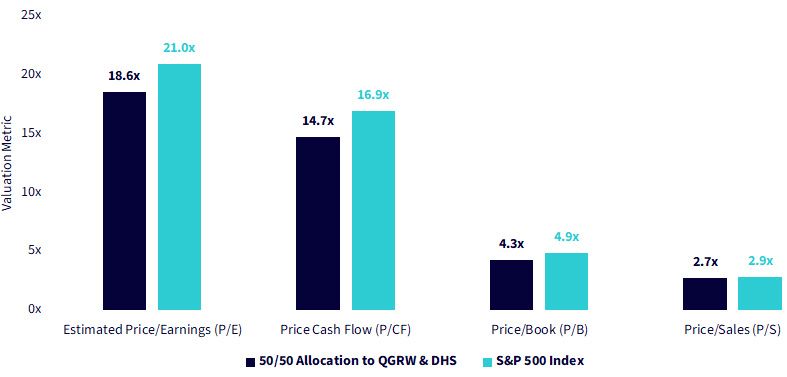
The 50/50 allocation to QGRW and DHS balances exposures to premiere growth stocks with the DHS's value component to mitigate the risk of seeing valuation metrics run up too high versus the S&P 500 Index benchmark. The combination yields a portfolio with lower overall valuation than the market due to the deep discounts in DHS holdings.
Source: WisdomTree, specifically data from the Fund Comparison Tool in the PATH suite of tools, accessed 4/24/25. Holdings subject to change.
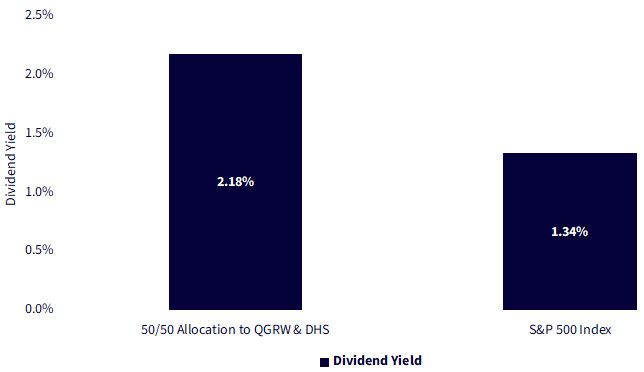
DHS is designed with a focus on the companies with relatively higher dividend yields within the U.S. market, which tends toward a more defensive positioning.
Source: WisdomTree, specifically data from the Fund Comparison Tool in the PATH suite of tools, accessed 4/24/25. Past performance is not indicative of future results. Investment return and principal value of an investment will fluctuate so that an investor's shares, when redeemed, may be worth more or less than their original cost. Current performance may be lower or higher than the performance data quoted. For the most recent month-end and standardized performance and to download the respective Fund prospectuses, click the relevant ticker: QGRW, DHS.
People connect with recognizable company names.
Figure 8 shows both the 50/50 allocation to QGRW and DHS and the S&P 500 Index have exposure to six of the Magnificent 72 stocks within the top 10.
However, it's notable that in each of the six cases, the weight to those stocks is trimmed with the overall exposure within the top 10 appearing more balanced. It's also interesting to see some classic dividend-payers like Philip Morris International and Exxon Mobil—companies that used to find themselves among the 10 largest U.S. stocks by market capitalization but have since been pushed out, largely by the growth in market capitalization of other companies.
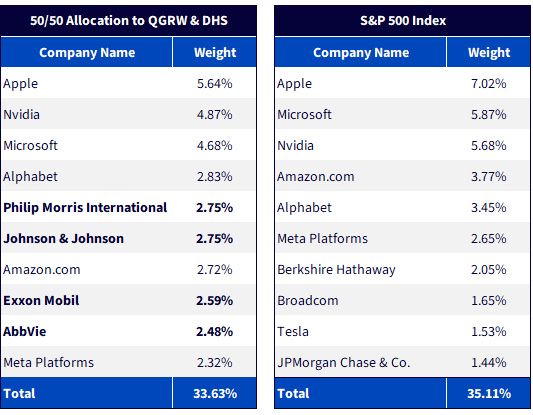
Source: WisdomTree, specifically data from the Fund Comparison Tool in the PATH suite of tools, accessed 4/24/25. The darker shading indicates companies within the QGRW/DHS blend that are not included in the top 10 of the S&P 500 Index. Holdings subject to change.
As April 2025 winds down, the mantra for U.S. equity investors in 2025 seems to emphasize being ready for anything. The 50/50 QGRW/DHS blend has some notable attributes that balance a more defensive, value exposure while also including some of the world's largest and highest quality businesses.
1 Source: This concept is widely attributed to Benjamin Graham, but the precise wording does not appear in such books as The Intelligent Investor or Security Analysis. It is likely something he said in some of his lectures.
2 Magnificent 7 refers to Amazon.com, Apple, Alphabet, Microsoft, Meta Platforms, Nvidia and Tesla.
There are risks associated with investing, including the possible loss of principal. Please read the Fund’s prospectus for specific details regarding the Fund’s risk profile.
QGRW: Growth stocks, as a group, may be out of favor with the market and underperform value stocks or the overall equity market. Growth stocks are generally more sensitive to market movements than other types of stocks. The Fund is non-diversified, as a result, changes in the market value of a single security could cause greater fluctuations in the value of Fund shares than would occur in a diversified fund. The Fund invests in the securities included in, or representative of, its Index regardless of their investment merit. The Fund does not attempt to outperform its Index or take defensive positions in declining markets and the Index may not perform as intended. Please read the Fund’s prospectus for specific details regarding the Fund’s risk profile.
DHS: Funds focusing their investments on certain sectors increase their vulnerability to any single economic or regulatory development. This may result in greater share price volatility. Dividends are not guaranteed, and a company currently paying dividends may cease paying dividends at any time.
You cannot invest directly in an index.

Global Head of Research
Christopher Gannatti began at WisdomTree as a Research Analyst in December 2010, working directly with Jeremy Schwartz, CFA®, Director of Research. In January of 2014, he was promoted to Associate Director of Research where he was responsible to lead different groups of analysts and strategists within the broader Research team at WisdomTree. In February of 2018, Christopher was promoted to Head of Research, Europe, where he was based out of WisdomTree’s London office and was responsible for the full WisdomTree research effort within the European market, as well as supporting the UCITs platform globally. In November 2021, Christopher was promoted to Global Head of Research, now responsible for numerous communications on investment strategy globally, particularly in the thematic equity space. Christopher came to WisdomTree from Lord Abbett, where he worked for four and a half years as a Regional Consultant. He received his MBA in Quantitative Finance, Accounting, and Economics from NYU’s Stern School of Business in 2010, and he received his bachelor’s degree from Colgate University in Economics in 2006. Christopher is a holder of the Chartered Financial Analyst Designation.

