
WTMF
Managed Futures Strategy Fund

Published November 5, 2026

Equity Strategist
Equity market declines often make diversification feel urgent. Positions that ostensibly offer different exposures can suddenly decline together if they’re positively correlated, leaving investors with greater sensitivity to the risks than initially anticipated. For portfolios built primarily around stocks and bonds, alternative strategies can introduce additional, decorrelated sources of return that help reduce dependence on favorable market conditions.
That flexibility can be especially valuable when the source of market stress changes. An inflation shock, a deteriorating growth outlook and a sudden shift in investor sentiment can each call for a different response. No matter the source, alternatives can expand the portfolio toolkit through decorrelated sources of return and frequently exhibit meaningful downside protection when markets sour. Here are a few of WisdomTree’s greatest ideas:
The WisdomTree Managed Futures Strategy Fund (WTMF) seeks positive total returns in rising or falling markets with returns that are not directly correlated with broad equity or fixed income markets. Its actively managed, systematic approach uses futures across commodities, currencies, equities and interest rates, with the ability to take long and short positions as its signals change. The Fund may also allocate up to 10% of net assets to bitcoin futures or exchange-traded products that hold bitcoin.
For equity investors, WTMF’s appeal is the ability to respond to trends across several markets, as persistent moves in currencies, commodities or interest rates may create opportunities even when stocks struggle. The flexibility to adjust directional exposures gives WTMF several potential sources of return beyond equity appreciation.
But the return potential also extends into downside protection during the worst sessions for U.S. equities. Over the past 10 years, the S&P 500 has fallen by one standard deviation (about 1.13%) on 256 occasions. WTMF outperformed the index on 253 of those occurrences, a hit rate of 99%. More impressively, WTMF produced positive absolute returns when the S&P 500 fell by 1.13% or more on 91 occasions. That means that, 35% of the time, WTMF outperformed the worst declines for the S&P 500 by delivering positive performance, rather than exclusively less negative returns.
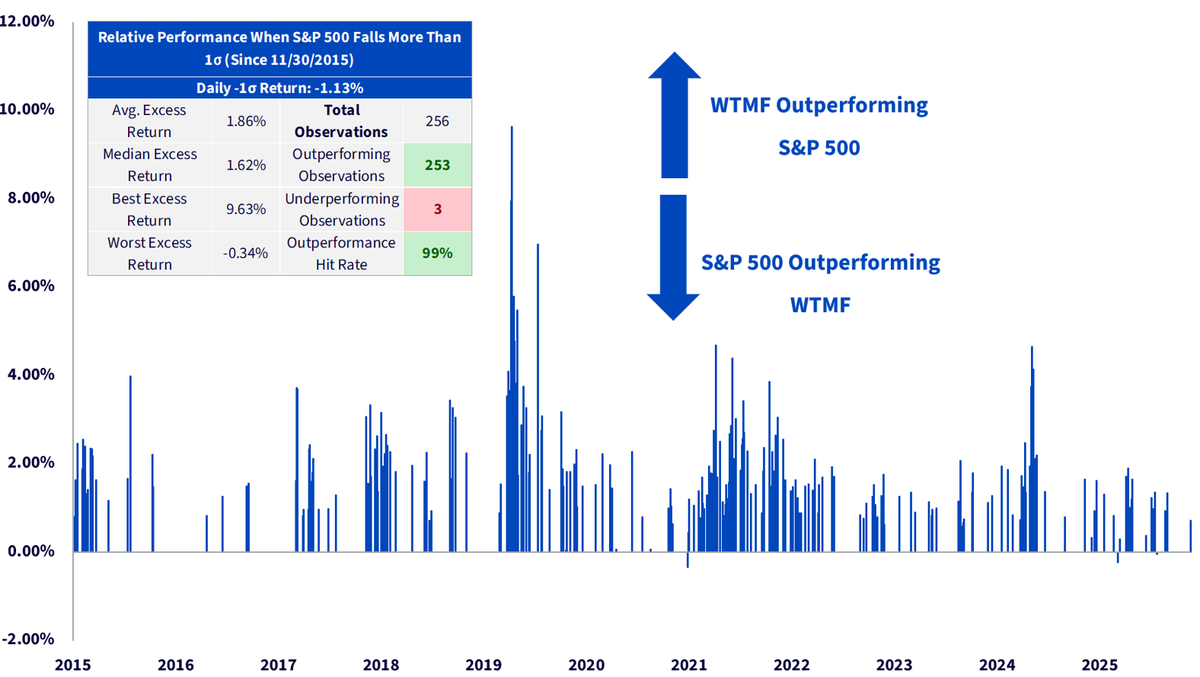
Source: WisdomTree, S&P as of 10/22/2026. Past performance is not indicative of future results. You cannot invest directly in an index. Evaluation period corresponds to the beginning of our S&P 500 daily return series in November 2015.
The WisdomTree Equity Premium Income Fund (WTPI) seeks to track the Volos U.S. Large Cap Target 2.5% PutWrite Index. Its strategy systematically sells put options tied to the S&P 500, with cash collateral invested in U.S. Treasury bills. This combines premium income with income earned on the collateral to buffer portfolios from equity market weakness.
The portfolio benefit comes from changing how investors participate in equity markets. Premiums received can help offset losses on the options during declines, potentially reducing downside participation relative to owning the market outright. Higher implied volatility generally increases the premiums available on newly written options, creating opportunities to collect more income as positions are renewed (and if actual market volatility is less than implied). We view it as a way to seek a smoother equity-related return stream during volatile markets, and a protective complement to an existing stock allocation.
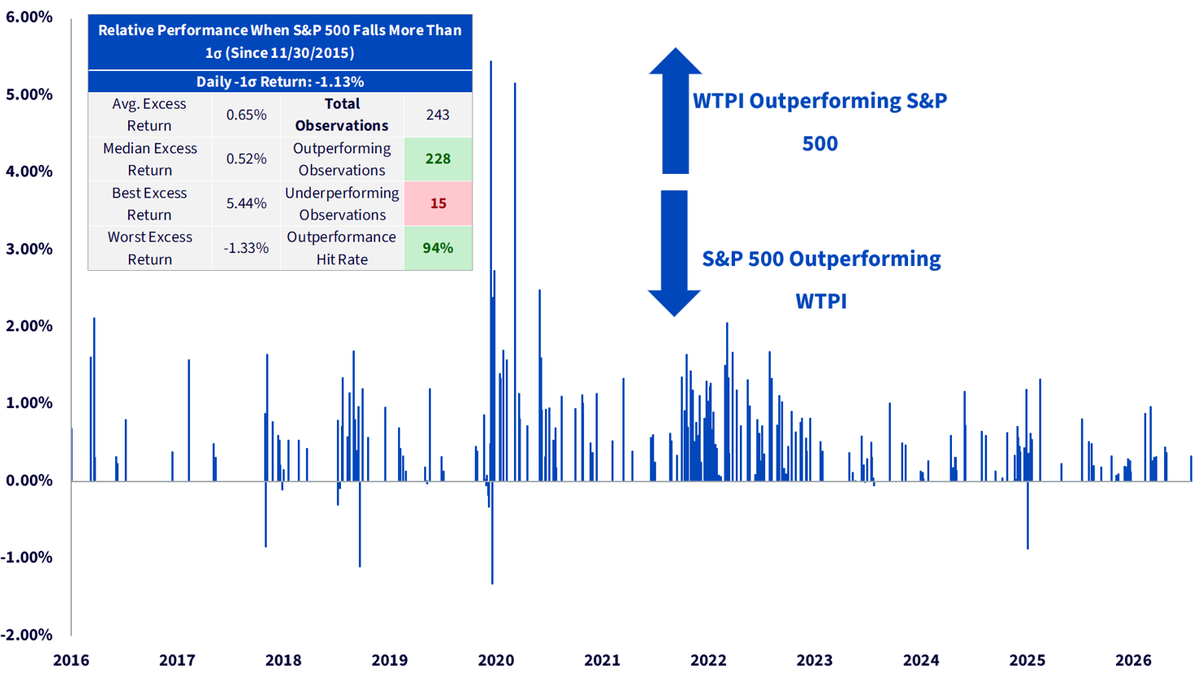
Source: WisdomTree, S&P as of 10/22/2026. Past performance is not indicative of future results. You cannot invest directly in an index. Evaluation period begins with WTPI inception date of February 24, 2016.
Like WTMF, WTPI also sports an impressive hit rate on the S&P 500’s worst days. Over the 243 days since WTPI inception in February 2016 where the S&P 500 declined by one standard deviation or more, WTPI outperformed on 228 of them, a 94% hit rate, underscoring its effectiveness as an equity-related (but decorrelated) diversifier.
The WisdomTree Enhanced Commodity Strategy Fund (GCC) provides exposure to energy, agriculture, industrial and precious metals, primarily through futures contracts. The Fund may also invest up to 10% of net assets in bitcoin futures or exchange-traded products that hold bitcoin. Its enhanced roll process seeks to improve the economics of maintaining futures exposure as contracts approach expiration.
Commodity prices respond to supply and demand forces that can differ substantially from those driving corporate earnings and equity valuations. Energy shortages, weather disruptions and changes in industrial demand can create investment opportunities outside traditional stock and bond markets. Broad exposure spreads participation across commodity sectors with different underlying drivers.
That can be particularly useful when inflation or supply constraints pressure equities. Rising input costs may weigh on corporate margins while supporting the prices of the commodities responsible for those pressures. GCC gives portfolios exposure to that potential offset. Its diversification benefits depend on the environment, however: commodities can decline alongside stocks during a growth scare, and bitcoin exposure introduces additional volatility.
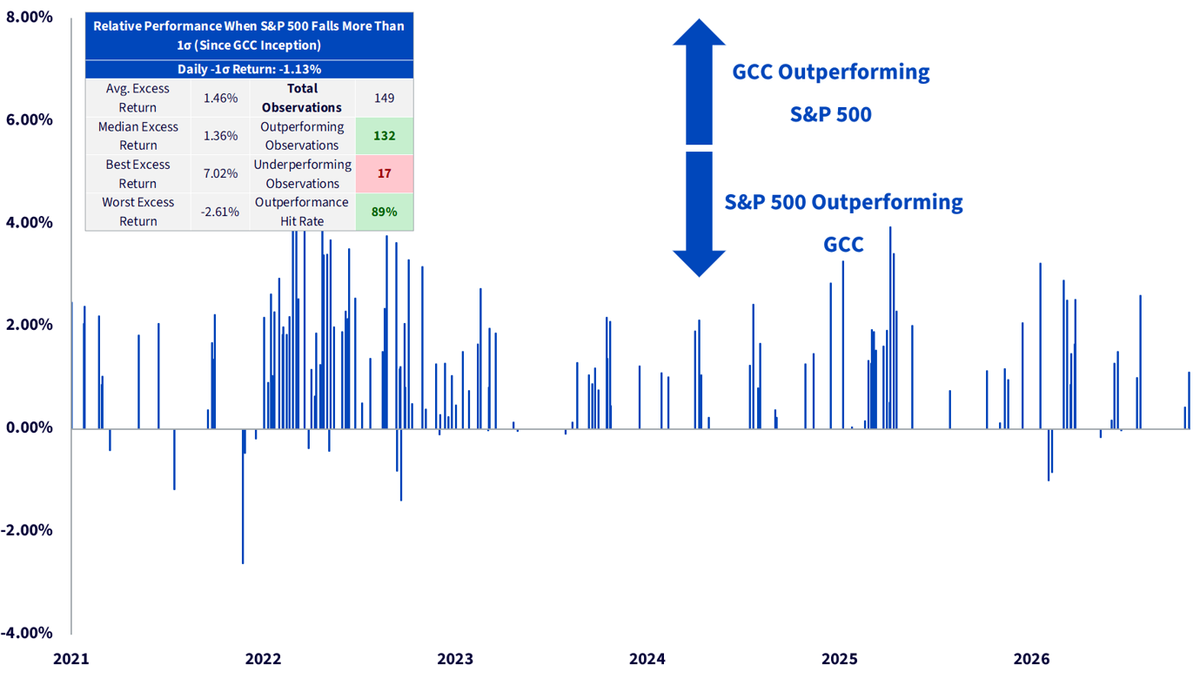
Source: WisdomTree, S&P as of 10/31/2026. Past performance is not indicative of future results. You cannot invest directly in an index. Evaluation period begins with GCC inception date of December 21, 2020.
WTMF, WTPI and GCC offer different ways to broaden a portfolio’s sources of return while serving as decorrelated, diversifying influences during episodic volatility. Trend following can adapt to changing market direction, option premium income can help cushion equity-related losses and commodities can provide exposure to economic forces that otherwise pressure traditional assets. Evaluating their behavior on difficult equity days helps put those potential benefits into practical terms.
For investors concerned about renewed volatility, these strategies can help build a more resilient allocation before the next selloff arrives. Their downside mitigation potential should be assessed alongside their individual risks, recognizing that relative outperformance can still involve losses and that historical results do not guarantee future protection.
There are risks associated with investing including possible loss of principal. Please read the Fund’s prospectus for specific details regarding the Fund’s risk profile.
WTMF: An investment in this Fund is speculative, involves a substantial degree of risk, and should not constitute an investor’s entire portfolio. One of the risks associated with the Fund is the complexity of the different factors which contribute to the Fund’s performance, as well as its correlation (or non-correlation) to other asset classes.
These factors include use of long and short positions in commodity futures contracts, currency forward contracts, swaps and other derivatives. In addition, bitcoin exchange-traded products (ETPs) and bitcoin futures are relatively new and the markets may be less developed. They are subject to unique and substantial risks, and historically, have been subject to significant price volatility. As a result, the markets for bitcoin futures and bitcoin ETPs may be less developed, and at times, potentially less liquid and more volatile, than more established commodity futures and ETP markets. While the bitcoin futures market has grown substantially since bitcoin futures commenced trading, there can be no assurance that this growth will continue. Derivatives can be volatile and may be less liquid than other securities and more sensitive to the effects of varied economic conditions.
The Fund should not be used as a proxy for taking long only (or short only) positions in commodities or currencies. The Fund could lose significant value during periods when long only indexes rise (or short only) indexes decline. The Fund’s investment objective is based on historic price trends. There can be no assurance that such trends will be reflected in future market movements. The Fund generally does not make intra-month adjustments and therefore is subject to substantial losses if the market moves against the Fund’s established positions on an intra-month basis. In markets without sustained price trends or markets that quickly reverse or “whipsaw” the Fund may suffer significant losses.
The Fund is actively managed thus the ability of the Fund to achieve its objectives will depend on the effectiveness of the portfolio manager. Due to the investment strategy of this Fund, it may make higher capital gain distributions than other ETFs. The Fund will not invest in bitcoin directly.
WTPI: The Fund expects to sell put options and hold U.S. Treasury bills. Derivative investments can be volatile. As a result, these investments may be less liquid than securities, and more sensitive to the effects of varied economic conditions. Options may be subject to volatile swings in price influenced by changes in the value of the underlying instrument. The potential return to the Fund is limited to the amount of option premiums it receives; however, the Fund can potentially lose up to the entire strike price of each option it sells. The Fund invests in the securities included in, or representative of, its Index regardless of their investment merit, and the Fund does not attempt to outperform its Index. Due to the investment strategy of the Fund, it may make higher capital gain distributions than other ETFs.
GCC: An investment in this Fund is speculative, involves a substantial degree of risk, and should not constitute an investor’s entire portfolio. One of the risks associated with the Fund is the complexity of the different factors which contribute to the Fund’s performance. These factors include use of commodity futures contracts. In addition, bitcoin exchange-traded products (ETPs) and bitcoin futures are relatively new and the markets may be less developed. They are subject to unique and substantial risks, and historically, have been subject to significant price volatility. As a result, the markets for bitcoin futures and bitcoin ETPs may be less developed, and at times, potentially less liquid and more volatile, than more established commodity futures and ETP markets. While the bitcoin futures market has grown substantially since bitcoin futures commenced trading, there can be no assurance that this growth will continue. In addition, derivatives can be volatile and may be less liquid than other securities and more sensitive to the effects of varied economic conditions. The value of the shares of the Fund relate directly to the value of the futures contracts and other assets held by the Fund and any fluctuation in the value of these assets could adversely affect an investment in the Fund’s shares. Because of the frequency with which the Fund expects to roll futures contracts, the price of futures contracts further from expiration may be higher (a condition known as “contango”) or lower (a condition known as “backwardation”) and the impact of such contango or backwardation may be greater than the impact would be if the Fund experienced less portfolio turnover. The Fund will not invest in bitcoin directly.

Equity Strategist
Brian Manby is an Equity Strategist at WisdomTree and part of the Investment Strategy team.
He is responsible for developing and communicating equity market insights, investment themes, and portfolio strategies that support the firm’s ETF and investment solutions platform. He evaluates sectors, valuations, fundamentals and equity styles to identify investment opportunities and provide actionable perspectives to clients and advisors. He also helps investors understand how WisdomTree’s equity strategies can be used to achieve long-term investment objectives in evolving market environments.
Brian joined WisdomTree in October 2018 as an Investment Strategy Analyst after a few years as a Consultant for FactSet Research Systems, Inc. He earned a B.A. in Economics and Political Science from the University of Connecticut in 2016 and has been a Chartered Financial Analyst since 2022.

