


The Commodity ETF Tax Surprise: When a Big Rally Doesn’t Mean a Big Return for Investors
Published November 10, 2026

Jonathan Flynn
Director of Market Strategy
Key Takeaways
- Three commodity exchange-traded funds posted approximately 32%–51% year-to-date price returns, while estimated flow-weighted buyer returns were roughly 9%–16% through October 30, 2026.
- Investors buying shortly before a taxable distribution may receive income reflecting earlier fund activity, even if their own shares have barely appreciated.
- The WisdomTree Enhanced Commodity Strategy Fund (GCC) completed its substantial October distribution and uses contract selection and portfolio construction to seek enhanced returns.
A strong year for commodities has created a new question for investors: How much of the rally did they capture, and what taxable distributions might still be coming?
A Big Rally, but Not Necessarily for Every Investor
Commodities have attracted renewed attention in 2026, as investors seek diversification, inflation protection and exposure to real assets. Yet an ETF’s headline return and the return earned by investors who bought it are not necessarily the same. Our analysis of three major commodity ETFs through October 30, 2026, illustrates the disconnect. Although the funds’ year-to-date price returns ranged from approximately 32% to 51%, estimated flow-weighted returns on dollars entering during the year ranged from roughly 9% to 16%. In one fund, approximately $976 million of $1.36 billion in gross inflows had earned 10% or less by October 30. These estimates reflect the timing of weekly inflows, not actual investor-account performance.
Figure 1: Commodity ETF Price Returns vs. Estimated Buyers’ Returns
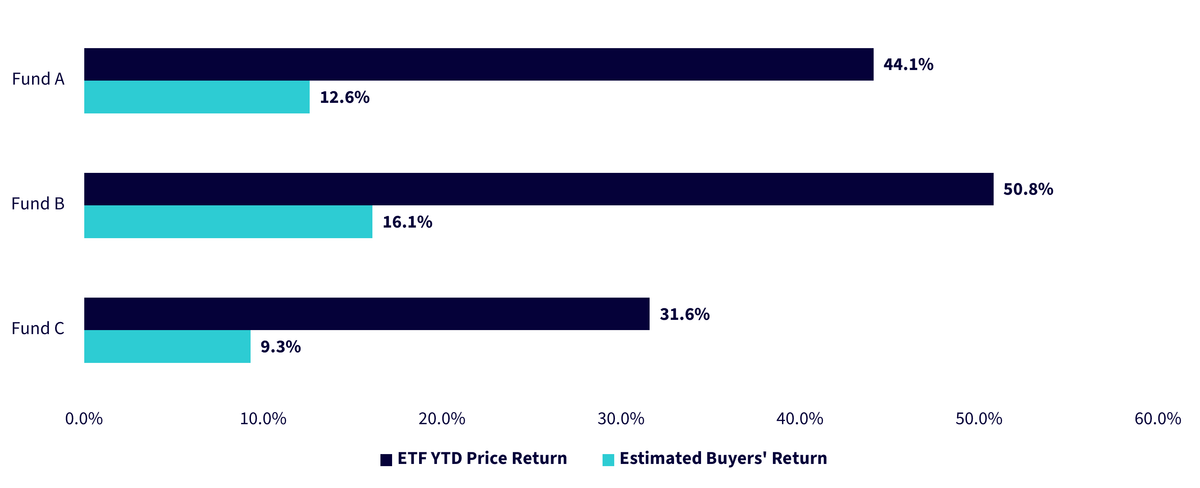
Source: WisdomTree Market Strategy analysis; ETF.com weekly net flows and daily closing prices. Each inflow week assigned estimated return from average daily price in that week to October 30, 2026; flow-weighted estimate, not actual investor trades or account returns. Funds anonymized.
The explanation is straightforward: many investors arrived after substantial appreciation had already occurred. Now, as year-end approaches, those investors have another reason to pay attention: taxable fund distributions.
The Question Advisors Should Ask Before Buying
Has the commodity ETF already made its major taxable distribution for the year, or could one still be coming? That question matters because taxable distributions are generally determined by income and gains realized within a fund, not by how long a particular shareholder has owned it. An investor purchasing shares late in the year may receive a distribution reflecting activity that occurred before the purchase. Imagine an investor buys $100,000 of a fund shortly before a taxable distribution equal to 20% of its share price. Even if the investor has earned little or no appreciation, the distribution may generate taxable income. The fund’s share price would ordinarily decline by approximately the distribution amount on the ex-dividend date, so the payment is not an additional 20% investment return. Nor does a 20% distribution mean a 20% tax rate. But it can accelerate a tax obligation for a recent buyer. For investors who already missed much of a rally, that can be an unwelcome combination: modest personal gains and a meaningful taxable distribution.
Why Commodity ETF Structures Matter
Not all commodity ETFs are taxed alike. Some futures-based products are structured as partnerships, while others are registered investment companies that may obtain futures exposure directly or through subsidiaries. Certain regulated futures contracts can receive so-called 60/40 treatment: 60% of eligible gains or losses are treated as long-term and 40% as short-term, regardless of holding period. That rule does not describe the tax treatment of every commodity ETF shareholder or every fund distribution. Traditional equity ETFs often use in-kind redemptions to help manage embedded capital gains. Futures-based strategies may not be able to use that mechanism in the same way for all exposures. Contract rolls, portfolio adjustments and the fund’s legal structure can influence realized income, gains and eventual distributions. The lesson is not to avoid commodities. It is to look beyond performance charts and understand how a fund’s investment process and distribution calendar may affect the shareholder experience.
GCC: A Distribution Already Behind It, and an Enhanced Process Ahead
The WisdomTree Enhanced Commodity Strategy Fund (GCC) made a substantial distribution with an ex-dividend date of October 27, 2026, and payment date of October 29. The reported amount was $6.45254 per share, classified on WisdomTree’s recent-distributions page as ordinary income, with no short- or long-term capital gains reported in that listing. For an investor evaluating GCC in November, that specific October distribution is already behind the fund. This does not guarantee that GCC will make no additional distributions, or that it is categorically more tax-efficient than other commodity ETFs. It does, however, demonstrate why the timing of a new allocation deserves consideration. GCC also offers a differentiated reason to consider commodity exposure. Rather than simply tracking a traditional front-month futures benchmark, the strategy seeks to enhance returns through contract selection and portfolio construction. WisdomTree’s Research Team sets longer-term strategic allocations, evaluates eligible futures maturities for liquidity, and generally favors contracts with attractive expected carry. The team also reviews supply-and-demand conditions, sentiment and technical factors for potential tactical adjustments. The approach seeks to manage an important component of futures returns: the benefit or cost of rolling contracts along the futures curve. The fund provides broad exposure across energy, agriculture, precious and industrial metals, along with a limited allocation to bitcoin futures exposure. Its enhanced roll process is designed to offer a different investment experience from a conventional commodity benchmark, although it cannot eliminate market or futures-related risks.
What Investors Keep Matters
Strong commodity returns have drawn significant investor interest. But headline performance does not tell advisors what their clients earned, and it certainly does not tell them what their clients may owe in taxes. As investors assess commodity allocations heading into 2027, three questions belong together: What has the fund earned? What have its shareholders actually experienced? And what taxable distributions could lie ahead? For those considering a new allocation, we believe GCC merits a closer look, not only because its substantial October distribution has already occurred, but because its enhanced futures process offers a differentiated approach to commodity investing.
Sources for this blog: WisdomTree Market Strategy analysis of weekly ETF flows and daily prices through October 30, 2026; WisdomTree GCC recent-distributions page (user-provided screenshot); WisdomTree Enhanced Commodity Strategy Fund presentation, June 2026. Flow-weighted buyer returns are estimates and exclude investor-specific taxes and trading costs.
Categories
Related articles

A New Chapter in Systematic Alpha: Introducing WSLS and WTAL

The Return of the De-Dollarization Theme? Winners and Losers in the $40 Trillion Debt Era

When Neutral Atoms Meet Rare Earths
What’s Happening in the Prices of Rare-Earth Elements?
Four Markets, One Basket: A Mental Model for Commodities into 2027
When Markets Zigzag, Trend-Followers Can Shine
Gold Monthly August 2026: Sentiment Turns More Positive
Precious Metals, Battery Materials and the Future of Mining: Dr. Richard Stewart, CEO of Sibanye-Stillwater, on The Next Big Thing
When Markets Get Complicated, Your Toolkit Should Be Ready
About the contributor

Jonathan Flynn
Director of Market Strategy
Jonathan Flynn serves as Director of Market Strategy at WisdomTree, helping bridge research, product strategy, distribution and investor engagement through data-driven market insights and thematic storytelling.
He brings more than 25 years of experience working with leading wealth management teams and advisors, with deep expertise in investor behavior, ETF trends, market flows and behavioral finance. Jonathan specializes in identifying emerging themes early, translating complex ideas into compelling investment narratives and helping investors better understand the intersection of sentiment, positioning and long-term opportunity.
His work is grounded in the belief that understanding investor behavior and crowd dynamics can help uncover tomorrow’s investment opportunities before they become consensus.