


Stablecoins Supercharged
Published August 19, 2025

Dovile Silenskyte
Director, Digital Assets Research
Key Takeaways
- The GENIUS Act transforms stablecoins into fully regulated, dollar-aligned financial instruments backed by Treasuries, embedding them into the core of U.S. monetary strategy.
- Mandatory Treasury reserves create a structural bid for U.S. government debt, anchoring yields and turning stablecoin issuers into influential macro players.
- Compliance-heavy regulation will trigger a stablecoin shake-out, elevating top issuers into federally scrutinized digital banks while exporting U.S. monetary dominance worldwide.
The GENIUS Act represents a seismic shift in macroeconomic policy: the U.S. is embedding the dollar into the next-generation financial infrastructure, uniting monetary strategy, capital markets and digital technology under a sweeping legislative vision.
The Act cleared both chambers of Congress with bipartisan support and was signed into law by President Donald Trump on July 18, 2025.
Simultaneously, the administration is drafting an executive order to expand 401(k) investment options to include alternative assets such as digital currencies. If implemented, this could unleash a wave of institutional participation, repositioning crypto as a core pillar in retirement portfolios. Alongside the GENIUS1 and CLARITY2 Acts, this signals a coordinated federal initiative to embed digital assets across both institutional finance and retail wealth infrastructure.
Macro Power Play
The GENIUS Act rewrites the stablecoin playbook. It mandates:
- Full 1:1 backing in cash, short-term Treasuries, government money market funds or similar investments.
- A tiered oversight model, prioritizing systemic issuers.
- Bankruptcy protections that elevate stablecoin holders.
This is not about incremental safety. It is about transforming stablecoins into sovereign-aligned financial instruments that are transparent, liquid and compliant by design.
Treasury Domination and Yield Curve Implications
As the stablecoin market grows and with reserves held in Treasuries and similar instruments, stablecoin issuers become enduring demand engines for the U.S. government debt. This persistent bid will anchor yields, steepen the curve and unlock complex fiscal arbitrage opportunities. Issuers may tactically optimize reserve allocations across t-bill auctions, repo markets or cross-currency trades. These are yield-enhancing moves that are particularly valuable in low-volatility conditions.
This structural demand could suppress front-end yields and distort rate transmission mechanisms. Effectively, stablecoins may evolve into reflexive macro players—buyers of last resort that embed digital liquidity into the sovereign debt machine.
Figure 1: Stablecoin Transaction Volumes Now Rival Traditional Payment Systems—A Sign of Their Growing Systemic Footprint
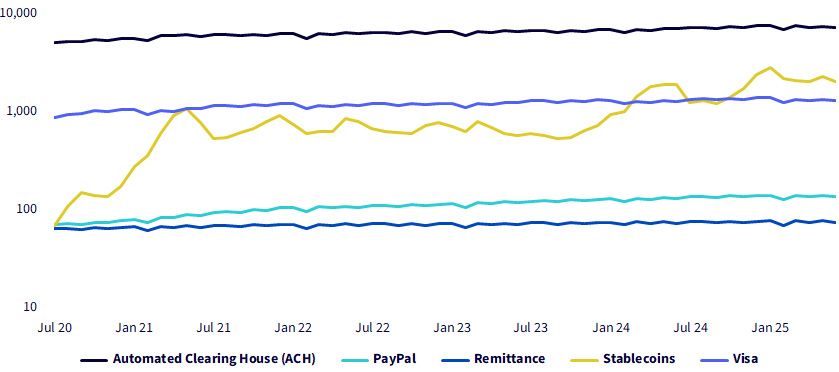
Sources: Artemis Terminal, WisdomTree, 7/21/25. Average last 30-days rolling adjusted volume of stablecoin transactions (USD), excluding maximal extractable value activity and intra-centralized exchange transactions, against the current average daily volume of other financial systems. Data is aggregated on a weekly basis for periods of one year and up. Past performance is not indicative of future results.
Forecasts suggest stablecoin supply could reach $2–4 trillion by 2030, absorbing trillions in Treasuries.3 That would be on par with flows from major mortgage or foreign buyers. While it is not clear if this stablecoin supply is substituting for other forms of U.S. dollar money or other global currencies, at least some portion of this seems likely to be net new demand. This institutionalizes a new regime where crypto, liquidity and dollar strength reinforce one another in a fiscal feedback loop.
Geopolitical Game-Changer
The U.S. has launched an assertive monetary offensive as the European Union stalls and Asia treads cautiously. The GENIUS Act positions the dollar as the default layer for global value transfer by codifying stablecoin issuance into federal law.
- Offshore issuers face a binary outcome: either establish regulated U.S. entities or meet stringent American standards—effectively exporting U.S. regulation globally.
- In inflation-hit economies such as Argentina and Turkey, where stablecoins already serve as de facto dollars, the Act transforms this informal dominance into formal monetary reach.
Figure 2: North America Leads Stablecoin Usage, Reinforcing U.S. Leverage over Global Crypto Infrastructure
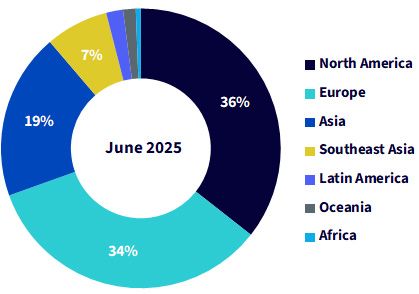
Sources: Artemis Terminal, WisdomTree, 7/21/25. Time zone-based analysis is used to determine the regional breakdown. Regional breakdown of adjusted number of stablecoin transactions, excluding maximal extractable value and intra-centralized exchange transfers, based on 20% of all activity tagged on Ethereum and Solana only. Past performance is not indicative of future results.
The GENIUS Act is not domestic fine-tuning. It is a digital dollar power play designed to entrench U.S. dominance and box out rivals. Paired with the CLARITY Act, which aims to define regulatory bounds for decentralized finance (DeFi) and crypto platforms, this legislative duo forms a blueprint for American supremacy in digital finance.
Shake-Out
This is financial Darwinism. Compliance costs are surging, legal intricacies multiplying and capital standards rising. Players with offshore shells, thin reserves or ambiguous governance models will be wiped out. In their place, top-tier stablecoin issuers will evolve into on-chain banks—with governance boards, audit trails, risk dashboards and regulatory interfaces.
Think Basel III meets blockchain—not startups, but digital financial institutions with systemic heft. Survival demands more than code. It requires capital, compliance and scale.
Bottom Line
Skeptical? Good. But this is not business as usual. It is a systemic upgrade—a dollar-centric redesign of financial infrastructure. The U.S. installed programmable, compliant rails to power the next digital economy with enough muscle to marginalize the euro in tokenized finance.
The U.S. is not just catching up. It is seizing control. With the GENIUS Act, stablecoins become instruments of statecraft, and crypto markets become the new frontier of dollar hegemony. Institutional capital will follow compliance, and compliance now wears stars and stripes.
Dovile Silenskyte is an employee of WisdomTree UK Limited, a European subsidiary of WisdomTree Asset Management Inc.'s parent company, WisdomTree, Inc.
1 Guiding and Establishing National Innovation for U.S. Stablecoins.
2 The Clarity Act has only been passed by the House of Representatives. The Senate version will likely have substantial differences, and language will be driven from two different Senate Committees (Agriculture for commodities issues and Banking for securities issues).
3 Sources: Finextra, 5/1/25; Crowdfund Insider, 6/5/25.
Important Risks Related to this Article
Crypto assets, such as bitcoin and ether, are complex, generally exhibit extreme price volatility and unpredictability, and should be viewed as highly speculative assets. Crypto assets are frequently referred to as crypto “currencies,” but they typically operate without central authority or banks, are not backed by any government or issuing entity (i.e., no right of recourse), have no government or insurance protections, are not legal tender and have limited or no usability as compared to fiat currencies. Federal, state or foreign governments may restrict the use, transfer, exchange and value of crypto assets, and regulation in the U.S. and worldwide is still developing.
Crypto asset exchanges and/or settlement facilities may stop operating, permanently shut down or experience issues due to security breaches, fraud, insolvency, market manipulation, market surveillance, KYC/AML (know your customer/anti-money laundering) procedures, noncompliance with applicable rules and regulations, technical glitches, hackers, malware or other reasons, which could negatively impact the price of any cryptocurrency traded on such exchanges or reliant on a settlement facility or otherwise may prevent access or use of the crypto asset. Crypto assets can experience unique events, such as forks or airdrops, which can impact the value and functionality of the crypto asset. Crypto asset transactions are generally irreversible, which means that a crypto asset may be unrecoverable in instances where: (i) it is sent to an incorrect address, (ii) the incorrect amount is sent or (iii) transactions are made fraudulently from an account. A crypto asset may decline in popularity, acceptance or use, thereby impairing its price, and the price of a crypto asset may also be impacted by the transactions of a small number of holders of such crypto asset. Crypto assets may be difficult to value, and valuations, even for the same crypto asset, may differ significantly by pricing source or otherwise be suspect due to market fragmentation, illiquidity, volatility and the potential for manipulation. Crypto assets generally rely on blockchain technology, and blockchain technology is a relatively new and untested technology that operates as a distributed ledger. Blockchain systems could be subject to internet connectivity disruptions, consensus failures or cybersecurity attacks, and the date or time that you initiate a transaction may be different than when it is recorded on the blockchain. Access to a given blockchain requires an individualized key, which, if compromised, could result in loss due to theft, destruction or inaccessibility. In addition, different crypto assets exhibit different characteristics, use cases and risk profiles. Information provided by WisdomTree regarding digital assets, crypto assets or blockchain networks should not be considered or relied upon as investment or other advice or as a recommendation from WisdomTree, including regarding the use or suitability of any particular digital asset, crypto asset, blockchain network or any particular strategy.
Categories

About the contributor

Dovile Silenskyte
Director, Digital Assets Research
Dovile Silenskyte is a director of digital assets research at WisdomTree. Before joining WisdomTree in May 2024, Dovile worked as an index equity product strategist at BlackRock. Currently, she is responsible for conducting analyses for in-house digital assets publications and assisting the sales team with client queries about products and markets. Dovile holds an MSc in Finance from Texas A&M University – Commerce, and she is also a chartered financial analyst (CFA).