


Keep Your Eye on the CAR-T
Published October 18, 2024

Christopher Gannatti, CFA
Global Head of Research
Key Takeaways
- Despite weak public biotech stock performance, venture capital in private biotech markets remains robust, with 2024 on track to rival 2021’s funding environment.
- Recent breakthroughs in CAR-T and CRISPR therapies are pushing biotech innovation forward, with promising results in autoimmune diseases showing the sector’s long-term growth potential.
- As biotechnology advances through scientific milestones, patient investors may benefit from upcoming therapeutic breakthroughs, even if returns lag in the short term.
In late 2023, we wrote about how we thought that after equity performance challenges for the better part of two years, this year could encapsulate a “comeback” for biotech shares.
If investors judged the veracity of that statement based on the share price performance of publicly listed biotech companies, it has so far proved to be incorrect. However, this may not tell us the full story.
Private Markets Increase in Importance as a Signal
The market for initial public offerings has been fairly quiet since 2021, with the exception of a few bigger names here and there. It appears that companies have gained a certain degree of comfort with staying private for a longer time.
When investors think back to 2021, two characteristics stand out:
- The U.S. Federal Reserve and other central banks had pegged interest rates at exceptionally low levels in order to stimulate economic growth during an uncertain pandemic period.
- Significant fiscal policy stimulus was also working its way through the global economy.
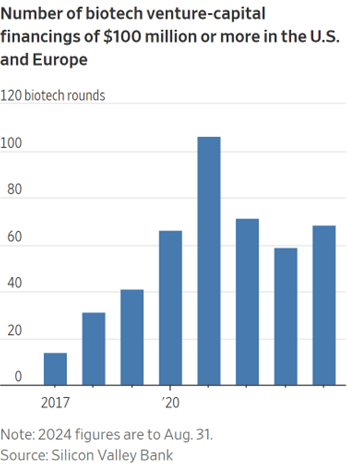
Combined, these ingredients led to a very frothy funding environment for biotechnology venture capitalists, as well as higher price multiples for public market investors. In figure 1, we can see:
- In 2021, there were 106 funding rounds valued at $100 million or more.
- Through the first eight months of 2024, there were 68 funding rounds valued at $100 million or more—which means it’s not impossible that 2024 could be competitive with 2021 when all is said and done. We think this is a powerful signal in that we are not seeing anywhere near the degree of economic stimulus that we were seeing in 2021.
Figure 1: Number of Biotech Venture-Capital Financings of $100 Million or More in the U.S. and Europe
Source: Silicon Valley Bank, as seen in the article: Brian Gormley,
“Venture Mega-Rounds Return to Biotech,” Wall Street Journal,
9/26/24. Past performance is not indicative of future results.
Science Continues Its Forward March
We have written before about chimeric antigen receptor (CAR-T) therapies. The simple, high-level explanation of this is figuring out how to give instructions to a person’s own immune system. There have been cases where certain types of blood cancers have responded well to this approach, but we just read about initial successful applications for certain autoimmune conditions.1
Three individuals from China with severe autoimmune conditions have gone into remission after being treated with bioengineered and CRISPR-modified immune cells. This is the first time people with autoimmune disorders have been treated with engineered immune cells created from donor cells rather than their own. This advance could lead to the mass production of such therapies.
One recipient, Mr. Gong, a 57-year-old man from Shanghai with systemic sclerosis, experienced significant improvements in his condition just days after receiving the therapy. Engineered immune cells, known as chimeric antigen receptor (CAR) T cells, have shown promise in treating blood cancers and autoimmune conditions like lupus and multiple sclerosis. However, using a person’s own immune cells for this therapy is expensive and time-consuming.
Researchers have started creating CAR-T therapies from donated immune cells, which could reduce costs and production times. If successful, one donor’s cells could be used to treat more than 100 people. The trial, led by Xu Huji at Naval Medical University in Shanghai, is the first to report results for autoimmune diseases, with recipients remaining in remission more than six months after treatment.
The process involves extracting T cells from a donor, modifying them with CAR proteins that target B cells and using CRISPR-Cas9 to knock out genes to prevent immune reactions. The first person to receive the treatment was a 42-year-old woman with autoimmune myopathy, followed by Mr. Gong and another man with aggressive sclerosis. The CAR T cells targeted and destroyed pathogenic B cells, leading to significant improvements in symptoms and declines in autoantibody levels.
None of the recipients experienced severe inflammatory reactions or evidence of graft rejection. However, researchers are still investigating long-term safety concerns, such as the emergence of new tumors. The big question now is whether this approach will work in more people and how durable the effects will be.
Conclusion: Science First, Returns Later
We continue to think that biotechnology presently sits on the cusp of a lot of interesting jumps forward in capability. As we see the advances in artificial intelligence and computing power, it’s becoming more and more clear that DNA represents the storage of certain biological information, and if one can process and understand that information, one can use the resulting cells to accomplish valuable tasks.
CAR-T is merely one type of therapy among many that we believe has enormous potential.
1 Source: Smriti Mallapaty, “World-first therapy using donor cells sends autoimmune diseases into remission,” Nature, 10/4/24. Microsoft Co-Pilot assisted with the summary.
Categories
Related articles

About the contributor

Christopher Gannatti, CFA
Global Head of Research
Christopher Gannatti began at WisdomTree as a Research Analyst in December 2010, working directly with Jeremy Schwartz, CFA®, Director of Research. In January of 2014, he was promoted to Associate Director of Research where he was responsible to lead different groups of analysts and strategists within the broader Research team at WisdomTree. In February of 2018, Christopher was promoted to Head of Research, Europe, where he was based out of WisdomTree’s London office and was responsible for the full WisdomTree research effort within the European market, as well as supporting the UCITs platform globally. In November 2021, Christopher was promoted to Global Head of Research, now responsible for numerous communications on investment strategy globally, particularly in the thematic equity space. Christopher came to WisdomTree from Lord Abbett, where he worked for four and a half years as a Regional Consultant. He received his MBA in Quantitative Finance, Accounting, and Economics from NYU’s Stern School of Business in 2010, and he received his bachelor’s degree from Colgate University in Economics in 2006. Christopher is a holder of the Chartered Financial Analyst Designation.