
DDLS
Dynamic International SmallCap Equity Fund

Published October 23, 2024

Equity Strategist
For the past two years, U.S. equities have been the preeminent leader of global financial markets. Propelled by the success of the Magnificent 7 and other AI beneficiaries, the S&P 500 posted annualized gains of 28% from 2023 through September of this year. The technology-laden NASDAQ 100 fared even better, delivering 42.5% on an annualized basis over the same period.
Though U.S. markets have given investors much to celebrate for roughly half of the post-pandemic environment, the extent of the rally is prompting new considerations about diversifying U.S. equity risk as the Fed newly pivots to rate cuts. Whether they’re concerned by rich valuations, skeptical of the health of the U.S. economy or simply want to pocket some unrealized gains, investors are warming to the idea that international equities may be a useful addition for portfolio diversification and asset allocation.
Unsurprisingly, one of the most impactful equity diversifiers for U.S. large caps has been their exact opposite: international small caps. Since 1992, they’ve been relatively uncorrelated with the S&P 500 and a slightly better diversifier than international large caps and emerging market equities.
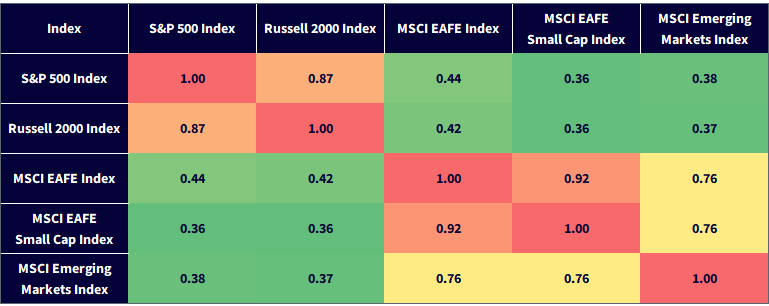
Source: WisdomTree Fund Comparison Tool, from 1992 to 8/31/2024. Past performance is not indicative of future results. You cannot invest
directly in an index. Subject to change. MCSI EAFE Index represents international large caps. MSCI EAFE Small Cap Index represents international
small caps. MCSI Emerging Markets Index represents emerging markets equities.
More importantly, they’ve frequently outperformed on the downside as well.
Over the past eight years, there have been 907 trading days where the S&P 500 fell. On those days, the MSCI EAFE Small Cap Index outperformed the U.S. benchmark more than two-thirds of the time.
If we break the distribution of negative daily S&P 500 returns into quintiles, the diversification benefit is evident. The MSCI EAFE Small Cap Index outperformed in each quintile and had the most pronounced effect during the S&P 500’s worst days, when it fell more than 1.2%.
Across the whole period, it outperformed on the S&P’s negative days by more than 40 basis points (bps) on average.
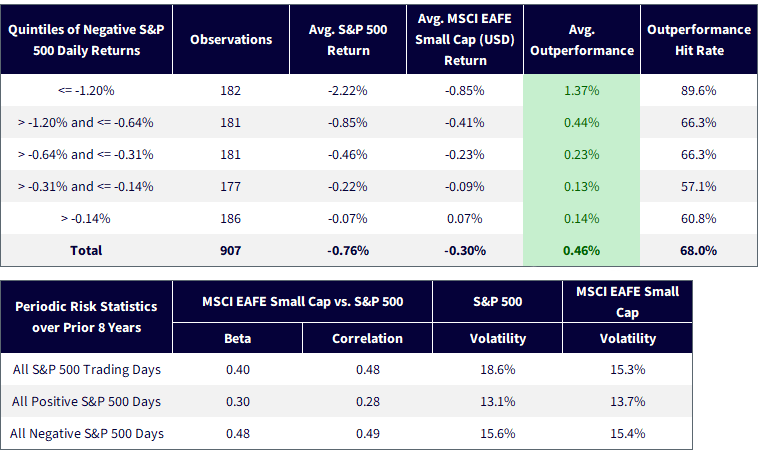
Sources: WisdomTree, MSCI, S&P, as of 9/30/24. Past performance is not indicative of future results. You cannot invest directly in an index.
International small caps’ sensitivity to moves in U.S. markets has been subdued over this period as well. Beta and correlation measures between positive and negative trading days for the S&P 500 demonstrate that they have moved more independently with comparable volatility. Over the whole period, however, volatility has been meaningfully reduced by more than 3 percentage points, enhancing their appeal as a diversifier.
The WisdomTree Dynamic Currency Hedged International SmallCap Equity Fund (DDLS) has improved the outperformance hit rate as well, boosting it three-quarters of the time that the S&P 500 has declined.
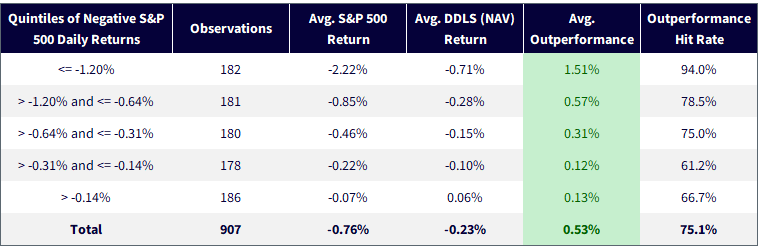
Sources: WisdomTree, S&P, as of 9/30/24. Past performance is not indicative of future results. You cannot invest directly in an index.
Launched in 2016, DDLS applies WisdomTree’s flagship dividend-weighting methodology to the small-cap segment of the developed international equity market. It utilizes a dynamic currency hedge overlay in an attempt to tactically add return and reduce volatility from currency exposures each month.
Since its inception, DDLS has consistently outperformed the MSCI EAFE Small Cap Index (in USD), adding more than 2.2% per year in annualized terms. The benefits of the dividend-weighting and dynamic currency hedge approach have been especially apparent in the past three years of the post-pandemic environment, as DDLS returned more than 6% per year while broader international small caps fell.
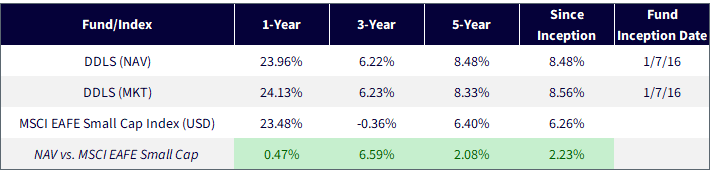
Sources: WisdomTree, MSCI, as of 9/30/24. You cannot invest directly in an index. Past performance is not indicative of future
results. Investment return and principal value of an investment will fluctuate so that an investor’s shares, when redeemed,
may be worth more or less than their original cost. Current performance may be lower or higher than the performance data
quoted. For the most recent month-end and standardized performances, click here.
The volatility profile of the Fund and its asset class are even more compelling. Traditionally, investors associate small caps with higher volatility and greater market sensitivity, and that’s usually true in the U.S. due to the prevalence of unprofitable, low-quality companies. The standard deviation of Russell 2000 returns, for example, has been about 5–6 percentage points higher than the S&P 500 over the past decade-plus.
But overseas, the incremental volatility of small caps is much less than exhibited in the U.S., primarily because they are comparatively healthier than U.S. small caps from a fundamental standpoint.
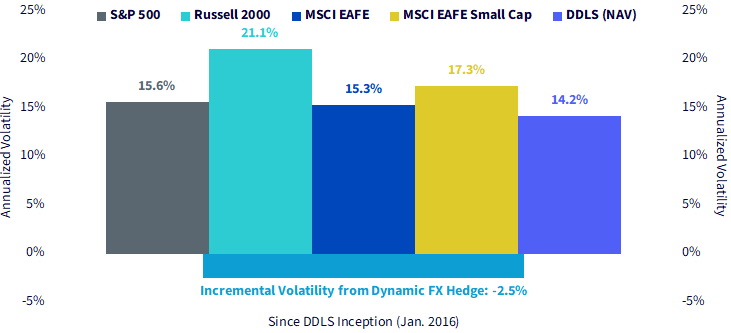
Sources: WisdomTree, MSCI, S&P, FTSE Russell, as of 9/30/24. Volatility calculated using monthly returns since DDLS inception 1/7/16. Past
performance is not indicative of future results. You cannot invest directly in an index.
The volatility profile of DDLS, however, is aided by its dynamic currency hedge. Currency fluctuations are inevitably an additional source of volatility within a U.S. investor’s portfolio when international exposures are not currency-hedged— one that we believe is not adequately compensated by additional return.
The decision to dynamically hedge currency exposures within DDLS has helped reduce the Fund’s volatility (compared to that of its unhedged twin, the WisdomTree International SmallCap Dividend Fund, or DLS) by about 2.5 percentage points, which coincides with a 15% proportional reduction.
Over rolling three-year return periods, DDLS has exhibited reduced volatility versus U.S. small caps and broader international small caps every single time. Compared to the S&P 500, it was less volatile in two-thirds of the 70 observations since inception.

Sources: WisdomTree, MSCI, S&P, FTSE Russell, as of 9/30/24. Rolling volatility calculated using monthly returns since DDLS
inception on 1/7/16. Past performance is not indicative of future results. You cannot invest directly in an index.
International small caps also exhibit reduced sensitivity to broader market activity, which is a key advantage for investors seeking U.S. diversification potential.
Since DDLS's inception, U.S. small caps have been the asset class most sensitive to movements in broader U.S. equities, proxied by the S&P 500. International equities have been slightly less sensitive over the same period, but not to a significant extent. DDLS, however, compounded the reduction benefit with a beta 20% lower than broader international small caps and about 35% lower than U.S. small caps.
Its impact has been consistent versus international equities as well, with a beta consistently 20% lower than the MSCI EAFE and MSCI EAFE Small Cap Indexes.
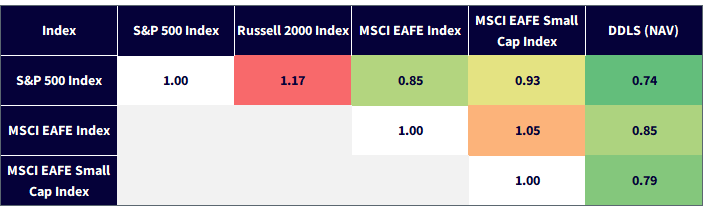
Sources: WisdomTree, S&P, MSCI, Russell, for the period 1/7/16 to 9/30/24. Using monthly returns since DDLS’s inception on 1/7/16.
Past performance is not indicative of future results.
There is also an opportunity to diversify away from lofty U.S. equity valuations. Today, DDLS trades at a three- to four-point discount to the MSCI EAFE Small Cap Index and more than 10 points lower than the S&P 500 on a price-to-earnings (P/E) and estimated P/E basis.
Meanwhile, its dividend yield is almost four times larger than the S&P’s and provides a 1.8% pickup compared to the MSCI EAFE Small Cap Index. This could be especially valuable as global interest rates begin to fall. Companies with larger dividend payments could theoretically benefit from declining rates, as bond (the traditional investment of choice for investment income) yields readjust to reflect market conditions and monetary policy.
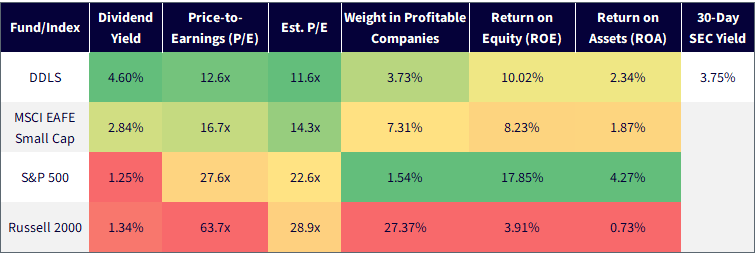
Sources: WisdomTree, MSCI, S&P, Russell, as of 9/30/24 (30-Day SEC Yield as of 10/21/24). Past performance is not indicative of future results.
You cannot invest directly in an index. To view prospectus, click here. This material must be accompanied by the prospectus.
A key distinction, however, lies between U.S. and international small caps.
Across all the measures shown above, the MSCI EAFE Small Cap Index is fundamentally stronger than the Russell 2000. Return on equity (ROE) more than doubles, while return on assets (ROA) is nearly three times greater. Dividend yield more than doubles as well, while P/E and forward P/E multiples are dramatically reduced.
More importantly, the international small-cap market features less than one-third of the Russell 2000’s weight in unprofitable companies. DDLS improves all these measures even more, with lower multiples, greater dividend yields and improved quality and profitability elements.
Portfolio diversification comes in many forms, and the right solution for a given investor depends on their own allocations. After the melt-up in U.S. large-cap equities, however, many investors may have greater exposures than they’re comfortable with and might benefit from their total opposite: international small caps.
Today, DDLS sports attractive fundamentals compared to its broader asset class and U.S. small caps. It also maintains an interesting historical risk and return profile that has been relatively uncorrelated to U.S. large caps and has provided alpha during negative days for the S&P 500 with reduced sensitivity to domestic markets. We think it could be a potentially beneficial tool to diversify U.S. equity risk during periods of potential economic uncertainty, changing interest rate regimes and elevated market multiples.
There are risks associated with investing, including the possible loss of principal. Foreign investing involves special risks, such as risk of loss from currency fluctuation or political or economic uncertainty. The Fund invests in derivatives in seeking to obtain a dynamic currency hedge exposure. Derivative investments can be volatile, and these investments may be less liquid than other securities and more sensitive to the effects of varied economic conditions. Derivatives used by the Fund may not perform as intended. A Fund that has exposure to one or more sectors may be more vulnerable to any single economic or regulatory development. This may result in greater share price volatility. The composition of the Index underlying the Fund is heavily dependent on quantitative models and data from one or more third parties, and the Index may not perform as intended. The Fund invests in the securities included in, or representative of, its Index regardless of their investment merit, and the Fund does not attempt to outperform its Index or take defensive positions in declining markets. Please read the Fund’s prospectus for specific details regarding the Fund’s risk profile.
Dynamic International SmallCap Equity Fund

Equity Strategist
Brian Manby is an Equity Strategist at WisdomTree and part of the Investment Strategy team.
He is responsible for developing and communicating equity market insights, investment themes, and portfolio strategies that support the firm’s ETF and investment solutions platform. He evaluates sectors, valuations, fundamentals and equity styles to identify investment opportunities and provide actionable perspectives to clients and advisors. He also helps investors understand how WisdomTree’s equity strategies can be used to achieve long-term investment objectives in evolving market environments.
Brian joined WisdomTree in October 2018 as an Investment Strategy Analyst after a few years as a Consultant for FactSet Research Systems, Inc. He earned a B.A. in Economics and Political Science from the University of Connecticut in 2016 and has been a Chartered Financial Analyst since 2022.
