


Is Five Becoming the New Four?
Published November 9, 2022

Kevin Flanagan
Head of Investment and Fixed Income Strategy
Thanks to Powell & Co., the month of November has gotten off to an inauspicious start for the money and bond markets. I recently blogged about Fed Funds and Treasury yields becoming a “four”gone conclusion , and now that these milestones have been met, you have to ask yourself the question: is five becoming the new four?
It all begins with where the terminal rate of the Federal Funds target range is going. At the September FOMC meeting, the Fed’s own median estimate placed the level at 4.6%. However, at the November FOMC meeting presser, Chairman Jerome Powell provided an update, stating that “incoming data suggests the September dots should be higher.” What, exactly, is higher? Well, if you look at the June 2023 Fed Funds Futures contract, the level was 5.14%, as of this writing. In other words, the market is pricing in a terminal Fed Funds target range of 5%–5.25%.
Fed Funds vs. Treasury Yields
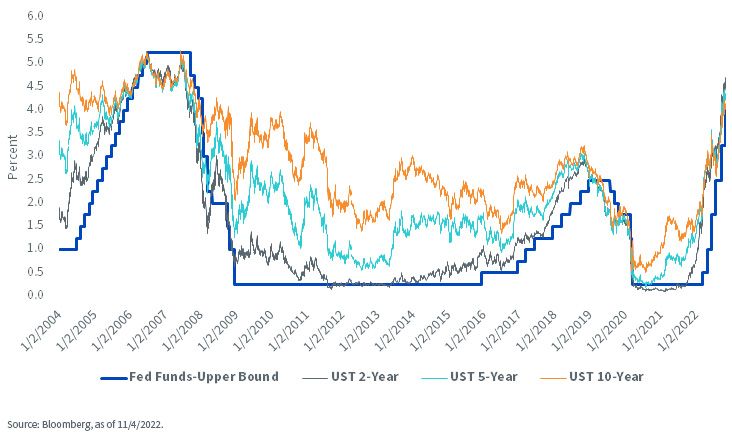
If this is where the Fed is headed in this rate hike cycle, where does that put the key U.S. Treasury (UST) 2-, 5- and 10-Year yields? Typically, these maturities will trade with a ‘spread’ or yield level over Fed Funds, especially during a tightening backdrop. This is exactly what investors have witnessed in this go-round as well (see graph), and there is nothing to make me to think this trend won’t continue until the Fed pivots to a ‘pause and cut’ monetary policy phase.
Based on Powell’s presser, the Fed is guiding the markets for a potential ‘higher for longer’ Fed Funds scenario, underscored by his comments that rate hikes still have “some ways to go” and it would be “premature to pause,” let alone to think of cutting.
So, let’s look to history for some possible guidance for UST yields. The last time the Fed took Fed Funds to 5% or higher was the 2004–2006 rate hike period. At that time, the peak readings for UST 2- and 5-Year yields reached 5.28% and 5.23%, respectively, while the 10-Year topped out at 5.29% in mid-2007.
Conclusion
The aforementioned UST yield levels are not meant to be an outright prediction. There is no doubt the Fed seems to be leaning toward a slower pace of rate hikes, but the terminal rate sure looks like it’s going to be headed in the 5% direction. Against this backdrop, history suggests 5% yield handles could be forthcoming for short-term Treasuries, at a minimum, with intermediate maturities such as the 5-Year note not too far behind. At this point, I’m not ready to make that assumption for the UST 10-
Year yield (at least not yet), but it does appear as if some renewed elevation moving back into the 4.25%–4.5% trading range (if not a bit higher) is a reasonable scenario.
Stay tuned…things change quickly!
Related articles
A ‘Warsh’ Out at the Fed

Fed Watch: The Changing of the Guard Finally Arrives
Private Credit Beyond the Headlines: Why Diversification and Liquidity Matter More Than Ever
Are Bessent’s Hands Tied?
‘Warsh’ and Dry

What’s ‘Under the Hood’ of Your Core Bond Position?

Powell Stays…Should the Dot Plot?

Fed Watch: Powell’s Last Stand & What Comes Next?
Inflation’s First Official Debut
About the contributor

Kevin Flanagan
Head of Investment and Fixed Income Strategy
Kevin serves as the Head of Investment and Fixed Income Strategy. In this role, he writes macro and fixed income-related content and works closely with the sales, research and marketing teams. In addition, Kevin conducts client-facing webinars and meetings, providing expertise on WisdomTree’s existing and future bond ETFs. Prior to joining WisdomTree, Kevin spent 30 years at Morgan Stanley, where he was Managing Director and Chief Fixed Income Strategist for Wealth Management. He was responsible for tactical and strategic recommendations and created asset allocation models for fixed income securities. He was a contributor to the Morgan Stanley Wealth Management Global Investment Committee, primary author of Morgan Stanley Wealth Management’s monthly and weekly fixed income publications, and collaborated with the firm’s Research and Consulting Group Divisions to build ETF and fund manager asset allocation models. Kevin has an MBA from Pace University’s Lubin Graduate School of Business, and a B.S. in Finance from Fairfield University.