


Bonds: A H1 2023 Report Card
Published July 19, 2023

Kevin Flanagan
Head of Investment and Fixed Income Strategy
Yes, schools are out for summer vacation, but there’s no resting in the fixed income arena. After arguably the worst year on modern record in 2022, it was our belief that this year was set up to be a potential positive experience for the bond investor. And, despite continued rate hikes from the Federal Reserve and other global central banks, fixed income total returns have indeed moved back into the plus column thus far in 2023.
Let’s take a look at the first-half report card.
Fixed Income Total Returns
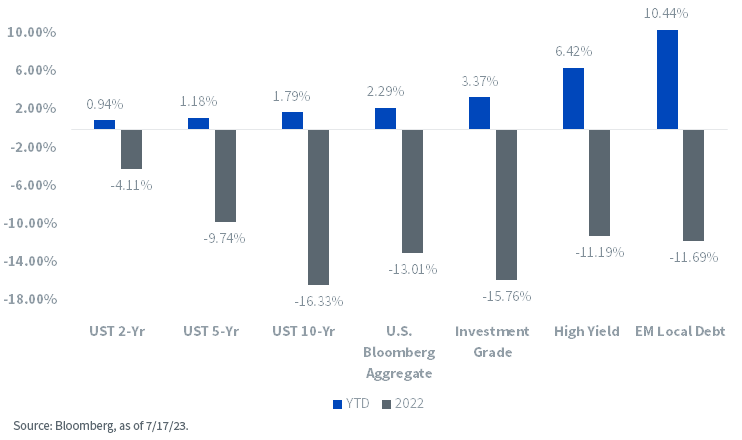
Unfortunately, in order to gain some perspective on this year’s developments so far in the bond market, we do need to take a look back at the ‘year that should not be named’…2022. In other words, any positive performances here in 2023 must be looked at in the context of just how ‘bad’ 2022 actually was.
As I wrote at the time, there was no place for the fixed income investor to hide last year, with the notable exception of U.S. Treasury (UST) floating rate notes (FRNs). The lion’s share of total returns in key global bond arenas ended up not just on the negative side of the ledger, but with many entering double-digit negative territory.
The best place to start would be the U.S. Bloomberg Aggregate Index (Agg), otherwise known as the benchmark for fixed income markets. In 2022, the Agg plummeted by 13%, as the four major areas that make up this index all struggled mightily. Through the first two weeks of July this year, the Agg has managed to rebound by almost 2.3%. While this performance does not come close to making up for last year’s loss, it’s still nice to be back in the plus column.
Similar developments can be found in the three closely watched sectors of the UST market; the 2-, 5- and 10-Year areas. In 2022, each of these sectors was negative, with the magnitude increasing with maturity, ranging from -4.1% for the 2-Year to as low as -16.3% for the 10-Year. Here in 2023, positive total returns have been registered anywhere from almost 1% (UST 2-Yr) to 1.8% (10-Yr). Within the U.S. corporate bond universe, the results have been somewhat better, especially in high yield (HY). In fact, U.S. HY has posted the best showing thus far, rising by a little more than 6.4%, following a 2022 decline of 11.2%. For investment grade, the positive return through mid-July is a bit more modest, coming in at 3.4%, as compared to last year’s nearly 16% shortfall.
From a more global perspective, the gold medal goes to emerging markets (EM) local debt. Indeed, EM local has witnessed a robust gain of 10.4% here in 2023, getting closer and closer to completely reversing last year’s decrease of 11.7%.
Conclusion
Obviously, the results outlined in this blog post are, to some extent, yesterday’s news. The natural question is where are we going from here? With the Fed, and perhaps other global central banks, nearing the end of their respective rate hike cycles, inflation continuing to cool and economic growth softening, it seems reasonable to expect fixed income returns will remain in positive territory through the second half of this year.
Categories
Related articles
A ‘Warsh’ Out at the Fed

Fed Watch: The Changing of the Guard Finally Arrives
Private Credit Beyond the Headlines: Why Diversification and Liquidity Matter More Than Ever
Are Bessent’s Hands Tied?
‘Warsh’ and Dry

What’s ‘Under the Hood’ of Your Core Bond Position?

Powell Stays…Should the Dot Plot?

Fed Watch: Powell’s Last Stand & What Comes Next?
Inflation’s First Official Debut
About the contributor

Kevin Flanagan
Head of Investment and Fixed Income Strategy
Kevin serves as the Head of Investment and Fixed Income Strategy. In this role, he writes macro and fixed income-related content and works closely with the sales, research and marketing teams. In addition, Kevin conducts client-facing webinars and meetings, providing expertise on WisdomTree’s existing and future bond ETFs. Prior to joining WisdomTree, Kevin spent 30 years at Morgan Stanley, where he was Managing Director and Chief Fixed Income Strategist for Wealth Management. He was responsible for tactical and strategic recommendations and created asset allocation models for fixed income securities. He was a contributor to the Morgan Stanley Wealth Management Global Investment Committee, primary author of Morgan Stanley Wealth Management’s monthly and weekly fixed income publications, and collaborated with the firm’s Research and Consulting Group Divisions to build ETF and fund manager asset allocation models. Kevin has an MBA from Pace University’s Lubin Graduate School of Business, and a B.S. in Finance from Fairfield University.