
QGRW
U.S. Quality Growth Fund

Published July 21, 2025

Global Head of Research
Artificial Intelligence (AI) is not a monolith—it is a layered, rapidly evolving megatrend that permeates multiple sectors and value chains. Investors seeking exposure to AI need more than just a broad "tech" exchange-traded fund (ETF). WisdomTree offers a range of different ETFs that touch the AI narrative from six distinct vectors: quality growth, cybersecurity, cloud computing, biotechnology, the broad-based AI ecosystem and technology-focused real estate.
Each Fund is a building block representing a unique slice of the AI-driven future. Below, we explore the conceptual logic behind each ETF's AI linkage, helping investors think beyond performance and toward portfolio construction based on differentiated AI exposures.
WisdomTree U.S. Quality Growth Fund (QGRW)
QGRW is built to track the total return performance, before fees and expenses, of the WisdomTree U.S. Quality Growth Index. The specific methodology focuses on large-cap U.S. companies with strong return on equity, return on assets and earnings growth metrics. The group of so-called Magnificent 7 companies has tended to qualify for inclusion, and the market capitalization-weighting schematic has led to these stocks having high exposure.
At the cutting edge of AI, we're witnessing a high-stakes race among the world's most resource-rich companies to train the largest and most sophisticated models in history. These are the trillion-dollar firms building trillion-parameter systems—engines of productivity, automation and knowledge generation. While many groundbreaking models are still incubating within private firms, QGRW continues to lean into public market giants that are deploying capital at unprecedented scale to stay ahead in AI's arms race. It's not just exposure to AI—it's exposure to the platforms driving AI's exponential frontier.
WisdomTree Cybersecurity Fund (WCBR)
WCBR is built to track the total return performance, before fees and expenses, of the WisdomTree Team8 Cybersecurity Index. The specific methodology focuses on companies that are engaged in the provision of specific cybersecurity services that fit within the eight distinct themes that Team8 has delineated as representing the future of cybersecurity. These companies are also required to meet certain revenue growth requirements.
AI being adopted at scale is effectively a new paradigm within technology that requires all of us to think about cybersecurity in new ways. This strategy is seeking the publicly traded companies that are focusing on the future of cybersecurity, many of which will use different types of AI to help secure our systems.
WisdomTree Cloud Computing Fund (WCLD)
WCLD is built to track the total return performance, before fees and expenses, of the BVP Nasdaq Emerging Cloud Index. The specific focus is on software-as-a-service (SaaS) cloud companies that are generating more than 50% of their revenues from cloud computing services sold to enterprise customers. There are also revenue growth criteria.
It is interesting to remember that software is, at the core, what AI really is. However, large language models (LLMs) have changed so much about what we think software can do that we have to re-assess how we think about the value of different kinds of software. Robotic process automation is a great example. Before LLMs, this was seen as an exciting way to move toward automating certain types of complex tasks. After LLMs, particularly with the capabilities that we see in 2025, the market is re-thinking what robotic process automation looks like.
WisdomTree BioRevolution Fund (WDNA)
WDNA is built to track the total return performance, before fees and expenses, of the WisdomTree BioRevolution Index. The specific focus is on companies that are delivering innovations in such areas as human health, agriculture and food, materials, chemicals and energy, and biological machines and interfaces.
However, looking beyond that high-level focus, it is important to recognize that a lot of biological innovation comes from being able to process information at greater and greater scale. Consider DNA and mRNA, two types of encodings of biological information. Processing more and more of this information more and more quickly could lead to a treasure trove of future innovation. It was telling that a Nobel prize was awarded to the effort behind the AlphaFold protein shape prediction system, for example.
WisdomTree Artificial Intelligence and Innovation Fund (WTAI)
WTAI is built to track the total return performance, before fees and expenses, of the WisdomTree Artificial Intelligence and Innovation Index.
As can be gleaned from the name of the strategy, the full approach is focused on AI. We often think of it as "full ecosystem" exposure. AI, for example, could not be calculated if not for semiconductors, one of the major areas of exposure. Many of the larger players tend to be included, but smaller, innovative companies can also make their way into the strategy.
WisdomTree New Economy Real Estate Fund (WTRE)
WTRE is built to track the total return performance, before fees and expenses, of the WisdomTree New Economy Real Estate Index. The proliferation of our global technological footprint indicates that technology-focused real estate is essential.
Of late, a lot of focus has been placed on data centers, as this is where the physical training and inference compute for the large AI models tends to be located. This is an exposure in this strategy, along with communications-related technology, technology-oriented warehouse real estate, life sciences real estate and even real estate that can be used to facilitate the development of the cryptocurrency ecosystem.
Amazon has quietly crossed a technological Rubicon in its warehouses. With over one million robots now deployed—rivaling the number of human workers—Amazon has transformed fulfillment into a highly automated system where machines handle everything from shelf picking and order sorting to packaging and cart transport. At facilities like its three-million-square-foot site in Shreveport, robots perform synchronized tasks alongside humans, pushing products through 25% faster than legacy sites. This integration of robotics and AI hasn't just improved speed—it has fundamentally reshaped the economics. The number of packages handled per employee has skyrocketed from approximately 175 in 2015 to nearly 3,870 in 2025. That's a twentyfold leap in throughput per worker, driving Amazon's revenue-per-employee sharply higher while shrinking its labor footprint per facility to the lowest level in 16 years.1
Notably, one of the pillars of WTRE's strategy is exposure to the next generation of logistics technology.
Figure 1 looks at the standardized performance of these strategies.
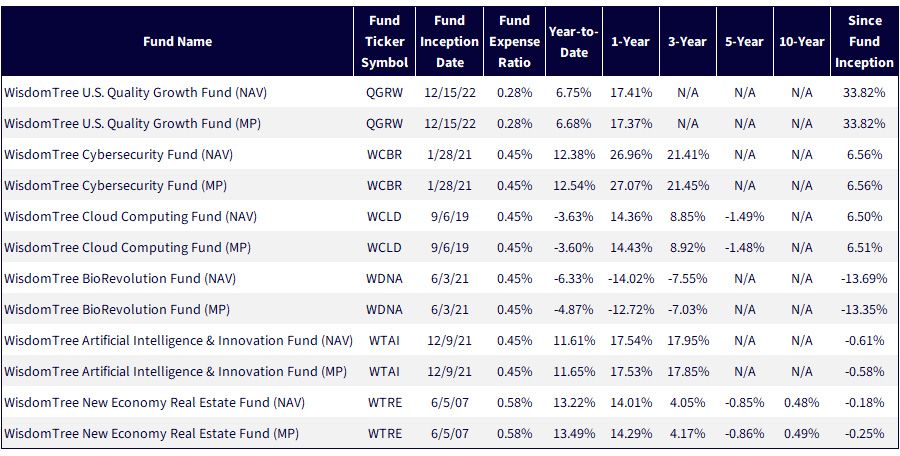
Sources: Morningstar, FactSet and WisdomTree, specifically data from the PATH Fund Comparison Tool, accessed as of 7/11/25, but showing returns for the period ended 6/30/25. NAV denotes total return performance at net asset value. MP denotes market price performance. Past performance is not indicative of future results. Investment return and principal value of an investment will fluctuate so that an investor's shares, when redeemed, may be worth more or less than their original cost. Current performance may be lower or higher than the performance data quoted. For the most recent month-end and standardized performances, click the relevant ticker: QGRW, WCBR, WCLD, WDNA, WTAI and WTRE.
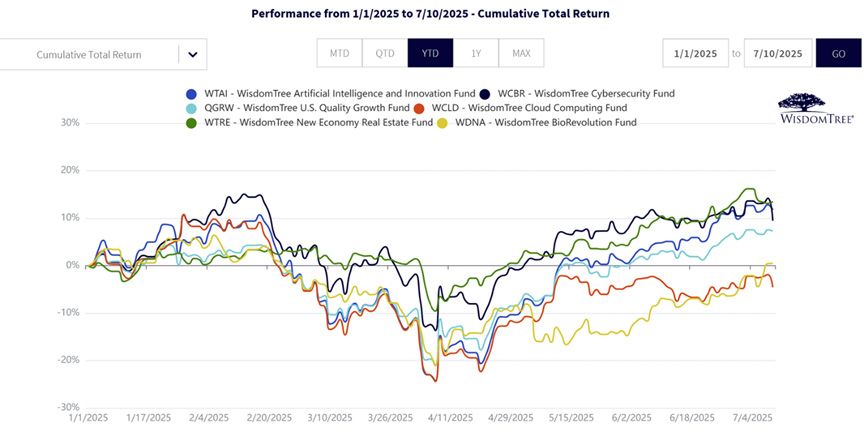
Even if many agree that AI has been a major force in 2025, the policy environment, particularly the evolving tariff policy from the Trump Administration, has played a major role in the returns that we have seen. Figure 2 shows how these strategies have performed so far in 2025.
Figure 2: A Wide Dispersion across Different Strategies Touching AI
Measuring Risk in These Different AI-Exposed Strategies
There is no single AI solution because the concept is proliferating so strongly across the global economy. In figure 3a, we consider the risk across these six strategies from the perspective of exposure to companies with negative earnings. More exposure to firms with negative earnings could represent greater risk.
Figure 3a: Considering Relative Risk between Strategies—Negative Earnings
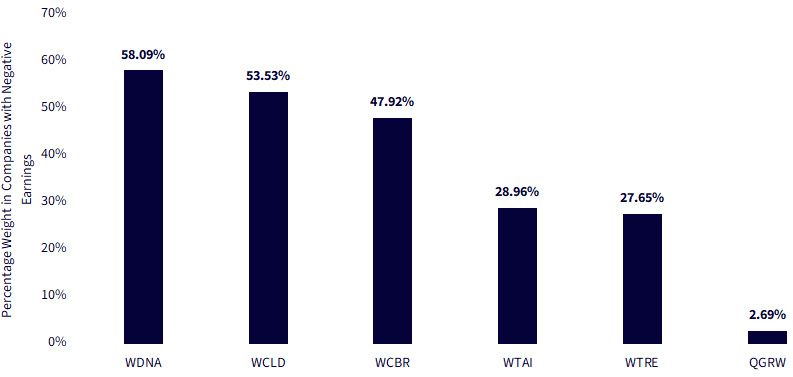
Sources: Morningstar, FactSet and WisdomTree, specifically data from the PATH Fund Comparison Tool, accessed as of 7/11/25, but showing exposure as of 6/30/25. Subject to change.
Market capitalization size exposure is another way to conceptualize risk. More exposure to smaller companies could delineate greater risk.
It's astonishing how the hierarchy of company sizes has shifted in the age of AI. Nvidia—once a niche GPU designer—is now the world's first $4 trillion company, leapfrogging Apple and Microsoft in market cap.2 We often talk about the Magnificent 7 as trillion-dollar titans, but that threshold is increasingly becoming the new baseline in tech's upper echelons. Against this backdrop, the standard definition of "large cap"—companies above $10 billion—feels almost quaint. Many private firms riding the AI megatrend already exceed that mark, even before going public. On the other end, companies under $2 billion are considered small caps—yet any firm meaningfully involved in generative AI or foundational infrastructure can cross that threshold rapidly. The lines between size segments are being redrawn in real time by the velocity of innovation.
With market capitalization, we are seeing the consequence of there being no real upper limit as companies have been generally getting larger and larger over time.
Figure 3b: Considering Relative Risk between Strategies—Market Cap Size
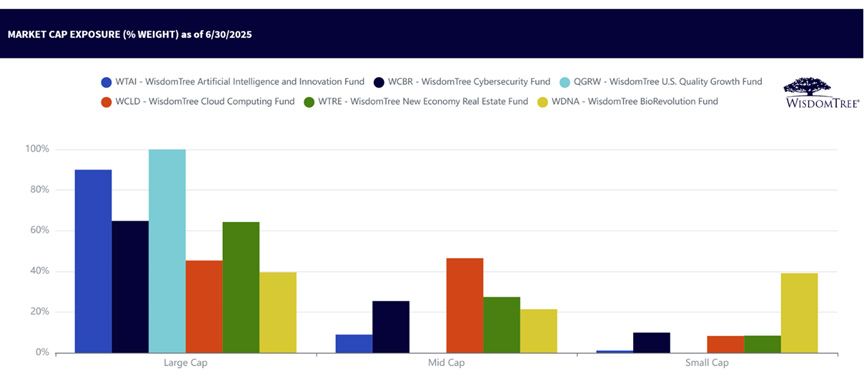
Sources: Morningstar, FactSet and WisdomTree, specifically data from the PATH Fund Comparison Tool, accessed as of 7/11/25, but showing exposure as of 7/10/25. Subject to change.
1 S. Herrera, "Amazon Is on the Cusp of Using More Robots than Humans in its Warehouses, The Wall Street Journal, 6/30/25.
2 R. Whelan, et al., "How Nvidia Became the World's First $4 Trillion Company," The Wall Street Journal, 7/9/25.
There are risks associated with investing, including the possible loss of principal. Please read the Fund’s prospectus for specific details regarding the Fund’s risk profile.
QGRW: Growth stocks, as a group, may be out of favor with the market and underperform value stocks or the overall equity market. Growth stocks are generally more sensitive to market movements than other types of stocks. The Fund is non-diversified, as a result, changes in the market value of a single security could cause greater fluctuations in the value of Fund shares than would occur in a diversified fund. The Fund invests in the securities included in, or representative of, its Index regardless of their investment merit. The Fund does not attempt to outperform its Index or take defensive positions in declining markets and the Index may not perform as intended.
WCBR: The Fund invests in cybersecurity companies, which generate a meaningful part of their revenue from security protocols that prevent intrusion and attacks to systems, networks, applications, computers, and mobile devices. Cybersecurity companies are particularly vulnerable to rapid changes in technology, rapid obsolescence of products and services, the loss of patent, copyright and trademark protections, government regulation and competition, both domestically and internationally. Cybersecurity company stocks, especially those which are internet related, have experienced extreme price and volume fluctuations in the past that have often been unrelated to their operating performance. These companies may also be smaller and less experienced companies, with limited product or service lines, markets or financial resources and fewer experienced management or marketing personnel. The Fund invests in the securities included in, or representative of, its Index regardless of their investment merit and the Fund does not attempt to outperform its Index or take defensive positions in declining markets. The composition of the Index is heavily dependent on quantitative and qualitative information and data from one or more third parties, and the Index may not perform as intended.
WCLD: The Fund invests in cloud computing companies, which are heavily dependent on the internet and utilizing a distributed network of servers over the internet. Cloud computing companies may have limited product lines, markets, financial resources or personnel and are subject to the risks of changes in business cycles, world economic growth, technological progress and government regulation. These companies typically face intense competition and potentially rapid product obsolescence. Additionally, many cloud computing companies store sensitive consumer information and could be the target of cybersecurity attacks and other types of theft, which could have a negative impact on these companies and the Fund. Securities of cloud computing companies tend to be more volatile than securities of companies that rely less heavily on technology and, specifically, on the internet. Cloud computing companies can typically engage in significant amounts of spending on research and development, and rapid changes to the field could have a material adverse effect on a company’s operating results. The composition of the Index is heavily dependent on quantitative and qualitative information and data from one or more third parties and the Index may not perform as intended.
WDNA: The Fund invests in BioRevolution companies, which are companies significantly transformed by advancements in genetics and biotechnology. BioRevolution companies face intense competition and potentially rapid product obsolescence. These companies may be adversely affected by the loss or impairment of intellectual property rights and other proprietary information or changes in government regulations or policies. Additionally, BioRevolution companies may be subject to risks associated with genetic analysis. The Fund invests in the securities included in, or representative of, its Index regardless of their investment merit and the Fund does not attempt to outperform its Index or take defensive positions in declining markets. The composition of the Index is governed by an Index Committee and the Index may not perform as intended.
WTAI: The Fund invests in companies primarily involved in the investment theme of artificial intelligence (AI) and innovation. Companies engaged in AI typically face intense competition and potentially rapid product obsolescence. These companies are also heavily dependent on intellectual property rights and may be adversely affected by loss or impairment of those rights. Additionally, AI companies typically invest significant amounts of spending on research and development, and there is no guarantee that the products or services produced by these companies will be successful. Companies that are capitalizing on innovation and developing technologies to displace older technologies or create new markets may not be successful. The Fund invests in the securities included in, or representative of, its Index regardless of their investment merit and the Fund does not attempt to outperform its Index or take defensive positions in declining markets. The composition of the Index is governed by an Index Committee and the Index may not perform as intended.
WTRE: Foreign investing involves special risks, such as risk of loss from currency fluctuation or political or economic uncertainty. Investments in real estate involve additional special risks, such as credit risk, interest rate fluctuations and the effect of varied economic conditions. A Fund focusing on a single country, sector and/or emphasizing investments in smaller companies may experience greater price volatility. The Fund invests in the securities included in, or representative of, its Index regardless of their investment merit and the Fund does not attempt to outperform its Index or take defensive positions in declining markets.

Global Head of Research
Christopher Gannatti began at WisdomTree as a Research Analyst in December 2010, working directly with Jeremy Schwartz, CFA®, Director of Research. In January of 2014, he was promoted to Associate Director of Research where he was responsible to lead different groups of analysts and strategists within the broader Research team at WisdomTree. In February of 2018, Christopher was promoted to Head of Research, Europe, where he was based out of WisdomTree’s London office and was responsible for the full WisdomTree research effort within the European market, as well as supporting the UCITs platform globally. In November 2021, Christopher was promoted to Global Head of Research, now responsible for numerous communications on investment strategy globally, particularly in the thematic equity space. Christopher came to WisdomTree from Lord Abbett, where he worked for four and a half years as a Regional Consultant. He received his MBA in Quantitative Finance, Accounting, and Economics from NYU’s Stern School of Business in 2010, and he received his bachelor’s degree from Colgate University in Economics in 2006. Christopher is a holder of the Chartered Financial Analyst Designation.
