

Early to the Private Credit Party
Published July 18, 2025

Head of Investment and Fixed Income Strategy
Key Takeaways
- Interest in private credit has surged over the last year, as investors look for alternative credit solutions that offer something different from traditional credit, like investment-grade and high-yield corporate bonds.
- Despite rates returning to normal levels, HYIN offers an eye-catching 11.57% SEC 30-day yield, significantly higher than the 5.08% and 7.06% yields for investment-grade and high-yield bonds, respectively.
- For investors seeking diversification from rate-sensitive fixed income, private and alternative credit strategies like HYIN provide compelling yield enhancement and low correlation to core bond benchmarks.
One of the fixed income asset classes that has garnered a tremendous amount of interest over the last year has been private credit. In the past, investing in private or other alternative credit vehicles was limited to either institutional or ultra-high-net-worth investors. Recognizing the potential demand for this high-yielding space, WisdomTree partnered with a leading firm specializing in alternative credit, Gapstow Capital Partners, and launched one of the first funds with which investors could gain access to the elusive private credit area more than four years ago: the WisdomTree Private Credit and Alternative Income Fund (HYIN).1
What Is Alternative Credit?
While investors may hear about private/alternative credit, sometimes what this actually entails gets lost in translation. This asset class is different from traditional fixed income credit, such as investment-grade (IG) or high-yield (HY) bonds.2 Private/alternative credit encompasses debt-based securities that typically offer higher yields than traditional fixed income credit but can also come with additional risks. Investor demand in the private/alternative credit arena is arguably led by the higher income potential that is offered. Here are some examples:
- Private Credit: Direct lending between a borrower and a non-bank lender that may include floating interest rates.
- Structured Credit: This involves pooling loans or bonds and creating different risk tranches for vehicles, such as residential and/or commercial mortgage-backed securities (MBS), asset-backed securities (ABS) and collateralized loan obligations (CLOs).
Performance—A"Normal" Rate Setting
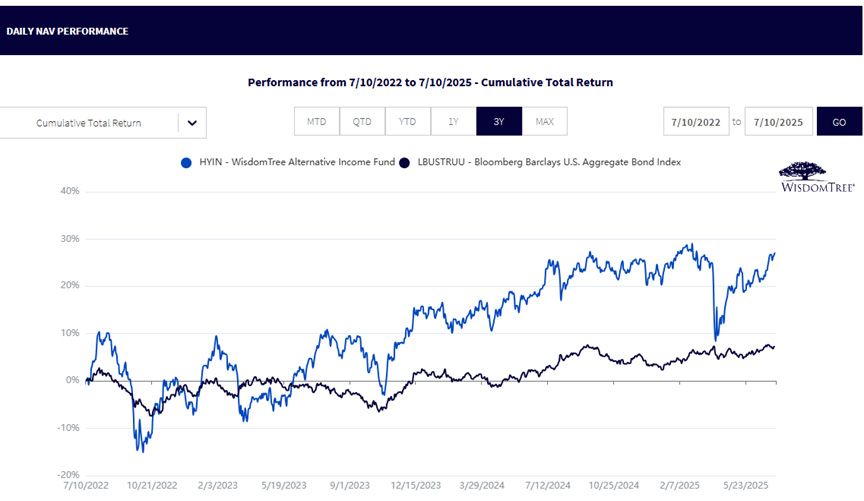
Source: WisdomTree, as of 7/11/25. Performance is historical and does not guarantee future results. Current performance may be lower or higher than quoted. Investment returns and principal value of an investment will fluctuate so that an investor's shares, when redeemed, may be worth more or less than their original cost. For the most recent month-end and standardized performances, click here.
- Over the last three years, investors have experienced the Fed raising rates from abnormally low levels to the beginnings of the current rate-cut cycle.
- These two distinct monetary policy cycles brought interest rates back to more historical norms and offer a glimpse of the yield readings investors should more likely witness going forward and how private/alternative credit fared versus core fixed income during this three-year period.
- Over this three-year timeframe, HYIN outperformed the Bloomberg Barclays U.S. Aggregate Bond Index (Agg) by almost +20% (+27.0% vs. +7.2%).
- Since inception, HYIN has produced a return of nearly +10%, while the Agg actually produced a negative figure of nearly -3%.
Key Metric
- As of July 10, 2025, the SEC 30-day yield for HYIN was 11.57%, while the IG and HY Yield to Worst (YTW) readings were 5.08% and 7.06%, respectively.
Private/Alternative Credit in a Portfolio
The private/alternative credit space can be used in a variety of ways in an overall investment portfolio. While this arena tends to fall under the fixed income umbrella, it actually has a low correlation to more rate-sensitive vehicles such as the Agg. In addition, with credit spreads for the more traditional IG and HY sectors at historical lows, investors are offered another avenue to enhance yield.
Conclusion
As investors have witnessed over the last several years, the investment backdrop can shift quickly, and private credit and alternative income solutions such as HYIN provide investors with a longer-term strategy to complement their portfolios.
1 Prior to July 17, 2025, the Fund was known as the WisdomTree Alternative Income Fund.
2 Investment-grade is proxied by the Bloomberg U.S. Agg Corporate Yield to Worst. High-yield bonds are proxied by the Bloomberg U.S. Corporate High Yield Yield to Worst.
Important Risks Related to this Article
Unless otherwise stated, all data is as of July 11, 2025.
There are risks associated with investing, including the possible loss of principal. The Fund invests in alternative credit sectors through investments in underlying closed-end investment companies (“CEFs”), including those that have elected to be regulated as business development companies (“BDCs”), and real estate investment trusts (“REITs”). The value of a CEF can decrease due to movements in the overall financial markets. BDCs generally invest in less-mature private companies, which involve greater risk than well-established, publicly traded companies and are subject to high failure rates among the companies in which they invest. By investing in REITs, the Fund is exposed to the risks of owning real estate, such as decreases in real estate values, overbuilding, increased competition and other risks related to local or general economic conditions. The Fund invests in the securities included in, or representative of, its Index regardless of their investment merit, and the Fund does not attempt to outperform its Index or take defensive positions in declining markets. Please read the Fund’s prospectus for specific details regarding the Fund’s risk profile.
Categories
About the contributor

Head of Investment and Fixed Income Strategy
Kevin serves as the Head of Investment and Fixed Income Strategy. In this role, he writes macro and fixed income-related content and works closely with the sales, research and marketing teams. In addition, Kevin conducts client-facing webinars and meetings, providing expertise on WisdomTree’s existing and future bond ETFs. Prior to joining WisdomTree, Kevin spent 30 years at Morgan Stanley, where he was Managing Director and Chief Fixed Income Strategist for Wealth Management. He was responsible for tactical and strategic recommendations and created asset allocation models for fixed income securities. He was a contributor to the Morgan Stanley Wealth Management Global Investment Committee, primary author of Morgan Stanley Wealth Management’s monthly and weekly fixed income publications, and collaborated with the firm’s Research and Consulting Group Divisions to build ETF and fund manager asset allocation models. Kevin has an MBA from Pace University’s Lubin Graduate School of Business, and a B.S. in Finance from Fairfield University.