
GDE
Efficient Gold Plus Equity Strategy Fund

Published March 11, 2025


Global Chief Investment Officer
"Gold is a permanent fixture in the financial system—it has outlasted every paper currency and stands as the ultimate form of wealth preservation." – Ray Dalio
Gold: More Than Just a Tactical Hedge
Investors have long turned to gold as a tactical asset, seeking its protection during periods of uncertainty, geopolitical tensions and dollar weakness. However, beyond its role as a "safe haven" hedge, gold's historically low correlation with most other asset classes suggests it can offer far more than just short-term crisis protection. Gold has historically been a strong diversifier. The five-year correlation between gold and U.S. equities has remained below 20% for well over the last 33 years.1
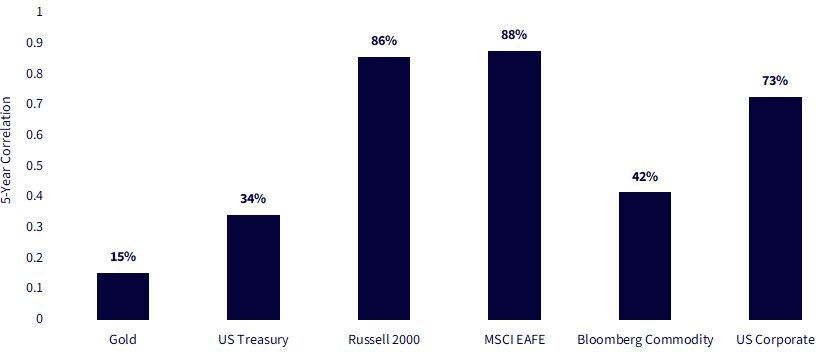
Sources: WisdomTree, Bloomberg, as of 12/31/24, using monthly data. Gold is proxied by the LBMA Gold Price PM Index. U.S. Treasury is proxied by the Bloomberg US Treasury Index. Bloomberg Commodity is the Bloomberg Commodity Index. U.S. Corporate is proxied by the Bloomberg US Corporate Index. For definitions of indexes in the chart above, please visit the glossary.
We believe that gold is not merely a reactive play but a strategic portfolio cornerstone, capable of enhancing long-term diversification and resilience in an ever-evolving financial landscape.
The WisdomTree Efficient Gold Plus Equity Strategy Fund (GDE) capitalizes on a capital-efficient design by combining U.S. large-cap equities with gold futures exposure. Traditionally, investors seeking exposure to both gold and equities would need to allocate separately, requiring additional capital. GDE, however, combines these asset classes, providing 90% exposure to U.S. equities and a 90% notional exposure to gold futures by using the remaining 10% in an unfunded gold futures position (thus providing leverage), effectively delivering a $180 total notional exposure per $100 invested.
In 2024, a year marked by strong U.S. equity performance and gold reaching record highs, GDE outshined the two largest ETFs in its Morningstar category,2 delivering superior returns amidst a dynamic market environment, as seen in figure 2.
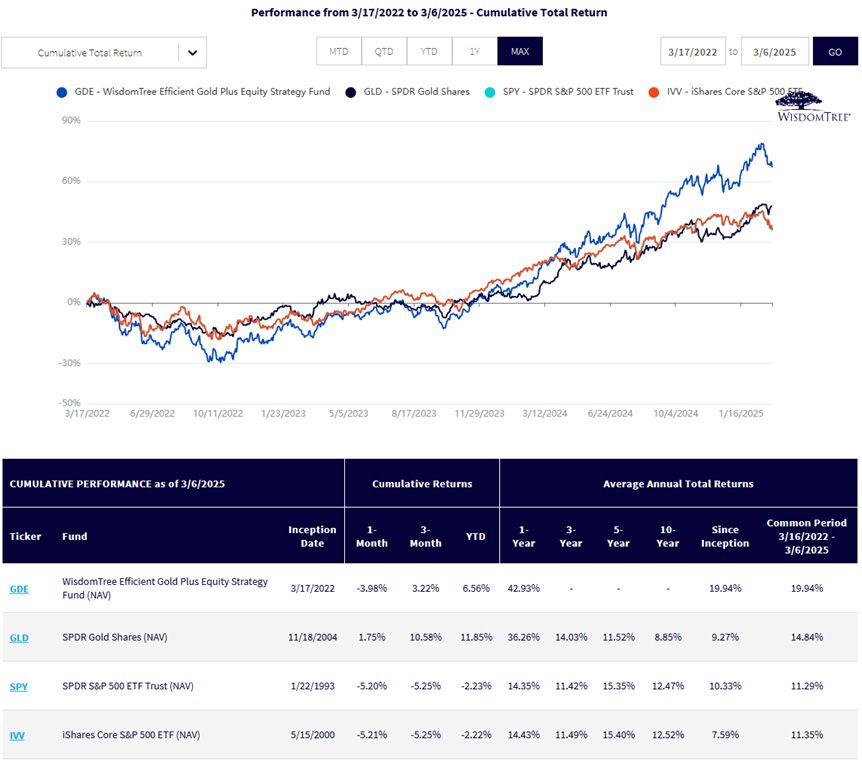
Sources: WisdomTree and FactSet, specifically data from the Fund Comparison Tool in the PATH suite of tools, accessed 3/7/25. The Common Period (3/16/2022 - 3/6/2025) provides a standardized timeframe for comparing fund performance on an equal basis. While GDE was officially launched on 3/17/2022, performance calculations may reference the prior market close (3/16/2022) to ensure consistency in reporting. This approach aligns with industry standards for evaluating investment performance across multiple funds. Performance based on NAV. Past performance is not indicative of future results. Investment return and principal value of an investment will fluctuate so that an investor's shares, when redeemed, may be worth more or less than their original cost. Current performance may be lower or higher than the performance data quoted. For the most recent month-end and standardized performances, click the relevant ticker: GDE, GLD, SPY, IVV.
The performance of gold is central to the discussion of the ongoing drivers of GDE. Gold's recent breakout3 at US$2,877 an ounce marks an important turning point amid indications that the upcycle is backed by long-term demand trends. Despite the resurgence in real rates, and against the backdrop of a stronger U.S. dollar, the gold price continues to move higher. The demand for gold continues to be driven by tariff threats alongside central banks' strategic shift toward buying gold bullion as part of their reserve management.
The largest ETF option for investors seeking exposure to gold is the SPDR Gold Shares (GLD). As mentioned previously, typically investors have to allocate to U.S. equities and gold separately. When comparing GDE's performance versus GLD and SPY, as shown in figure 3, GDE delivered superior results by leveraging the strengths of both asset classes at half the cost.
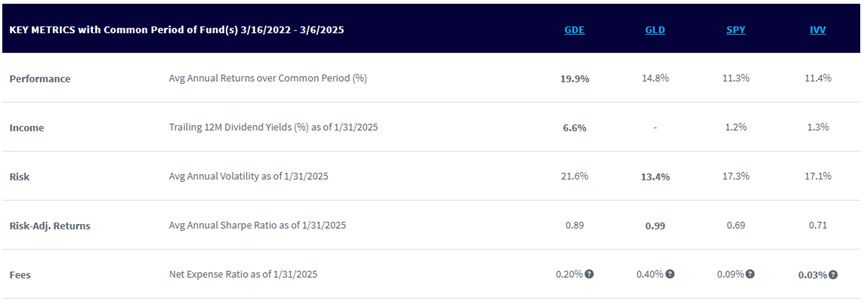
Sources: WisdomTree and FactSet, specifically data from the Fund Comparison Tool in the PATH suite of tools, accessed 3/7/25. The Common Period (3/16/2022 - 3/6/2025) provides a standardized timeframe for comparing fund performance on an equal basis. While GDE was officially launched on 3/17/2022, performance calculations may reference the prior market close (3/16/2022) to ensure consistency in reporting. This approach aligns with industry standards for evaluating investment performance across multiple funds. For definitions of terms in the table above, please visit the glossary. Past performance is not indicative of future results. Investment return and principal value of an investment will fluctuate so that an investor's shares, when redeemed, may be worth more or less than their original cost. Current performance may be lower or higher than the performance data quoted. For the most recent month-end and standardized performances, click the relevant ticker: SPY, GDE, GLD, IVV.
Conclusion
GDE's capital-efficient design allows investors to gain exposure to gold without having to reduce the equity allocation, we believe making it an optimal portfolio diversification tool in the current market environment. In an era of economic uncertainty, inflation concerns and stretched equity valuations, GDE provides an innovative solution for investors seeking gold exposure without sacrificing equity returns. With capital-efficient stacking, strong historical performance and diversification benefits, we believe GDE is an attractive addition to long-term investment strategies.
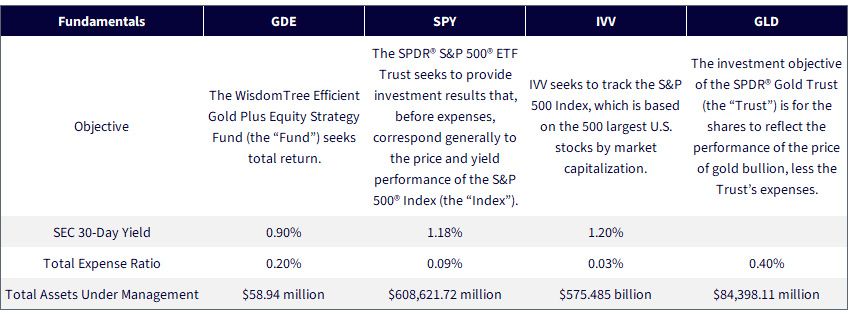
Sources: WisdomTree, iShares, State Street, as of 3/7/25. Past performance is not indicative of future results. Investment return and principal value of an investment will fluctuate so that an investor's shares, when redeemed, may be worth more or less than their original cost. Current performance may be lower or higher than the performance data quoted. For definitions of terms in the table above, please visit the glossary. Past performance is not indicative of future results. Investment return and principal value of an investment will fluctuate so that an investor's shares, when redeemed, may be worth more or less than their original cost. Current performance may be lower or higher than the performance data quoted. For the standardized performances of the Funds mentioned in the table, please click their respective tickers: GDE, GLD, SPY, IVV.
1 WisdomTree, Bloomberg, from January 31, 1988, to December 31, 2024. Gold is proxied by the LBMA Gold Price PM Index, and S&P 500 is proxied by the S&P 500 Total Return Index. U.S. Treasury is proxied by the Bloomberg US Treasury Index.
2 GDE is in the Morningstar US Fund Large Blend Category.
3 Bloomberg, as of 2/5/25.
GDE: There are risks associated with investing, including the possible loss of principal. The Fund is actively managed and invests in U.S.-listed gold futures and U.S. equity securities. The Fund’s use of U.S.-listed gold futures contracts will give rise to leverage, magnifying gains and losses and causing the Fund to be more volatile than if it had not been leveraged. Moreover, the price movements in gold and gold futures contracts may fluctuate quickly and dramatically and have a historically low correlation with the returns of the stock and bond markets. U.S. equity securities, such as common stocks, are subject to market, economic and business risks that may cause their prices to fluctuate. The Fund’s investment strategy will also require it to redeem shares for cash or to otherwise include cash as part of its redemption proceeds, which may cause the Fund to recognize capital gains. Please read the Fund’s prospectus for specific details regarding the Fund’s risk profile.
Diversification does not ensure a profit or guarantee against loss.
SPY: Equity securities may fluctuate in value and can decline significantly in response to the activities of individual companies and general market and economic conditions. Passively managed funds invest by sampling the index, holding a range of securities that, in the aggregate, approximates the full index in terms of key risk factors and other characteristics. This may cause the fund to experience tracking errors relative to the performance of the index.
The Fund’s investments are subject to changes in general economic conditions, general market fluctuations and the risks inherent in investment in securities markets. Investment markets can be volatile, and prices of investments can change substantially due to various factors including, but not limited to, economic growth or recession, changes in interest rates, changes in the actual or perceived creditworthiness of issuers and general market liquidity. The Fund is subject to the risk that geopolitical events will disrupt securities markets and adversely affect global economies and markets. Local, regional or global events such as war, acts of terrorism, the spread of infectious illness or other public health issues, or other events could have a significant impact on the Fund and its investments.
SPY is distributed by ALPS Distributors, Inc., not affiliated with Foreside Fund Services, LLC, or WisdomTree, Inc.
IVV: Investing involves risk, including the possible loss of principal.
The iShares Funds are distributed by BlackRock Investments, LLC (together with its affiliates, “BlackRock”), not affiliated with Foreside Fund Services, LLC, or WisdomTree, Inc.
GLD: Investing involves risk, and you could lose money on an investment in GLD.
ETFs trade like stocks, are subject to investment risk, fluctuate in market value and may trade at prices above or below the ETF’s net asset value. Brokerage commissions and ETF expenses will reduce returns.
Commodities and commodity-index linked securities may be affected by changes in overall market movements, changes in interest rates and other factors such as weather, disease, embargoes, or political and regulatory developments, as well as the trading activity of speculators and arbitrageurs in the underlying commodities.
Frequent trading of ETFs could significantly increase commissions and other costs such that they may offset any savings from low fees or costs.
Diversification does not ensure a profit or guarantee against loss.
Investing in commodities entails significant risk and is not appropriate for all investors.
Before investing, consider the Fund’s investment objectives, risks, charges and expenses.
The Marketing Agent for GLD, State Street Global Advisors Funds Distributors, LLC, is not affiliated with Foreside Fund Services, LLC, or WisdomTree, Inc.
Efficient Gold Plus Equity Strategy Fund

Director, Macroeconomic Research, WisdomTree Europe
@AneekaGuptaWTAneeka Gupta is Director of Research at WisdomTree. Prior to the acquisition of ETF Securities in April 2018, Aneeka worked as an Equity & Commodities Strategist at the company. Aneeka has 17 years of experience working as a Research Analyst across a wide range of asset classes. In her current role she is responsible for conducting analysis for all in-house equity, commodity and macro publications and assisting the sales team with client queries around products and markets. Prior to WisdomTree, Aneeka began her career as an equity analyst at Bear Stearns International Ltd in London. She also worked as an Equity Sales Trader at Sunrise Brokers across US and Pan European Exchanges. Before that she worked as an Equity Derivatives Sales Manager at Mashreq Bank in Dubai. Aneeka holds a Masters in Mathematics from Oxford University and a BSc in Mathematics from the University of Delhi, India. She is also a CFA Charterholder.

Global Chief Investment Officer
Jeremy Schwartz has served as Global Chief Investment Officer since November 2021 and leads WisdomTree’s investment strategy team in the construction of WisdomTree’s equity Indexes, quantitative active strategies and multi-asset Model Portfolios. Jeremy joined WisdomTree in May 2005 as a Senior Analyst, adding Deputy Director of Research to his responsibilities in February 2007. He served as Director of Research from October 2008 to October 2018 and as Global Head of Research from November 2018 to November 2021. Before joining WisdomTree, he was a head research assistant for Professor Jeremy Siegel and, in 2022, became his co-author on the sixth edition of the book Stocks for the Long Run. Jeremy is also co-author of the Financial Analysts Journal paper “What Happened to the Original Stocks in the S&P 500?” He received his B.S. in economics from The Wharton School of the University of Pennsylvania and hosts the Behind the Markets podcast. Jeremy is a member of the CFA Society of Philadelphia.

