


Back to Blog
Token Trends & Blockchain Buybacks: How DeFi is Adapting TradFi's Playbook
September 17, 2025

Token Trends & Blockchain Buybacks: How DeFi Is Adapting TradFi’s Playbook
In recent months, a growing number of decentralized finance (DeFi) protocols—most notably Aave, Hyperliquid, Jito, and Lido—have begun experimenting with onchain token buybacks or have introduced proposals to do so.1,2,3,4This strategy mirrors traditional finance’s share repurchase programs but is uniquely tailored for crypto-native ecosystems. This post outlines the latest developments, supported by concrete data and official proposals, to help readers understand the factual landscape—without promoting any protocol or strategy.
Aave’s Onchain Buyback Program
Aave DAO recently launched a structured buyback initiative, allocating $1 million per week over a six-month pilot, resulting in over $50 million in repurchases annually.1 The repurchased AAVE tokens will be distributed to stakers, funded via protocol fees through the fee-switch mechanism.
Additionally, Aave has already executed repurchases totaling $4 million to $15.7 million, including roughly 70,000 AAVE tokens, as part of its Aavenomics overhaul.5 These moves were made possible by community-approved governance proposals and managed by the Aave Finance Committee.
Following the buyback announcement, AAVE experienced a 40% monthly price gain.17While this demonstrates how buyback announcements can coincide with market activity, future performance ultimately depends on broader conditions.
Hyperliquid’s Automated Buyback Dynamics
Hyperliquid has introduced a fee-based, automated buyback mechanism that channels trading fee revenue directly into token repurchases.2 The results have been substantial: in August 2025, trading fees generated over $105 million, driving HYPE token purchases and correlating with a price surge above $50.2
The protocol also executed a record $3.97 million daily buyback, marking the largest since tracking began.6 One broader report even estimates cumulative buybacks hitting $1.25 billion over seven months.7
HYPE rose significantly in the first half of 2025, during the period of active buybacks, though this should be seen as correlation rather than causation given multiple market drivers.
Jito’s Buyback Execution & Ongoing Economic Strategy
Jito, a key player in Solana’s validator and MEV landscape, has moved beyond proposals and officially executed its first major buyback.3 In early September 2025, the Cryptoeconomics subDAO (CSD) completed a $1 million $JTO buyback over a 10-day period, deploying capital in four structured phases via TWAP (time-weighted average price) orders JIP-17.8
This initial buyback marked the conclusion of the pilot phase, but Jito has confirmed plans to continue buybacks in the near term and is exploring more advanced mechanisms—such as an auction system—to automate $JTO value accrual over time.3
Alongside the buyback, Jito governance also passed JIP-24, doubling the DAO's share of revenue from the Jito Block Engine to 6%, significantly increasing inflows to the DAO treasury and providing a stronger foundation for sustained buyback capacity.9
The newly launched $JTO Tokenomics Hub now provides real-time visibility into protocol revenue, DAO financials, and governance health, reinforcing Jito's shift toward transparent, capital-efficient design.10
Looking ahead, Jito's first tokenholder call is scheduled for September 24, 2025, which may provide further insights into ongoing buyback strategies.
Lido’s Governance Momentum Toward Buybacks
Lido, the largest liquid staking protocol by total value locked (TVL), has also entered the conversation around token buybacks.4 While no program has been executed yet, several formal governance proposals have outlined mechanisms for using treasury inflows to repurchase LDO tokens.
One notable proposal, “Dynamic Buyback Program for LDO”, suggests allocating up to 70% of net new liquid treasury inflows toward ongoing buybacks, with circuit breakers and thresholds to ensure treasury sustainability.4 Other community discussions have proposed pairing buybacks with staking and revenue-sharing, showing a clear interest in aligning LDO supply with protocol cash flows Lido Forum.11
As of Q3 2025, no buyback contracts have been deployed, but the active debate signals that Lido’s community is seriously evaluating capital-efficient tokenomics, a move that parallels TradFi’s shift toward shareholder alignment via repurchase programs.
WLFI’s Direct Burn and Proposed Buyback-Burn Mechanism
World Liberty Financial (WLFI), took a different approach by experimenting with direct token burns rather than embedding a recurring buyback mechanism into protocol design. On September 3, 2025, WLFI executed a one-time burn of 47 million WLFI tokens, valued at approximately $11.34 million.12 This move, described as a “governance tribute,” reduced the treasury supply from 10 billion to about 9.953 billion tokens, explicitly aimed at an attempt to stabilize token value amid a post-launch price slide. 13
In parallel to the above “governance tribute”, WLFI introduced a governance proposal on September 1, 2025, to allocate 100% of protocol-owned liquidity (POL) fees toward an ongoing automated buyback-and-burn program.14 If passed, this would programmatically repurchase WLFI tokens from the market and burn them, funded by trading fees—directly mirroring the fee-based mechanisms in protocols like Hyperliquid.
As of September 5, 2025, the proposal remains in the voting/discussion phase with positive community sentiment but no final results yet.
This example underscores how newer protocols are experimenting with burns and buybacks to signal commitment to token value and aligning interests with tokenholders. In WLFI’s case, the direct burn strategy serves as an alternative model that could inspire a broader trend of discretionary supply reductions.
Emerging Examples: Jupiter and Arbitrum
The buyback trend extends beyond established protocols. Jupiter announced a token buyback program in January 2025, allocating 50% of platform fees to repurchasing JUP tokens.15 This initiative, projected to exceed $100 million annually, has contributed to JUP's resilience amid market fluctuations.16
Arbitrum, an Ethereum Layer 2 solution, has implemented a similar fee-funded buyback mechanism, with Offchain Labs announcing plans to repurchase ARB tokens in March 2025.17 This has helped stabilize ARB's value during periods of broader market uncertainty.
Hyperliquid's model has influenced a $166 million DeFi buyback surge in August 2025 across platforms, highlighting the growing adoption of these strategies.2
Snapshot of Onchain Buyback Activity
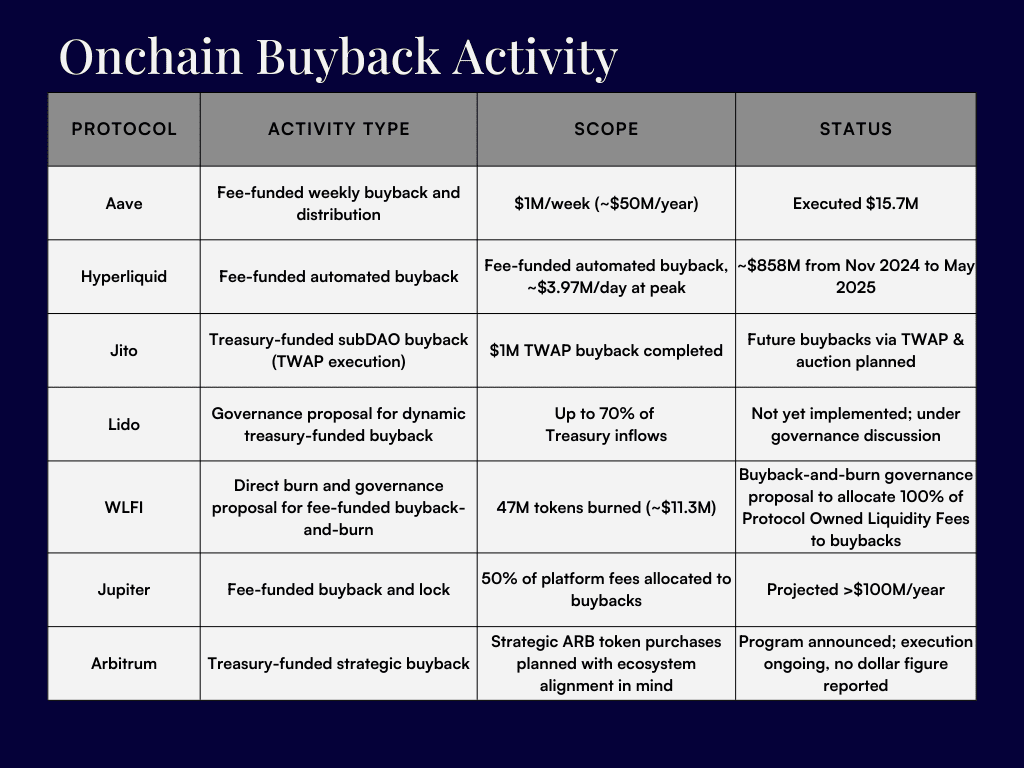
How DeFi Mirrors TradFi’s $1 Trillion Buyback Wave
Token buybacks in DeFi are unfolding in parallel with a historic wave of corporate share repurchases in traditional finance. In 2025 alone, U.S. public companies have announced over $1.05 trillion in share buybacks, led by firms like Apple, Meta, and Alphabet—continuing a capital allocation trend that intensified post-2020.18
The motivations overlap: capital efficiency, shareholder/tokenholder alignment, and signaling strength. While DeFi protocols often lack boards or CFOs, many are now using fee-based, governance-approved mechanisms to replicate similar effects—programmatically reducing token supply through smart contracts rather than boardroom decisions.
The result? A financial strategy that once required Wall Street infrastructure is now being executed with smart contracts.
U.S. regulatory shifts, such as a friendlier environment, have encouraged these strategies by reducing compliance uncertainties for DeFi protocols. For instance, the GENIUS Act, signed into law on July 18, 2025, establishes the first federal framework for stablecoins, mandating full reserve backing and transparency measures to foster innovation while protecting users.19Additionally, today's joint SEC-CFTC statement outlines harmonization efforts, including a September 29 roundtable and clarifications on spot crypto trading, signaling a collaborative approach to digital asset oversight.20
Criticisms and Risks
While token buybacks offer potential benefits, sustainability debates persist. Some analysts argue that buybacks prioritize short-term scarcity over innovation. For instance, despite allocating roughly a quarter of revenue toward buybacks, dYdX’s token remains down more than 90% from its all-time high .21, 22 This highlights the risk that buybacks may not offset broader market trends or protocol-specific challenges.
In traditional markets, buybacks are generally viewed as one form of capital return, alongside dividends. Rather than evaluating buybacks in isolation, many analysts prefer to measure total shareholder return (TSR), which captures both dividends and repurchases. For instance, Tesla conducted billions in share buybacks during 2022–23, but its stock price still declined over 60% from peak levels, demonstrating that repurchases don’t guarantee performance and must be assessed as part of the broader TSR picture23
Finally, academic research suggests that while buybacks can temporarily boost prices, they do not consistently deliver excess returns over time.24 For DeFi protocols with variable fee revenues, this reliance may create liquidity strain on the ecosystem or crowd out investment in ecosystem growth.
Conclusion
Onchain buybacks are rapidly becoming part of the DeFi playbook. From Aave’s weekly purchases to Hyperliquid’s fee-driven burns, to Jito’s structured $1M buyback, and Lido’s governance debates, protocols are experimenting with ways to link token supply to protocol revenues.1,7,3,4 Even newer entrants like WLFI and Jupiter are exploring variations of this theme.12, 15
Yet, compared to the $1 trillion+ in corporate buybacks in 2025, DeFi’s roughly $2 billion total is still small in scale. The innovation lies not in matching TradFi’s size, but in executing these strategies entirely onchain—via governance proposals, automated smart contracts, and transparent treasuries.
The bigger picture: buybacks are one tool among many for managing protocol economics. Their growth signals a maturing DeFi sector that is increasingly borrowing from TradFi while experimenting with crypto-native mechanisms. Whether these mechanisms prove durable will depend on sustainable revenue, community governance, and the ability to balance short-term scarcity with long-term utility.
Sources:
1 "Aave Launches Weekly Token Buyback Program of $1 Million." Holder.io, 2025, https://holder.io/news/aave-weekly-buyback-1m/. Accessed 8 Sept. 2025.
2 Sandor, Krisztian. "Hyperliquid’s HYPE Hits Record High Above $50 on Trading Boom, Token Buybacks." CoinDesk, 27 Aug. 2025, https://www.coindesk.com/markets/2025/08/27/hyperliquid-s-hype-hits-record-high-above-usd50-on-trading-boom-token-buybacks. Accessed 8 Sept. 2025.
3 @jito_sol. "The Jito Foundation is pleased to announce 4 updates to $JTO tokenomics…" X (Twitter), 4 Sept. 2025, 10:45 a.m., https://x.com/jito_sol/status/1963614290885136506. Accessed 8 Sept. 2025.
4 Kuzmich. "Lido DAO Proposal: Introducing a Dynamic Buyback Program for LDO." Lido Research Forum, 7 Aug. 2025, https://research.lido.fi/t/dynamic-buyback-program-for-ldo/10494. Accessed 8 Sept. 2025.
5 "Aave’s Strategic Buyback: A DeFi Milestone." CoinWy, 2025, https://coinwy.com/aave-token-buyback-milestone-2025/. Accessed 8 Sept. 2025.
6 Ainvest News Desk. "Hyperliquid Executed Monumental $3.97M HYPE Token Buyback." Ainvest, 2025, https://www.ainvest.com/news/hyperliquid-3-97-million-hype-token-buyback-signals-strong-confidence-decentralized-finance-2507/. Accessed 8 Sept. 2025.
7 Meme Insider Staff. "Hyperliquid’s $1.25 Billion HYPE Token Buyback in Seven Months." Meme Insider, 2025, https://meme-insider.com/en/article/hyperliquid-hype-token-buyback-hits-1-25-billion/. Accessed 8 Sept. 2025.
8 Jito Foundation. "JIP‑17: Activate a Cryptoeconomics subDAO (The CSD)." Jito Foundation Forum, 2025, https://forum.jito.network/t/jip-17-activate-a-cryptoeconomics-subdao-the-csd/785. Accessed 8 Sept. 2025.
9 Jito Foundation. "JIP‑24: Jito DAO Receives All Jito Block Engine Fees and Future BAM Fees." Jito Foundation Forum, 2025, https://forum.jito.network/t/jip-24-jito-dao-receives-all-jito-block-engine-fees-and-future-bam-fees/860. Accessed 8 Sept. 2025.
10 Lido DAO. "Proposal: Enable LDO Staking with Protocol Revenue Sharing." Lido Research Forum, 2025, https://research.lido.fi/t/proposal-enable-ldo-staking-with-protocol-revenue-sharing/10195. Accessed 8 Sept. 2025.
11 Katte, Stephen. "World Liberty Burns 47M Tokens in Bid to Pump Price as Slide Continues." Cointelegraph, 3 Sept. 2025, https://cointelegraph.com/news/wlfi-token-burn-price-drop-world-liberty-financial. Accessed 8 Sept. 2025.
12 "WLFI Presale Price Comparison Shows Struggles Despite Burn Efforts." CryptoNews, 3 Sept. 2025, https://cryptonews.net/news/altcoins/31550725/. Accessed 8 Sept. 2025.
13 "Proposal: Use 100% of WLFI Treasury Liquidity Fees for Buyback & Burn." WLFI Governance Forum, 1 Sept. 2025,
https://governance.worldlibertyfinancial.com/t/proposal-use-100-of-wlfi-treasury-liquidity-fees-for-buyback-burn/41226. Accessed 8 Sept. 2025.
14 CryptoSlate Staff. "Jupiter to Buy Back JUP Tokens With 50% of Fees Starting Next Week." CryptoSlate, 2025, https://cryptoslate.com/jupiter-to-buyback-jup-tokens-with-50-of-fees-starting-next-week/. Accessed 8 Sept. 2025.
15 Cointelegraph Research. "Jupiter Buybacks to Top $100M Annually: Research." Cointelegraph, 2025, https://cointelegraph.com/news/jupiter-buybacks-to-top-100m-annually-research. Accessed 8 Sept. 2025.
16 Invezz Staff. "Offchain Labs Announces ARB Buyback Plan to Strengthen Arbitrum’s Ecosystem." Invezz, 11 Mar. 2025, https://invezz.com/news/2025/03/11/offchain-labs-announces-arb-buyback-plan-to-strengthen-arbitrums-ecosystem/. Accessed 8 Sept. 2025.
17 Egan, Matt. “Corporate America Is on Track for a Record $1 Trillion in Stock Buybacks.” CNN Business, 14 August 2025, https://www.cnn.com/2025/08/14/investing/share-buybacks-2025. Accessed 8 Sept. 2025.
18 "Fact Sheet: President Donald J. Trump Signs GENIUS Act into Law." The White House, 18 July 2025, https://www.whitehouse.gov/fact-sheets/2025/07/fact-sheet-president-donald-j-trump-signs-genius-act-into-law/. Accessed 8 Sept. 2025.
19 Atkins, Paul, and Caroline Pham. "Joint Statement from the Chairman of the SEC and Acting Chairman of the CFTC." SEC.gov, 5 Sept. 2025, https://www.sec.gov/newsroom/speeches-statements/joint-statement-atkins-pham-090525. Accessed 8 Sept. 2025.
20 "DYDX Token Jumps 7% After dYdX Protocol Starts Buyback Program." CoinDesk, 2025, https://www.coindesk.com/markets/2025/04/11/dydx-launches-buyback-program/. Accessed 8 Sept. 2025.
21 "DYDX shoots up 10% as buybacks get a quarter of protocol revenue." Cointelegraph, 2025, https://cointelegraph.com/news/dydx-token-buyback-plan-price-crypto. Accessed 8 Sept. 2025.
22 Elliott, Rebecca. "Why Tesla Stocks Dropped So Much in 2022." TIME, 27 Dec. 2022, https://time.com/6243613/why-tesla-stock-down/. Accessed 8 Sept. 2025.
23 "Tesla Stock Is Headed for Its Biggest-Ever Annual Decline." The Wall Street Journal, 30 Dec. 2022, https://www.wsj.com/articles/tesla-stock-is-headed-for-its-biggest-ever-annual-decline-11672374248. Accessed 8 Sept. 2025.
24Lazonick, William. "Profits Without Prosperity." Harvard Business Review, Sept. 2014, https://hbr.org/2014/09/profits-without-prosperity. Accessed 8 Sept. 2025.
Categories
Perspectives in Onchain Finance
View all

About the contributor

Kelly Reddington
Marketing and Research Analyst
Kelly Reddington is a Marketer and Research Analyst at WisdomTree, specializing in digital assets and the evolving financial infrastructure. He plays a key role in product marketing, executive communications, and content strategy for WisdomTree's digital assets initiatives, helping articulate the firm's vision for the future of tokenization and onchain finance. Prior to joining WisdomTree, Kelly built a career at the intersection of cybersecurity, marketing, and blockchain technology. He holds a degree in Business Administration and Marketing from the University at Buffalo. With a passion for crypto, DeFi, and emerging financial technologies, Kelly brings a unique perspective to how these innovations are communicated and understood by both institutional and retail audiences.
Thought Leaders

Alice Liu
Senior Associate, Cryptocurrency Investments, WisdomTree Europe

Andrew Okrongly, CFA
Director, Model Portfolios

Blake Heimann
Associate Director, Quantitative Research

Christopher Gannatti, CFA
Global Head of Research

Chris Ryder
Head of WisdomTree Transfers

Dovile Silenskyte
Director, Digital Assets Research

Jason Guthrie
Director of Capital Markets, WisdomTree Europe

Jeff Weniger, CFA
Head of Equity Strategy

Jeremy J. Siegel
WisdomTree Senior Economist

Jeremy Schwartz, CFA
Global Chief Investment Officer

Kevin Flanagan
Head of Investment and Fixed Income Strategy

Mobeen Tahir
Director, Macroeconomics and Thematic Research

Nitesh Shah
Head of Commodities and Macroeconomic Research, WisdomTree Europe

Pierre Debru
Head of Research, Europe

Rick Harper
Chief Investment Officer, Fixed Income and Model Portfolios

Rohan Ranadive
Chief Risk Officer, WisdomTree Digital Assets

Samuel Rines
Macro Strategist, Model Portfolios

Vinh Tran
Associate Director, Business Development, Digital Assets

Will Peck
Head of WisdomTree Onchain

WisdomTree Onchain
Contributor
Alice Liu
Senior Associate, Cryptocurrency Investments, WisdomTree Europe
Andrew Okrongly, CFA
Director, Model Portfolios
Blake Heimann
Associate Director, Quantitative Research
Christopher Gannatti, CFA
Global Head of Research
Chris Ryder
Head of WisdomTree Transfers
Dovile Silenskyte
Director, Digital Assets Research
Jason Guthrie
Director of Capital Markets, WisdomTree Europe
Jeff Weniger, CFA
Head of Equity Strategy
Jeremy J. Siegel
WisdomTree Senior Economist
Jeremy Schwartz, CFA
Global Chief Investment Officer
Kevin Flanagan
Head of Investment and Fixed Income Strategy
Mobeen Tahir
Director, Macroeconomics and Thematic Research
Nitesh Shah
Head of Commodities and Macroeconomic Research, WisdomTree Europe
Pierre Debru
Head of Research, Europe
Rick Harper
Chief Investment Officer, Fixed Income and Model Portfolios
Rohan Ranadive
Chief Risk Officer, WisdomTree Digital Assets
Samuel Rines
Macro Strategist, Model Portfolios
Vinh Tran
Associate Director, Business Development, Digital Assets
Will Peck
Head of WisdomTree Onchain
WisdomTree Onchain
Contributor