


Dovile Silenskyte
Director, Digital Assets Research

Blake Heimann
Associate Director, Quantitative Research
Key Takeaways
- Bitcoin’s $124K price milestone may grab headlines, but it is the $95B derivatives market and upcoming UK crypto ETP retail access that signal crypto’s growing market maturity.
- Institutional-grade infrastructure is thriving, as Solana, Ethereum, and XRP lead a wave of real-world utility in decentralised finance, tokenisation, and cross-border finance.
- Regulatory clarity in the US and Europe is filtering the noise, positioning compliant networks and disciplined indices like the CoinDesk 20 for long-term institutional adoption.
Crypto is no longer a game of hype and hope. It has entered its real economy era where the market rewards infrastructure, integration, and institutionalisation.
Bitcoin may have grabbed headlines with its record $124K1 price in August, but the bigger story lies beneath: adoption is accelerating, regulation is evolving, and the market is demanding substance over speculation.
Bitcoin
The institutional floodgates are wide open. Over the past 12 months, nearly $38 billion2 has flowed into physical bitcoin exchange traded products (ETPs), pushing global AUM above $165 billion3.
Sovereign entities are following suit. Governments and corporations now collectively hold over 1.4 million bitcoins, almost 7% of total supply4.
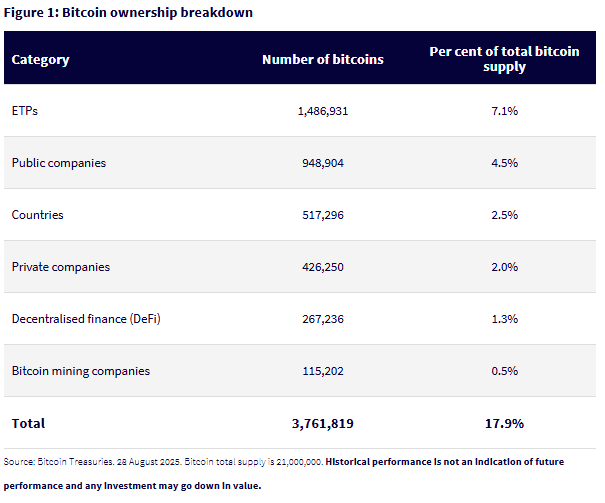
Derivatives markets validate this maturity. The open interest across bitcoin futures and options now exceeds $95 billion, signalling institutional depth, hedging sophistication, and reduced volatility.
And access is set to expand further as the UK Financial Conduct Authority (FCA) is set to allow retail access to Bitcoin and Ethereum ETPs from the start of October 2025. This could be a watershed moment for European mainstream allocation.
Macro tailwinds are blowing
Let’s not sugar-coat the macro backdrop. The US is veering towards fiscal instability:
- Debt above $34 trillion5.
- Deficit exceeding 6% of gross domestic product (GDP)6.
- Trump re-election driving fresh tax cuts and protectionism.
Markets are already pricing in rate cuts by September, and liquidity tailwinds could return fast. The result? Elevated risk of dollar debasement and structural tailwinds for store-of-value assets.
Our base-case model places bitcoin at $250K by 20307, assuming continued monetary expansion. If the US sticks to growth-first policies, that path could accelerate.
Bitcoin is no longer just a hedge. It is a strategic allocation.
Beyond bitcoin: infrastructure matters
The era of “everything pumps” is over. Altcoins are being judged on fundamentals. The market is maturing, and only networks delivering real-world value are gaining traction.
- Solana is becoming crypto’s consumer-grade backbone, dominating in decentralised physical infrastructure (DePIN), Web3 gaming, and low-cost decentralised finance (DeFi). It is not just “fast Ethereum”. It is building a new, leaner stack.
- Ethereum continues to dominate the institutional stack, housing 55%8 of all stablecoin supply and leading in tokenised assets. It is the default settlement layer for on-chain traditional finance (TradFi).
- XRP is surging ahead in cross-border infrastructure, bolstered by US regulatory clarity and real-world deployment as a SWIFT9 alternative.
These are not speculative coins. They are core infrastructure assets for a new financial system.
Clarity through curation: the CoinDesk 20 index
In a fragmented and often chaotic market, the CoinDesk 20 index acts as a beacon. Covering nearly 85%10 of adjusted total crypto market capitalisation, it functions as crypto’s S&P 500.
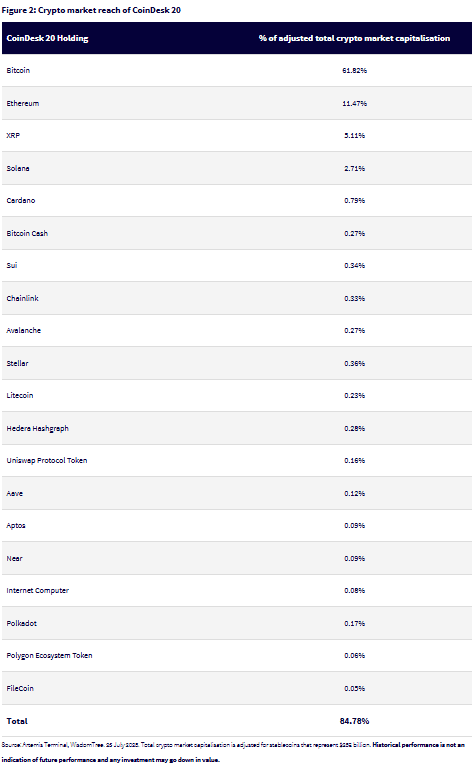
Source: Artemis Terminal, WisdomTree. 23 July 2025. Total crypto market capitalisation is adjusted for stablecoins that represent $258 billion. Historical performance is not an indication of future performance and any investment may go down in value.
The CoinDesk 20 index excludes meme coins and prioritises:
- Liquidity
- Institutional relevance
- Custody compatibility
For allocators seeking efficient exposure without the noise, CoinDesk 20 is the disciplined framework they need. It is designed for scalability and tradability.
What comes next: three unstoppable themes
- DeFi 2.0 is institutionalising: the next evolution of decentralised finance is here, and it looks a lot like traditional finance – only smarter and on-chain. With over $155 billion11 in total value locked (TVL), permissioned DeFi protocols are attracting serious institutional interest, transforming decentralised platforms into real capital markets infrastructure.
- Real-world asset tokenisation is scaling: the bridge between TradFi and DeFi is being built asset by asset. Over $26 billion12 in tokenised treasuries, bonds, and credit instruments are already live on-chain. While Ethereum currently leads the pack, other blockchains are catching up fast in pursuit of this trillion-dollar opportunity.
- Regulatory clarity is picking winners: regulation is no longer the enemy. It is the filter. Europe’s Markets in Crypto-Assets (MiCA) and the US GENIUS Act are setting clearer rules of the road. Networks like Ethereum, Solana, and XRP are best positioned to benefit from this shift, aligning naturally with institutional compliance mandates.
Conclusion
Crypto has finally outgrown its speculative adolescence. The market is no longer rewarding noise. It is rewarding networks, infrastructure, and allocation strategies with real-world relevance. Bitcoin has cemented itself as a strategic reserve asset, altcoins are proving their worth through utility, and regulation is no longer an existential threat but a filter that separates the serious from the unserious.
Allocators who continue to dismiss crypto as a sideshow risk missing the structural shift now underway: from speculative cycles to systemic integration. The next decade will not be defined by hype-driven manias but by disciplined adoption, institutional-grade infrastructure, and regulatory clarity that legitimises the winners.
Sources:
1Source: Artemis Terminal. 28 August 2025.
2Source: Bloomberg, WisdomTree. 01 August 2025.
3Source: Bloomberg, WisdomTree. 01 August 2025.
4Source: Bitcoin Treasuries. 28 August 2025. https://bitbo.io/treasuries/countries/
5Source: Congressional Budget Office. The Long-Term Budget Outlook: 2025 to 2055.
6Source: Congressional Budget Office. The Long-Term Budget Outlook: 2025 to 2055.
7Source: WisdomTree. June 2025. Bitcoin and gold: 3 model forecasts for 2030 and beyond
8Source: Artemis Terminal. 23 July 2025. Refers to stablecoin supply issued on Ethereum-based protocols.
9SWIFT = Society for Worldwide Interbank Financial Telecommunication.
10Source: Artemis Terminal, WisdomTree. 23 July 2025. The total crypto market capitalisation of $4,050 billion is adjusted for stablecoins that represent $258 billion of the total crypto market capitalisation.
11Source: Coingecko. 28 August 2025.
12Source: rwa.xyz. 28 August 2025.
Important Risks Related to this Article
Crypto assets, such as bitcoin and ether, are complex, generally exhibit extreme price volatility and unpredictability, and should be viewed as highly speculative assets. Crypto assets are frequently referred to as crypto “currencies,” but they typically operate without central authority or banks, are not backed by any government or issuing entity (i.e., no right of recourse), have no government or insurance protections, are not legal tender and have limited or no usability as compared to fiat currencies. Federal, state or foreign governments may restrict the use, transfer, exchange and value of crypto assets, and regulation in the U.S. and worldwide is still developing. Crypto asset exchanges and/or settlement facilities may stop operating, permanently shut down or experience issues due to security breaches, fraud, insolvency, market manipulation, market surveillance, KYC/AML (know your customer/anti-money laundering) procedures, non-compliance with applicable rules and regulations, technical glitches, hackers, malware or other reasons, which could negatively impact the price of any cryptocurrency traded on such exchanges or reliant on a settlement facility or otherwise may prevent access or use of the crypto asset. Crypto assets can experience unique events, such as forks or airdrops, which can impact the value and functionality of the crypto asset. Crypto asset transactions are generally irreversible, which means that a crypto asset may be unrecoverable in instances where: (i) it is sent to an incorrect address, (ii) the incorrect amount is sent, or (iii) transactions are made fraudulently from an account. A crypto asset may decline in popularity, acceptance or use, thereby impairing its price, and the price of a crypto asset may also be impacted by the transactions of a small number of holders of such crypto asset. Crypto assets may be difficult to value and valuations, even for the same crypto asset, may differ significantly by pricing source or otherwise be suspect due to market fragmentation, illiquidity, volatility and the potential for manipulation. Crypto assets generally rely on blockchain technology and blockchain technology is a relatively new and untested technology which operates as a distributed ledger. Blockchain systems could be subject to internet connectivity disruptions, consensus failures or cybersecurity attacks, and the date or time that you initiate a transaction may be different then when it is recorded on the blockchain. Access to a given blockchain requires an individualized key, which, if compromised, could result in loss due to theft, destruction or inaccessibility. In addition, different crypto assets exhibit different characteristics, use cases and risk profiles. Information provided by WisdomTree regarding digital assets, crypto assets or blockchain networks should not be considered or relied upon as investment or other advice, as a recommendation from WisdomTree, including regarding the use or suitability of any particular digital asset, crypto asset, blockchain network or any particular strategy.
Categories
Perspectives in Onchain Finance
View all

About the contributors

Dovile Silenskyte
Director, Digital Assets Research
Dovile Silenskyte is a director of digital assets research at WisdomTree. Before joining WisdomTree in May 2024, Dovile worked as an index equity product strategist at BlackRock. Currently, she is responsible for conducting analyses for in-house digital assets publications and assisting the sales team with client queries about products and markets. Dovile holds an MSc in Finance from Texas A&M University – Commerce, and she is also a chartered financial analyst (CFA).

Blake Heimann
Associate Director, Quantitative Research
Blake Heimann joined WisdomTree in 2020 and supports the creation, maintenance, and reconstitution of WisdomTree’s indices. Blake began his career in finance in 2017 as an Analyst at TD Ameritrade and, later, a Quantitative Analyst with a focus on the development of machine learning applications in finance.
Blake has bachelor’s degrees in Mathematics and Economics from Iowa State University, as well as a master’s in Computer Science from Georgia Tech, with a specialisation in Machine Learning. He is currently pursuing a master’s in Finance from the London School of Economics
Thought Leaders

Alice Liu
Senior Associate, Cryptocurrency Investments, WisdomTree Europe

Andrew Okrongly, CFA
Director, Model Portfolios

Blake Heimann
Associate Director, Quantitative Research

Christopher Gannatti, CFA
Global Head of Research

Chris Ryder
Head of WisdomTree Transfers

Dovile Silenskyte
Director, Digital Assets Research

Jason Guthrie
Director of Capital Markets, WisdomTree Europe

Jeff Weniger, CFA
Head of Equity Strategy

Jeremy J. Siegel
WisdomTree Senior Economist

Jeremy Schwartz, CFA
Global Chief Investment Officer

Kevin Flanagan
Head of Investment and Fixed Income Strategy

Mobeen Tahir
Director, Macroeconomics and Thematic Research

Nitesh Shah
Head of Commodities and Macroeconomic Research, WisdomTree Europe

Pierre Debru
Head of Research, Europe

Rick Harper
Chief Investment Officer, Fixed Income and Model Portfolios

Rohan Ranadive
Chief Risk Officer, WisdomTree Digital Assets

Samuel Rines
Macro Strategist, Model Portfolios

Vinh Tran
Associate Director, Business Development, Digital Assets

Will Peck
Head of WisdomTree Onchain

WisdomTree Onchain
Contributor
Alice Liu
Senior Associate, Cryptocurrency Investments, WisdomTree Europe
Andrew Okrongly, CFA
Director, Model Portfolios
Blake Heimann
Associate Director, Quantitative Research
Christopher Gannatti, CFA
Global Head of Research
Chris Ryder
Head of WisdomTree Transfers
Dovile Silenskyte
Director, Digital Assets Research
Jason Guthrie
Director of Capital Markets, WisdomTree Europe
Jeff Weniger, CFA
Head of Equity Strategy
Jeremy J. Siegel
WisdomTree Senior Economist
Jeremy Schwartz, CFA
Global Chief Investment Officer
Kevin Flanagan
Head of Investment and Fixed Income Strategy
Mobeen Tahir
Director, Macroeconomics and Thematic Research
Nitesh Shah
Head of Commodities and Macroeconomic Research, WisdomTree Europe
Pierre Debru
Head of Research, Europe
Rick Harper
Chief Investment Officer, Fixed Income and Model Portfolios
Rohan Ranadive
Chief Risk Officer, WisdomTree Digital Assets
Samuel Rines
Macro Strategist, Model Portfolios
Vinh Tran
Associate Director, Business Development, Digital Assets
Will Peck
Head of WisdomTree Onchain
WisdomTree Onchain
Contributor