


Treasury Yields: How Low Can We Go?
Published September 10, 2025

Kevin Flanagan
Head of Investment and Fixed Income Strategy
Key Takeaways
- Treasury yields fell sharply following a softer August jobs report, with the U.S. 2-year treasury now fully pricing in three Fed rate cuts.
- While the Fed is likely to cut rates in September, the decision-making process going forward is still highly data-dependent.
- With the UST 10-year yield near 4%, a sustained rally toward 2024’s lows appears unlikely unless recession risks escalate further.
It’s no understatement to say this could have been the most anticipated jobs report in quite some time. While it was not necessarily a referendum on whether the Fed would cut rates in a week or so, it was being viewed as perhaps the final input for Powell & Co. The overall report did confirm labor market activity is cooling, but it also seemed to confirm NY Fed Prez Williams’ description of a “no hire, no fire” jobs setting.
In terms of the upcoming Federal Open Market Committee (FOMC) meeting, in my opinion, the tenor of the August employment report confirms a 25-basis-point (bp) rate cut at the September FOMC meeting. Is a 50-bp rate cut completely ruled out? Not necessarily, but Powell & Co. have given no guidance on that front up to now. In fact, a negative payroll print would have made for a better argument for a 50-bp point cut. As for the remainder of 2025, an additional rate cut, or maybe two, is certainly now on the table, but once again, the Fed’s decision-making process will remain data-dependent with policy tilted more toward the employment aspect of its dual mandate.
Figure 1: U.S. Treasury Yields
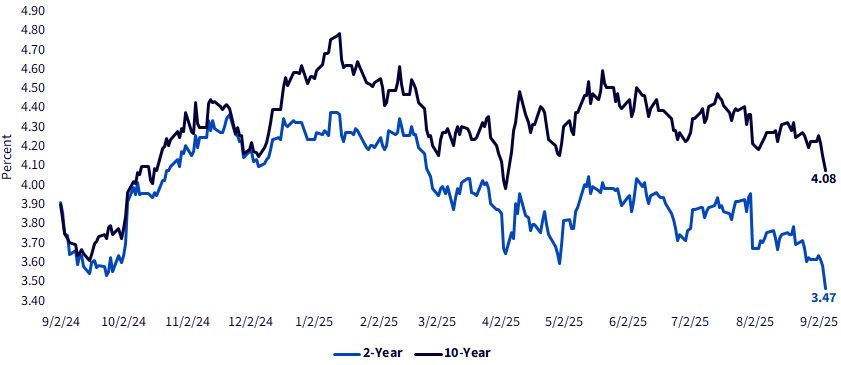
Source: Bloomberg, as of 9/5/25.
So, where can Treasury (UST) yields go in this environment? Treasuries rallied going into the jobs report, and the data provided the platform for this rally to continue post-release. As a result, the UST 10-yr yield fell to 4.08% while the 2-yr rate came in under the 3.50% threshold, as of this writing.
At these levels, the UST 2-yr yield is fully priced for three rate cuts and actually fell below the low watermark of 3.54% that was registered following the Fed’s 50-bp rate cut at the September 2024 FOMC meeting. However, the 10-yr yield has not experienced the same type of déjà vu. Indeed, at this time last year, the UST 10-yr yield fell to almost 3.60%, based on the increasing recession odds at that time. We’re not there at this point in terms of recession expectations.
That is an important consideration when trying to determine the upcoming movement in the 10-year yield. While rallies and sell-offs can overshoot in either direction, unless upcoming economic data shifts the outlook for a potential recession, it would appear as if the UST 10-yr rally could run out of gas. In other words, getting back to the 3.60% level would more than likely not occur.
Bottom Line
The key takeaway going forward is that Treasury yields don’t necessarily move in the same direction or with the same magnitude. With the UST 10-yr yield flirting with the 4% threshold, there is little margin for error if the economy can avoid an outright downturn.
Categories

About the contributor

Kevin Flanagan
Head of Investment and Fixed Income Strategy
Kevin serves as the Head of Investment and Fixed Income Strategy. In this role, he writes macro and fixed income-related content and works closely with the sales, research and marketing teams. In addition, Kevin conducts client-facing webinars and meetings, providing expertise on WisdomTree’s existing and future bond ETFs. Prior to joining WisdomTree, Kevin spent 30 years at Morgan Stanley, where he was Managing Director and Chief Fixed Income Strategist for Wealth Management. He was responsible for tactical and strategic recommendations and created asset allocation models for fixed income securities. He was a contributor to the Morgan Stanley Wealth Management Global Investment Committee, primary author of Morgan Stanley Wealth Management’s monthly and weekly fixed income publications, and collaborated with the firm’s Research and Consulting Group Divisions to build ETF and fund manager asset allocation models. Kevin has an MBA from Pace University’s Lubin Graduate School of Business, and a B.S. in Finance from Fairfield University.