


Margins, Mid-Caps and Market Resilience
Published September 10, 2025

Ryan Krystopowicz, CFA
Head of RIA Portfolio Solutions Distribution & Specialists

Brian Manby, CFA
Equity Strategist
Key Takeaways
- In a 2025 market dominated by tariff and inflation concerns, mid-caps have preserved profit margins near 30-year medians, highlighting their operational adaptability.
- While AI headlines center on large-cap growth, mid-sized companies are leveraging it as a margin defense tool, offsetting wage and input cost pressures through faster tech integration.
- Despite their resilience and balanced growth potential, mid-caps remain underrepresented in most portfolios, offering advisors a compelling opportunity to enhance diversification and valuation efficiency.
In a recent LinkedIn newsletter, we highlighted how mid-caps have historically delivered a compelling mix of growth and resilience, the "sweet spot" between innovation and maturity. They've graduated from the start-up phase, proven profitability and often trade at more reasonable valuations than their large-cap peers, while still delivering stronger earnings growth than small caps.
In this follow-up, we want to take that conversation a step further. Beyond the long-term track record of mid-caps, today's environment adds another reason for advisors to revisit the segment: their resilience in navigating policy shocks, cost pressures and market uncertainty.
Resilience under Tariff and Inflation Pressures
Much of the conversation around equity markets in 2025 has focused on tariffs and inflation. Headlines warn of margin erosion, yet mid-caps are holding up surprisingly well.
The S&P MidCap 400 Index currently shows a profit margin of about 6.7%, essentially unchanged from 2024 and comfortably above its 30-year median. This is a reminder of mid-caps' ability to adapt. They may lack the scale of mega-caps, but they often run leaner, more flexible operations that can adjust pricing, shift supply chains and preserve profitability in difficult environments.
No Sign of Tariffs Eroding Mid-Cap Margins
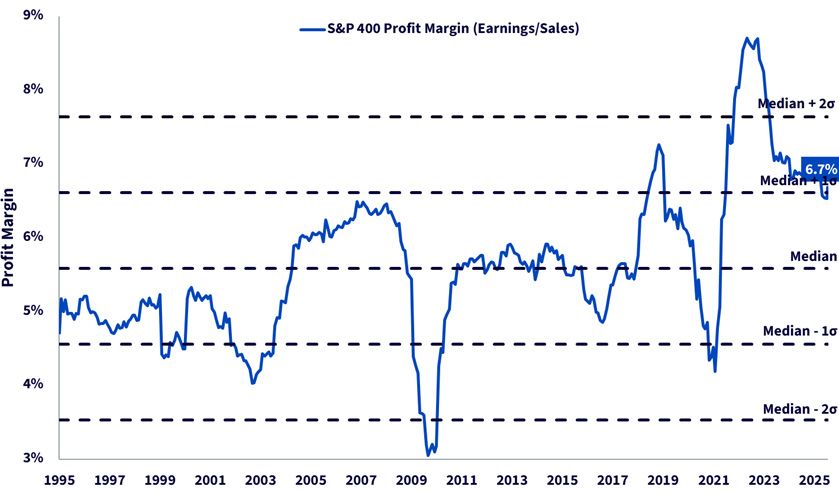
Source: WisdomTree, S&P, FactSet, as of 8/15/25. You cannot invest directly in an index.
AI beyond Growth: A Cost-Defense Tool
AI has become synonymous with large-cap technology growth stories. But its real potential may be in cost containment across traditional industries.
As WisdomTree Senior Economist Professor Jeremy Siegel has noted, productivity gains from AI are not confined to Silicon Valley. Mid-sized companies, with leaner structures and fewer legacy systems, can often integrate new technologies faster, helping offset wage pressures, tariffs and other input costs.
For advisors, this reframes AI as more than a growth catalyst. In the mid-cap space, it can also serve as a margin defense mechanism, a distinct advantage in today's inflationary environment.
The Advisor Blind Spot
Despite this resilience, mid-caps remain underrepresented in many advisor portfolios. In consultations, we often find they make up less than 5% of total equity exposure, typically buried in broad blend sleeves.
This is usually unintentional, driven by the gravitational pull of large-cap benchmarks like the S&P 500. But under-weighting to mid-caps leaves portfolios overly concentrated at the top of the market and missing out on a segment that combines profitability, adaptability and more attractive valuations.
A Streamlined Approach to Mid-Cap Allocation
For advisors looking to restore balance, the path doesn't need to be complicated:
- Carve out a sleeve for mid-caps rather than letting them get lost inside blend funds.
- Rebalance over-weights to largecaps to create more even exposure across the size spectrum.
- Consider valuation and style balance to ensure mid-caps play their full role between growth-heavy large caps and more volatile small caps.
For example, funds that emphasize shareholder yield and quality screens, like the WisdomTree U.S. Value Fund (WTV), offer one way to reintroduce mid-caps thoughtfully. But more important than any single vehicle is the principle of giving mid-caps deliberate space in a portfolio, rather than letting them remain an afterthought.
The Case for Mid-Caps in 2025
Mid-caps aren't just a bridge between large and small. They are a distinct asset class with unique advantages. Their ability to maintain profitability under tariff and inflation pressures, coupled with the potential to harness AI as both a growth engine and a cost-defense tool, makes them well-suited for today's market environment.
After years of being overlooked, mid-caps may be ready to re-enter the spotlight. For advisors seeking resilience, diversification and balance, this is a segment worth revisiting.
For those interested in more insights like this on asset allocation and practice management, make sure to register for the Modern Advisor Playbook LinkedIn Newsletter, authored by Ryan and rotating guest WisdomTree thought leaders.
Important Risks Related to this Article
There are risks associated with investing, including the possible loss of principal. Funds focusing their investments on certain sectors increase their vulnerability to any single economic or regulatory development. This may result in greater share price volatility. While the Fund is actively managed, the Fund’s investment process is expected to be heavily dependent on quantitative models and the models may not perform as intended. Please read the Fund’s prospectus for specific details regarding the Fund’s risk profile.
Categories
About the contributors

Ryan Krystopowicz, CFA
Head of RIA Portfolio Solutions Distribution & Specialists
Ryan drives the commercialization of model portfolio solutions and supports advisor growth strategies. He plays a central role in WisdomTree’s Model Portfolio Research Study, advancing insights on model adoption, advisor behavior and prospecting opportunities. Ryan's passion for third-party model portfolios and investment outsourcing was cultivated during his tenure at a Registered Investment Advisor, where he held roles across research and operations. He also brings WisdomTree’s research on advisor online presence to life through high-impact programming that turns key findings into practical guidance for improving digital credibility and prospect engagement. Ryan is a CFA charterholder and a graduate of Loyola University of Maryland.

Brian Manby, CFA
Equity Strategist
Brian Manby is an Equity Strategist at WisdomTree and part of the Investment Strategy team.
He is responsible for developing and communicating equity market insights, investment themes, and portfolio strategies that support the firm’s ETF and investment solutions platform. He evaluates sectors, valuations, fundamentals and equity styles to identify investment opportunities and provide actionable perspectives to clients and advisors. He also helps investors understand how WisdomTree’s equity strategies can be used to achieve long-term investment objectives in evolving market environments.
Brian joined WisdomTree in October 2018 as an Investment Strategy Analyst after a few years as a Consultant for FactSet Research Systems, Inc. He earned a B.A. in Economics and Political Science from the University of Connecticut in 2016 and has been a Chartered Financial Analyst since 2022.