


A Global Aversion for Long Duration
Published May 28, 2025

Kevin Flanagan
Head of Investment and Fixed Income Strategy
Key Takeaways
- The recent spike in U.S. 30-Year bond yields reflects investor concerns over long-term debt sustainability and fiscal policy shifts.
- Rising 30-Year yields in other major economies like Germany and Japan point to a global aversion to long duration, not just a U.S.-specific issue.
- Despite current volatility, 5% yields may represent a return to historical norms rather than a sign of runaway risk.
Last week, the U.S. Treasury (UST) market witnessed a rather volatile period of trading activity. Of course, things got started with the market digesting the news of Moody’s “one-notch” downgrade of the U.S. credit rating, which was then followed up with news that the House of Representatives had passed the “big, beautiful bill” pertaining to potential future fiscal policy. These two events put tariff-related concerns on the back burner and raised investor anxieties about swelling deficits and increased supply, i.e., debt sustainability.
Typically, the focus of government bond markets is the 10-Year maturity. However, when deficits, attendant supply and debt servicing enter into the conversation, the focus tends to shift more to the longer end of the yield curve, or the 30-Year sector. Why? Because when debt sustainability concerns enter the fray, longer-dated maturities are viewed as potentially the most vulnerable. In other words, what would the federal government have to pay investors to buy their debt for the long run in order to compensate them for this added risk?
Needless to say, at the height of last week’s trading activity, the UST 30-Year bond was generating the lion’s share of the headlines as the yield eclipsed the 5% threshold for the first time since October 2023, when it peaked at 5.11%. Interestingly, at that time, there were concerns regarding the budget deficit and supply as the Treasury debt managers raised the sizes of UST note and bond auctions. Couple that with a Fed that had just finished its aggressive rate hike cycle, and voila, you have 30-Year and 10-Year yields that are 5% at the time.
Now let’s forward to this latest episode, where you have concerns about deficits, Treasury debt loads and a Fed that is showing no signs of pre-emptively cutting rates, and the next thing you know, the 30-Year bond yield topped out at 5.15% in intraday trading, before finishing the week at 5.04%. Interestingly, the 10-Year yield didn’t come close to the 5% threshold, as it peaked at 4.62% and finished only +3 bps higher week/week.
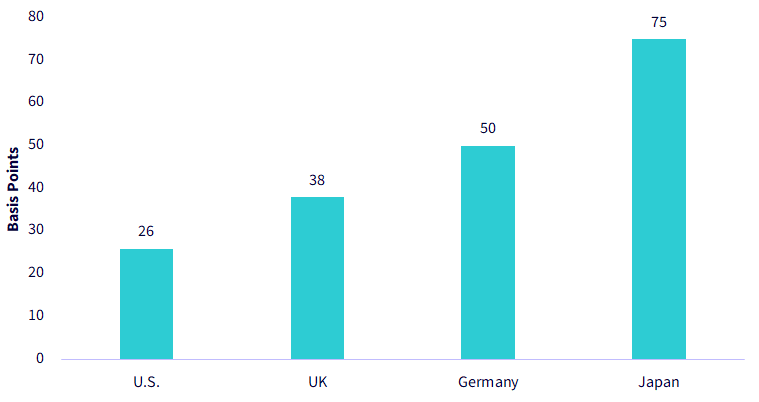
Change in 30-Year Yields Year-to-Date
Source: Bloomberg, as of 5/23/25.
What is more interesting, though, is that the rise in 30-Year yields is not just a U.S. phenomenon. Indeed, in three of the other largest developed sovereign debt markets, the respective 30-Years have also witnessed visible yield increases year-to-date. As the graph included here illustrates, the UK, Germany and Japan 30-Year bond yields have risen anywhere from +38 bps to +75 bps. In contrast, the UST 30-Year rate has risen by a more modest +26 bps.
Digging a little deeper, you can see that the increases in Germany and Japan’s respective 30-Year yields have been two and three times the size of the rise for the U.S. long bond. Were their credit ratings downgraded by Moody’s in the last week or so? Of course not. However, in the case of Germany, its federal government did recently vote for a massive increase in government borrowing to alter its “debt brake,” a rather visible shift in its own fiscal outlook.
To also provide some perspective, a “5%” handle on the UST 30-Year bond is part of our theme of rates returning to normal. From 1988–2007, the average yield was 6.41%. When zero interest rates and negative rates abroad showed up during the 2010–2021 period, the average yield plummeted to an “abnormal” 2.96%. Based on economist forecasts I’ve seen, even if the “big, beautiful bill” becomes law—remember, the Senate still has to weigh in—the fiscal year 2026 budget deficit is not projected to increase by an astronomical amount. Those $3 trillion to $5 trillion increase in debt projections? They are 10-year estimates.
Is the U.S. fiscal path sustainable in the long run? I’m definitely in the “no” camp. However, in the nearer term, if the Treasury debt managers manage to keep note and bond auction sizes relatively constant over the next year, the fundamentals will, as is usually the case, return to prominence.
Conclusion
In my opinion, what we may be seeing now is just a global aversion to long duration.
Categories

About the contributor

Kevin Flanagan
Head of Investment and Fixed Income Strategy
Kevin serves as the Head of Investment and Fixed Income Strategy. In this role, he writes macro and fixed income-related content and works closely with the sales, research and marketing teams. In addition, Kevin conducts client-facing webinars and meetings, providing expertise on WisdomTree’s existing and future bond ETFs. Prior to joining WisdomTree, Kevin spent 30 years at Morgan Stanley, where he was Managing Director and Chief Fixed Income Strategist for Wealth Management. He was responsible for tactical and strategic recommendations and created asset allocation models for fixed income securities. He was a contributor to the Morgan Stanley Wealth Management Global Investment Committee, primary author of Morgan Stanley Wealth Management’s monthly and weekly fixed income publications, and collaborated with the firm’s Research and Consulting Group Divisions to build ETF and fund manager asset allocation models. Kevin has an MBA from Pace University’s Lubin Graduate School of Business, and a B.S. in Finance from Fairfield University.