
USFR
Floating Rate Treasury Fund

Published May 14, 2025

Head of Investment and Fixed Income Strategy
Our overarching theme for U.S. fixed income has been, and will continue to be, based on the premise that interest rates will stay at more historically “normal” levels, but that, within this backdrop, investors will face heightened volatility. Without a doubt, looking at the U.S. Treasury (UST) market’s behavior through the first four months of the year, this landscape has been underscored. As a result, fixed income investors will need to make some potentially challenging investment decisions, where at first glance, a solution may seem like a suitable one, but when uncertainty enters the mix, an unexpected result could occur.
Source: Bloomberg, as of 5/7/23.
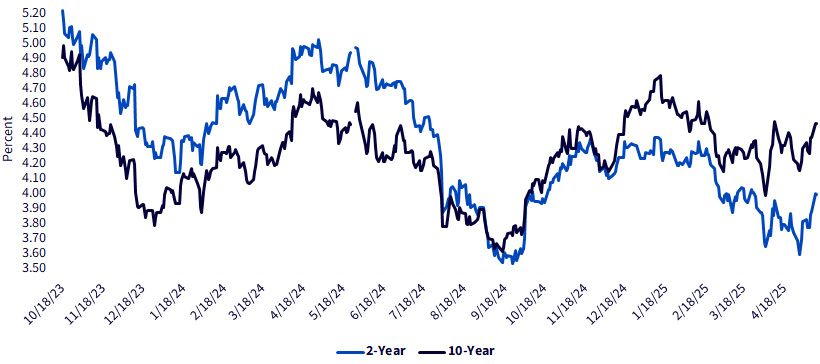
Let’s first take a look at some of that volatility I just mentioned. Since reaching their near-term peak readings around mid-October 2023, Treasury fixed coupon yields have experienced a roller-coaster ride, to say the least. In addition, even within these broader ups and downs, yield levels have shown visible sawtooth patterns as well.
It is also important to note that no sector of the Treasury fixed coupon curve was spared. As the graph illustrates, both shorter- and longer-dated maturities experienced the same results. As you can see, this short- and long-run volatility has continued right up until this writing here in 2025.
The only sector of Treasuries that has not been subject to this volatility is floating rate notes (FRNs). UST FRNs are reset with the weekly 3-month t-bill auction, plus a spread, and as a result, are anchored by the Fed Funds Rate and not impacted by speculative trading activity. Thus, tariff uncertainty and recession and/or inflation fears are not part of the daily trading mechanism that the fixed coupon maturities are confronted with.
Oftentimes, when bond investors are looking to use ultra-short duration as a hedge against volatility, they consider using structures that, unlike UST FRNs, are not 100% Treasuries, but rather are concentrated with either corporate credit or collateralized loan obligations (CLOs). Interestingly, these types of vehicles entail both a rate and credit component as a result.
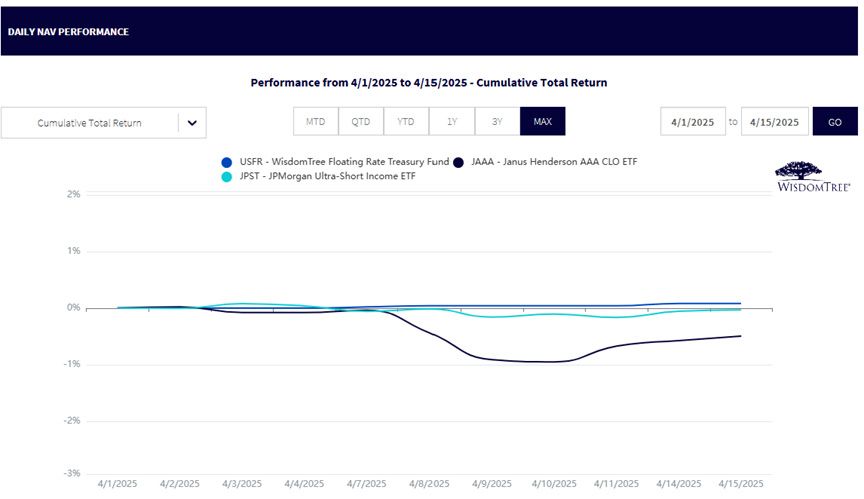
While ultra-short credit and/or CLO instruments can offer somewhat higher yields than Treasury FRNs, there is a reason: potential credit risk. Relatively recently, markets have witnessed a period where the credit component can overtake the duration aspect of a fund, specifically during a risk-off episode. Obviously, I’m referring to the post-Liberation Day sell-off where two of the largest and most well-known funds in the ultra-short credit and CLOs bucket, JPMorgan Ultra-Short Income ETF (JPST) and Janus Henderson AAA CLO ETF (JAAA), experienced negative returns, but the WisdomTree Floating Rate Treasury Fund (USFR) did not.
Source: Bloomberg, as of 5/12/23. Past performance is not indicative of future results. Investment return and principal value of an investment will fluctuate so that an investor’s shares, when redeemed, may be worth more or less than their original cost. Current performance may be lower or higher than the performance data quoted. For the most recent month-end and standardized performances, click the relevant ticker: USFR, JAAA, JPST.
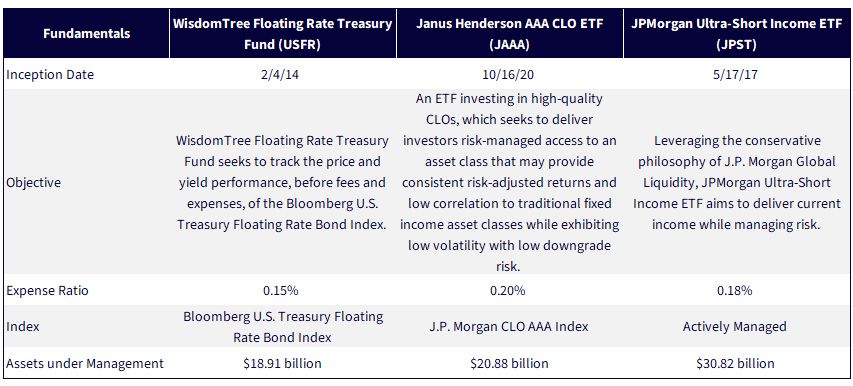
While this period of negative activity may have been somewhat short-lived, investors who put their funds in the ultra-short duration bucket are not expecting to see potential statement risk. Treasury FRNs are direct obligations of the U.S. government and do not carry that type of credit risk. USFR is a means to invest in the ultra-short duration bucket with exposures only to Treasury FRNs.
Sources: WisdomTree, Janus Henderson, J.P. Morgan, as of 5/14/25.
USFR: There are risks associated with investing, including the possible loss of principal. Securities with floating rates can be less sensitive to interest rate changes than securities with fixed interest rates, but may decline in value. Fixed income securities will normally decline in value as interest rates rise. The value of an investment in the Fund may change quickly and without warning in response to issuer or counterparty defaults and changes in the credit ratings of the Fund’s portfolio investments. Due to the investment strategy of this Fund it may make higher capital gain distributions than other ETFs. Please read the Fund’s prospectus for specific details regarding the Fund’s risk profile.
JAAA: The biggest risk is that the Fund’s returns and yields will vary, and you could lose money.
JPST: Investments in asset-backed, mortgage-related and mortgage-backed securities are subject to certain risks including prepayment and call risks, resulting in an unexpected capital loss and/or a decrease in the amount of dividends and yield. During periods of difficult credit markets, significant changes in interest rates or deteriorating economic conditions, such securities may decline in value, face valuation difficulties, become more volatile and/or become illiquid.
Floating Rate Treasury Fund

Head of Investment and Fixed Income Strategy
Kevin serves as the Head of Investment and Fixed Income Strategy. In this role, he writes macro and fixed income-related content and works closely with the sales, research and marketing teams. In addition, Kevin conducts client-facing webinars and meetings, providing expertise on WisdomTree’s existing and future bond ETFs. Prior to joining WisdomTree, Kevin spent 30 years at Morgan Stanley, where he was Managing Director and Chief Fixed Income Strategist for Wealth Management. He was responsible for tactical and strategic recommendations and created asset allocation models for fixed income securities. He was a contributor to the Morgan Stanley Wealth Management Global Investment Committee, primary author of Morgan Stanley Wealth Management’s monthly and weekly fixed income publications, and collaborated with the firm’s Research and Consulting Group Divisions to build ETF and fund manager asset allocation models. Kevin has an MBA from Pace University’s Lubin Graduate School of Business, and a B.S. in Finance from Fairfield University.

