

Mostly Dead: The Twilight of Price over Volume
Published May 29, 2025

Macro Strategist, Model Portfolios

Head of Equity Strategy
Key Takeaways
- In Q2 2025, companies like Pepsi and P&G showed that the era of aggressive price hikes covering for volume declines, known as “Price over Volume” (PoV), is waning as elasticity and consumer resistance grow amid new tariffs.
- Despite strong brands still wielding some pricing power, the easy PoV gains of 2021–2023 are over, with inflation fatigue and tariff-induced cost pressures shifting the balance of power back to the consumer.
- WisdomTree’s U.S. equity mandates, with their higher-than-benchmark profit margins, may offer investors a buffer in a PoV 2.0 world, where defending margins while regaining volume is key to outperformance.
“Price over Volume” (PoV) had its Princess Bride moment. In the cult classic movie, the characters take their friend’s dead body to a quirky healer. “It just so happens that your friend here is only mostly dead. There’s a big difference between mostly dead and all dead. Mostly dead is slightly alive.”
“Mostly dead” is what happened to Price over Volume, especially among consumer goods companies. In recent years, many drove revenue growth predominantly by raising prices, with minimal concern for slight volume declines.
Now, amid tariff fears, earnings season raised the question: Is it still a PoV World? Or are volume pressures finally starting to bite? The answer, it seems, is a bit of both: pricing power remains a growth lever, but volumes are showing strain. The new tariff regime is set to test the limits of pricing power further. Companies are still managing to push through price gains, but elasticity is no longer negligible. And tariffs threaten to raise input costs, squeezing margins.
We checked in on our U.S. equity mandates. Every one of them has higher net profit margins than their respective Morningstar benchmarks (figure 1). If the Price over Volume world is over, or simply dented, our holdings would seemingly have an extra buffer because of their thick profit margins.
Figure 1: Our U.S. Equity Mandates Have Higher Net Margins than Their Russell Benchmarks
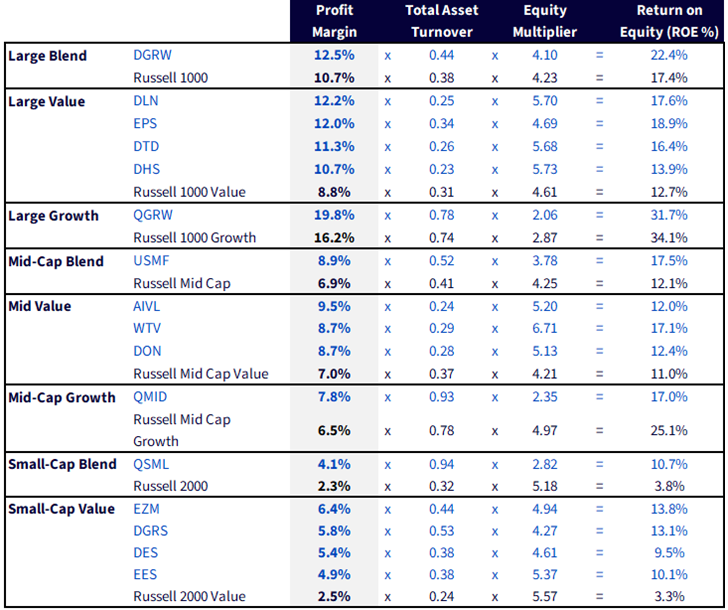
Source: WisdomTree PATH software, as of 4/30/25. Note that some Funds are classified by Morningstar in a different style box than the view of WisdomTree Research.
Pepsi provides a cool PoV case study. A few years ago, the company was a clear front-runner in its ability to ratchet up prices without sacrificing volumes. That has changed. Notably, the company’s snack segment (PepsiCo Foods North America—“PFNA”) saw volume fall 3% in its latest earnings report. Pricing? That was only up 1%.
Granted, pricing power has not evaporated—consumers are still paying up for Doritos and soda, with total volume declines of 2% offset by a 3% jump in prices (figure 2). But that does not make for an overly inspiring PoV narrative.
Figure 2: PepsiCo Earnings Release, 4/24/25
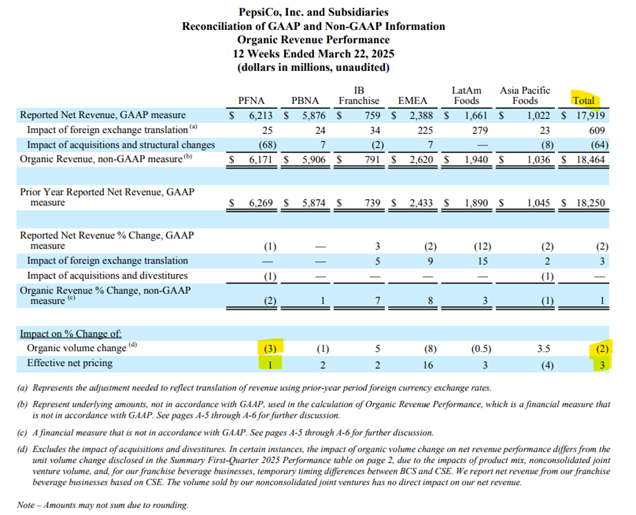
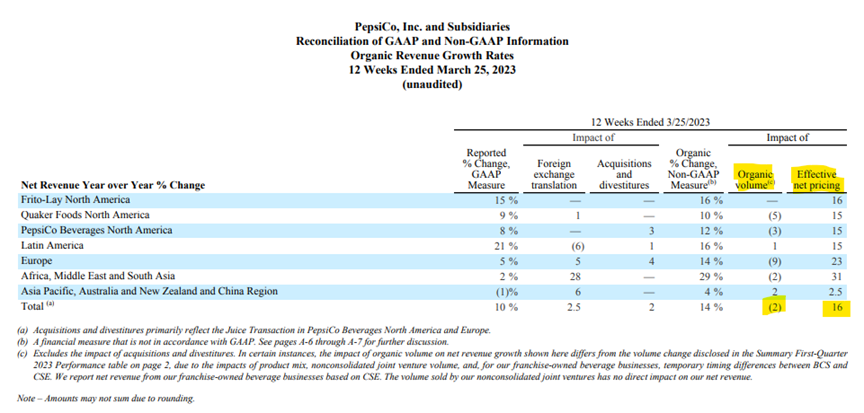
The era of double-digit price jumps is clearly over; this quarter’s low-single-digit pricing increase is a far cry from the peak PoV era. Not long ago—during the same quarter in 2023—Pepsi also reported a 2% decline in volume amid price increases of 16% (figure 3). That was the golden age of PoV. To re-reference The Princess Bride, Pepsi’s PoV thesis is mostly dead. Yes, price hikes are still covering for volume weakness, but the game has changed.
Figure 3: PepsiCo Earnings Release, 4/25/23
Though Pepsi does not instill much confidence in the return of PoV, Procter & Gamble gives the concept a twist. The company’s explicit statement is that price hikes are a tool to offset tariff pressures. Like Pepsi, P&G also faces the issue of competition from the post-COVID-19 boom in private labels, so the company is far from an example of PoV being alive and well. Instead, it’s an example of the emerging trend of companies threatening to return to PoV. It looks like some firms may start to take a blade to operating costs to maintain margins. If there is a hint of life for PoV, it is because tariffs are lighting a fire under companies to revive the “mostly dead” patient.
The play is clear, at least to us: raise prices, then blame it on import duties.
Figure 4: P&G Earnings Call, 4/24/25
Andre Schulten
Chief Financial Officer
Good morning, Andrea. Yes, the $1 billion to $1.5 billion before tax is the impact that we are estimating based on what we know today. That means the tariff rates that have been announced and enacted both in the U.S. and in all other markets in response to the U.S. tariffs. Exactly as you say, that's about 3% of cost of goods sold, about 140 to 180 basis points margin impact. The point -- this is not an average discussion, though, right? Because the impact is on certain SKUs, on certain brands and certain category country combinations.
So when we average this out across the globe, the numbers that you quote are correct. But if you look at certain market category combinations, the numbers in terms of pricing are way more significant that we would have to take net of what we believe we can deliver in productivity and other mitigating factors. So that's exactly the work that the teams are doing now. And that's why we keep all of the tools on the table. We will start with productivity. We will look at sourcing changes and formulation changes, which typically take longer. We will look at pricing with innovation, and we will look at straight pricing. All of those elements are on the table, and we're working through them right now.
Tariffs act as a supply chain shock, but we have been here before.
Into late 2025 and perhaps 2026, the combination of still-robust consumer health and the lingering inflationary mindset from the COVID-19 supply chain muck-up might make it relatively easy for companies to pass through some tariff-related inflation. But price-sensitive shoppers will switch to off-price or discounted items if markups get out of control.
The tug-of-war between a still-healthy job market (which supports spending) and inflation exhaustion (which limits consumers’ willingness to spend) creates a mixed picture for the success of PoV going forward. For now, staples companies are betting that their products are sufficiently nondiscretionary to avoid a volume collapse. Again, Price over Volume is only mostly dead.
At the moment, the 2021–2023 PoV theme is not surging back. That dynamic, pushing prices aggressively and in turn bolstering revenues and margins with only moderate hits to product volumes, is over. But this does appear to be an era of PoV 2.0. There will be attempts to push prices up, but those will prove problematic for volumes. The easy gains are gone.
The PoV thesis isn’t completely dead— pricing power always matters for strong brands—but it’s no longer a blank check. The balance of power is tilting back toward the consumer, slowly but surely. Whether it’s snacks and sodas, the message is consistent: future earnings will depend on winning back volume growth (or at least keeping volumes flat) while defending margins from both inflation and tariffs. Striking that balance will determine who thrives in the mostly dead PoV landscape. Companies that can maintain pricing discipline and entice customers with value will emerge on solid ground. Those who misjudge the new regime risk learning the hard way that volume, in the end, does matter after all.
If you’re interested in more commentary from Sam and Jeff, they are regular contributors to the Behind the Markets podcast, featuring Jeremy Schwartz, Jeremy Siegel and Chris Gannatti, where they discuss timely market insights and themes.
Important Risks Related to this Article
Full Fund names from figure 1:
- DGRW: WisdomTree U.S. Quality Dividend Growth Fund
- DLN: WisdomTree U.S. LargeCap Dividend Fund
- EPS: WisdomTree U.S. LargeCap Fund
- DTD: WisdomTree U.S. Total Dividend Fund
- DHS: WisdomTree U.S. High Dividend Fund
- QGRW: WisdomTree U.S. Quality Growth Fund
- USMF: WisdomTree U.S. Multifactor Fund
- AIVL: WisdomTree U.S. AI Enhanced Value Fund
- WTV: WisdomTree U.S. Value Fund
- DON: WisdomTree U.S. MidCap Dividend Fund
- QMID: WisdomTree U.S. MidCap Quality Growth Fund
- QSML: WisdomTree U.S. SmallCap Quality Growth Fund
- EZM: WisdomTree U.S. MidCap Fund
- DGRS: WisdomTree U.S. SmallCap Quality Dividend Growth Fund
- DES: WisdomTree U.S. SmallCap Dividend Fund
- EES: WisdomTree U.S. SmallCap Fund
For current holdings, please click the respective ticker: DGRW, DLN, EPS, DTD, DHS, QGRW, USMF, AIVL, WTV, DON, QMID, QSML, EZM, DGRS, DES, EES. Holdings are subject to risk and change.
DGRW / DLN / DTD / DHS / DON / DGRS / DES: Funds focusing their investments on certain sectors and/or smaller companies increase their vulnerability to any single economic or regulatory development. This may result in greater share price volatility. Dividends are not guaranteed, and a company currently paying dividends may cease paying dividends at any time.
EPS / EZM / EES: Funds focusing their investments on certain sectors and/or smaller companies increase their vulnerability to any single economic or regulatory development. This may result in greater share price volatility.
USMF: Investing in a Fund exposed to particular sectors increases the vulnerability to any single economic, political or regulatory development. This may result in greater share price volatility. Due to the investment strategy of the Fund, it may make higher capital gain distributions than other ETFs.
AIVL / WTV: Funds focusing their investments on certain sectors increase their vulnerability to any single economic or regulatory development. This may result in greater share price volatility. While the Fund is actively managed, the Fund’s investment process is expected to be heavily dependent on quantitative models, and the models may not perform as intended.
QGRW: Growth stocks, as a group, may be out of favor with the market and underperform value stocks or the overall equity market. Growth stocks are generally more sensitive to market movements than other types of stocks. The Fund is non-diversified; as a result, changes in the market value of a single security could cause greater fluctuations in the value of Fund shares than would occur in a diversified fund. The Fund invests in the securities included in, or representative of, its Index regardless of their investment merit. The Fund does not attempt to outperform its Index or take defensive positions in declining markets, and the Index may not perform as intended.
QMID: Growth stocks, as a group, may be out of favor with the market and underperform value stocks or the overall equity market. Growth stocks are generally more sensitive to market movements than other types of stocks. The Fund is non-diversified; as a result, changes in the market value of a single security could cause greater fluctuations in the value of Fund shares than would occur in a diversified fund. The Fund invests in the securities included in, or representative of, its Index regardless of their investment merit. The Fund does not attempt to outperform its Index or take defensive positions in declining markets, and the Index may not perform as intended. The Fund invests primarily in the securities of mid-capitalization companies, which may be less stable and more vulnerable to market volatility than large-cap companies, and may underperform small-cap companies during periods of economic expansion. The Fund is new and has limited operating history.
QSML: Growth stocks, as a group, may be out of favor with the market and underperform value stocks or the overall equity market. Growth stocks are generally more sensitive to market movements than other types of stocks. Funds focusing their investments on certain sectors and/or smaller companies increase their vulnerability to any single economic or regulatory development. This may result in greater share price volatility. The Fund is non-diversified; as a result, changes in the market value of a single security could cause greater fluctuations in the value of Fund shares than would occur in a diversified fund. The Fund invests in the securities included in, or representative of, its Index regardless of their investment merit. The Fund does not attempt to outperform its Index or take defensive positions in declining markets, and the Index may not perform as intended. The securities of small-capitalization companies generally trade in lower volumes and are subject to greater and more unpredictable price changes than larger-capitalization stocks or the stock market as a whole. Small-capitalization companies may be particularly sensitive to adverse economic developments, interest rates, government regulation, borrowing costs and earnings. The Fund is new and has limited operating history.
Categories
About the contributors

Macro Strategist, Model Portfolios
Samuel Rines is a Macro Strategist at WisdomTree, where he extends the firm's custom model portfolio management capabilities. Before joining WisdomTree in 2024, he was the Managing Director at CORBU, LLC, leading the PolyMacro advisory product. With over a decade of experience in economics and finance, Samuel has held significant roles such as Chief Economist at Avalon Investment & Advisory and Economist and Portfolio Manager at Chilton Capital Management LLC. He is also the author of "After Normal: Making Sense of the Global Economy," and holds a Master’s degree in Economics from the UNH Peter T. Paul College of Business and Economics, as well as having studied Economics at the University of Oxford.

Head of Equity Strategy
Jeff Weniger, CFA, has been with WisdomTree since 2017 and serves as the Head of Equities. He shapes the firm’s market outlook through a combination of macroeconomic and fundamental analysis. With more than two decades in investment strategy, Jeff is known for his work on market cycles and valuations. Before joining WisdomTree, Jeff was with BMO Private Bank and BMO Global Asset Management for 11 years. At BMO, he sat on the firm’s Asset Allocation Committee and co-managed ETF model portfolios across the U.S. and Canada. In 2013, at age 32, he became the youngest member of BMO’s Global Investment Forum. When he left BMO to come to WisdomTree, his final role was Director, Senior Strategist in the Office of the CIO in 2017.
Jeff is a frequent television guest on networks such as CNBC, Bloomberg, and Schwab, with regular print appearances in The Wall Street Journal, Barron’s and Reuters. He also appears weekly on the Behind the Markets podcast and is a regular on SiriusXM’s The Business Briefing. On X, Jeff has developed one of the larger followings in financial media. He earned a B.S. in Finance from the University of Florida and an MBA from the University of Notre Dame. He has held the CFA charter since 2006.