
DEM
Emerging Markets High Dividend Fund

Published October 1, 2024

Director of Modern Alpha
On September 24, just before the A-shares market opened, China’s top three capital market regulators—the People’s Bank of China (PBOC), the China Securities Regulatory Commission (CSRC) and the National Financial Regulatory Administration (NFRA)—unveiled a series of monetary policy and capital market initiatives.
• A 50-basis points (bps) cut in the reserve requirement ratio, with more cuts anticipated
• A 20-bps reduction in interest rates
• A 0.5% decrease in existing mortgage rates
• Lowering the minimum down payment for second homes from 25% to 15%
• Introducing swap facilities for financial institutions to access liquidity for stock purchases
• Providing low-interest loans to companies for share buybacks
The rate cuts exceeded expectations. There’s expectation and room for further reserve ratio cuts down the road. In 2000, China’s reserve ratio was 6%, while it is now averaging about 6.5%. Despite lower loan costs, credit creation remains weak, primarily due to a lack of demand. The ongoing absence of fiscal and income support is continuing to suppress consumer spending.
The stock market reacted positively when the rate cut policies were announced. This positive reaction happened as soon as the PBOC announced specific liquidity measures aimed at supporting the stock market.
The PBOC is establishing two liquidity channels: one for brokerages, insurance companies and banks to exchange bonds for cash to bolster stock holdings, and another for providing low-interest loans to firms for share buybacks.
While the market has welcomed this news, the effectiveness of these new liquidity facilities remains untested, and their success will be measured by how much the prevailing negative sentiment on China is reversed. PBOC generally is considered to be credible, but we expect the market to gradually learn and also test out PBOC’s success in following through.
Despite current challenges, China remains an investable market. The valuation is about half of the S&P 500 in price-to-forward earnings.
However, long-term investors are likely to adopt a cautious “wait and see” approach toward broader investments in China, as sentiment is still sour. Domestically, the official youth unemployment rate is 18.8%, which is an historical high. For Chinese youth and families who were used to plenty of job openings, this is a paradigm shift.
WisdomTree offers a diverse range of emerging markets strategies, each with a built-in factor tilt. The strategies provide varying degrees of exposure to China, from 0% to 22%. Our actively managed WisdomTree Emerging Markets Multifactor Fund (EMMF) takes a balanced approach, incorporating some exposure to China while emphasizing factor investing for long-term growth.
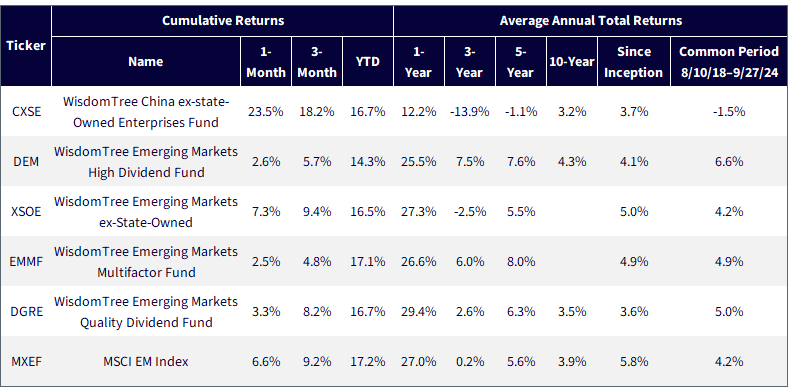
Sources: WisdomTree, FactSet, as of 9/27/24. The MSCI EM (Emerging Markets) Index is a free-float weighted equity index that captures large- and mid-
cap representation across emerging markets countries. Past performance is not indicative of future results. Investment return and principal
value of an investment will fluctuate so that an investor’s shares, when redeemed, may be worth more or less than their original cost.
Current performance may be lower or higher than the performance data quoted. For the most recent month-end and standardized
performance and to download the Fund prospectus, please click the respective ticker: DEM, DGRE, EMMF, XC, XSOE.
China’s baseline remains that when sentiment turns negative and economic data underperforms, the government will implement some stimulus measures to meet its economic targets. However, the recovery process is unlikely to be smooth, and improvements in household and company balance sheet will take time, which we’ve explained in detail in our China of Tomorrow podcast. A strategy like our multifactor approach, which screens for fundamental and technical factors, could help mitigate volatility along the way.
Investing involves risk including possible loss of principal. Please read the Fund’s prospectus for specific details regarding the Fund’s risk profile.
EMMF: Investments in non-U.S. securities involve political, regulatory, and economic risks that may not be present in U.S. securities. For example, foreign securities may be subject to risk of loss due to foreign currency fluctuations, political or economic instability, or geographic events that adversely impact issuers of foreign securities. Derivatives used by the Fund to offset exposure to foreign currencies may not perform as intended. There can be no assurance that the Fund's hedging transactions will be effective. The value of an investment in the Fund could be significantly and negatively impacted if foreign currencies appreciate at the same time that the value of the Fund's equity holdings falls. While the Fund is actively managed, the Fund's investment process is expected to be heavily dependent on quantitative models and the models may not perform as intended.
Additional risks specific to EMMF include but are not limited to Emerging Markets Risk. Investments in securities and instruments traded in developing or emerging markets, or that provide exposure to such securities or markets, can involve additional risks relating to political, economic, or regulatory conditions not associated with investments in U.S. securities and instruments or investments in more developed international markets.
DEM: Foreign investing involves special risks, such as risk of loss from currency fluctuation or political or economic uncertainty. Funds focusing on a single sector generally experience greater price volatility. Investments in emerging, offshore or frontier markets are generally less liquid and less efficient than investments in developed markets and are subject to additional risks, such as risks of adverse governmental regulation, intervention and political developments. Due to the investment strategy of this Fund it may make higher capital gain distributions than other ETFs. Dividends are not guaranteed, and a company currently paying dividends may cease paying dividends at any time.
XSOE: Foreign investing involves special risks, such as risk of loss from currency fluctuation or political or economic uncertainty. Investments in emerging or offshore markets are generally less liquid and less efficient than investments in developed markets and are subject to additional risks, such as risks of adverse governmental regulation and intervention or political developments. Funds focusing their investments on certain sectors and/or regions increase their vulnerability to any single economic or regulatory development. This may result in greater share price volatility. Investments in currency involve additional special risks, such as credit risk and interest rate fluctuations. The Fund invests in the securities included in, or representative of, its Index regardless of their investment merit and the Fund does not attempt to outperform its Index or take defensive positions in declining markets.
DGRE: Investing involves special risks, such as risk of loss from currency fluctuation or political or economic uncertainty. Fund's focusing on a single sector generally experience greater price volatility. Investments in emerging, offshore or frontier markets are generally less liquid and less efficient than developed markets and are subject to additional risks, such as of adverse governmental regulation, intervention and political developments. Due to the investment strategy of this Fund it may make higher capital gain distributions than other ETFs.
XC: Foreign investing involves special risks, such as risk of loss from currency fluctuation or political or economic uncertainty. Investments in emerging markets are generally less liquid and less efficient than investments in developed markets and are subject to additional risks. The Fund's investment strategy limits the types and number of investment opportunities available and, as a result, the Fund may underperform other funds. The Fund's exposure to certain sectors, countries, or regions may increase its vulnerability to any single economic or regulatory development related to such sector, country, or region. The Fund is non-diversified, as a result, changes in the market value of a single security could cause greater fluctuations in the value of Fund shares than would occur in a diversified fund. Investments in currency involve additional special risks, such as credit risk and interest rate fluctuations. The Fund invests in the securities included in, or representative of, its Index regardless of their investment merit and the Fund does not attempt to outperform its Index or take defensive positions in declining markets.

Director of Modern Alpha
Liqian Ren, Ph.D., joined WisdomTree as Director of Modern Alpha in 2018. She leads WisdomTree’s quantitative investment capabilities and serves as a thought leader for WisdomTree’s Modern Alpha® approach. Liqian was previously at Vanguard, where she worked for 12 years, most recently as a portfolio manager in the Quantitative Equity Group managing Vanguard’s active funds and conducting research on factor strategies. Prior to joining Vanguard, she was an associate economist at the Federal Reserve Bank of Chicago. Liqian received her bachelor’s degree in Computer Science from Peking University in Beijing, her master’s in Economics from Indiana University—Purdue University Indianapolis, and her MBA and Ph.D. in Economics from the University of Chicago Booth School of Business. Liqian co-hosts a podcast on China and Asian markets with Jeremy Schwartz, WisdomTree’s Global Head of Research, and she is a co-host on the Wharton Business Radio program Behind the Markets on SiriusXM 132.
