


Data Dependency = Volatility
Published May 22, 2024

Kevin Flanagan
Head of Investment and Fixed Income Strategy
Key Takeaways
- Fed policy has a heightened data dependency, leading to increased volatility in the bond market.
- The UST market’s narrative has shifted toward the possibility of rate cuts, but the Fed does not appear to be in a rush to implement them based on current inflation trends.
- Even though rate cuts remain the odds-on favorite for later this year, investors should heed the tenor of recent Fed-speak, which reinforced the notion of rates being higher for longer.
There is no question that Fed policy remains the primary force driving the money and bond markets for the third year in a row. There was some speculation heading into this year that if Powell & Co. embarked on a widely anticipated rate-cutting spree, perhaps the U.S. Treasury (UST) arena could take a collective breath and just let the policy maker “do its thing.” However, as we have discovered through the first nearly five months of the year, the best-laid plans have not been realized. Instead, I believe that they have been replaced by a Fed policy that has a heightened data dependency, and according to my math, data dependence equals volatility in the bond market.
U.S. Treasury 10-Year Yield
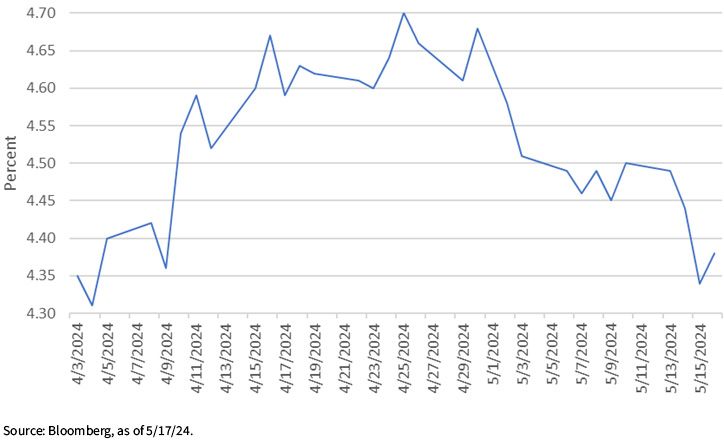
But you don’t need to take my word for it; just look at how the UST 10-Year yield has performed over the last month or so. While the overarching trend has been for higher yields in 2024, recent price action underscores how changing Fed policy perceptions have created a noticeably elevated volatility quotient for the 10-Year. Indeed, the yield completed a round trip from the beginning of April to mid-May. To provide some perspective, investors have witnessed the UST 10-Year rate rise from 4.35% to 4.70%, only to fall back to its starting point of 4.35%. Think about it…the yield went on a formidable 70-bp journey in just over a month’s time.
Why, you might ask? The economic data. While Powell downplaying rate hikes at the May FOMC presser certainly helped, it has been recent economic data that has paved the way. Because the Fed has emphasized the importance of being data-dependent in the monetary policy decision-making process, the UST market has been “hanging” on each key piece of new information and will continue to do so in the months ahead.
With the policy maker singling out inflation and the labor markets, these two reports naturally have received the lion’s share of attention, and rightfully so. Thus, a hotter-than-expected CPI report in April, combined with a robust jobs number, helped to push the UST 10-Year yield to its highest level since early November of last year. This was followed in May with an employment report that came in below expectations, a soft showing for retail sales and, perhaps most importantly, a CPI reading that was not “hotter” than expected. Needless to say, this latest stretch of data played into the UST market’s newfound narrative that rate cuts are back on the table and pushed the 10-Year yield back down to its aforementioned starting point.
Conclusion
Although one month’s worth of data may provide for a short-lived positive reaction for bonds, I believe that the Fed will look at it differently. Given what has transpired on the inflation front up until this month’s report, Powell & Co. do not appear to be in any hurry to begin implementing rate cuts any time soon. Against this backdrop, even though rate cuts remain the odds-on favorite for later this year, investors should heed the tenor of recent Fed-speak, which reinforced the notion of rates being higher for longer.
Categories

About the contributor

Kevin Flanagan
Head of Investment and Fixed Income Strategy
Kevin serves as the Head of Investment and Fixed Income Strategy. In this role, he writes macro and fixed income-related content and works closely with the sales, research and marketing teams. In addition, Kevin conducts client-facing webinars and meetings, providing expertise on WisdomTree’s existing and future bond ETFs. Prior to joining WisdomTree, Kevin spent 30 years at Morgan Stanley, where he was Managing Director and Chief Fixed Income Strategist for Wealth Management. He was responsible for tactical and strategic recommendations and created asset allocation models for fixed income securities. He was a contributor to the Morgan Stanley Wealth Management Global Investment Committee, primary author of Morgan Stanley Wealth Management’s monthly and weekly fixed income publications, and collaborated with the firm’s Research and Consulting Group Divisions to build ETF and fund manager asset allocation models. Kevin has an MBA from Pace University’s Lubin Graduate School of Business, and a B.S. in Finance from Fairfield University.