
IHDG
International Hedged Quality Dividend Growth Fund

Published May 23, 2024

Equity Strategist
Earlier this month, the WisdomTree International Hedged Quality Dividend Growth Fund (IHDG) celebrated its 10-year anniversary. Launched on May 7, 2014, it applied our now-flagship quality dividend growth methodology to international equity markets.
The Fund provides exposure to companies with the highest quality measurements across the developed international equity universe. WisdomTree’s quality definition considers static and trend-based observations of return on equity (ROE) and return on assets (ROA), which provides an explicit focus on profitability when paired with estimated earnings growth.
The resulting stock basket of roughly 300 companies is ultimately dividend-weighted to help keep valuations in check, since we’d typically expect higher-quality businesses to trade at a premium multiple compared to lower-quality peers.
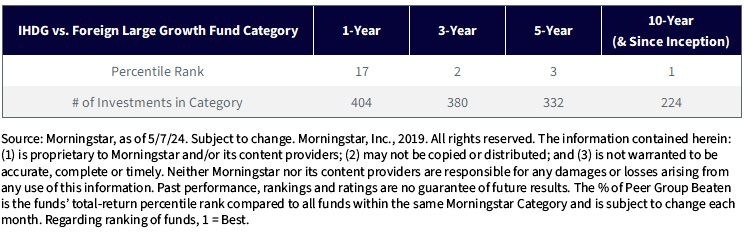
As a result, IHDG marries two equity factor philosophies that WisdomTree excels in: quality and dividends. The pairing has been successful as well. IHDG is consistently ranked within the top quintile in the Morningstar Foreign Large Growth Category throughout history and is top-three over the three-, five- and 10-year periods.
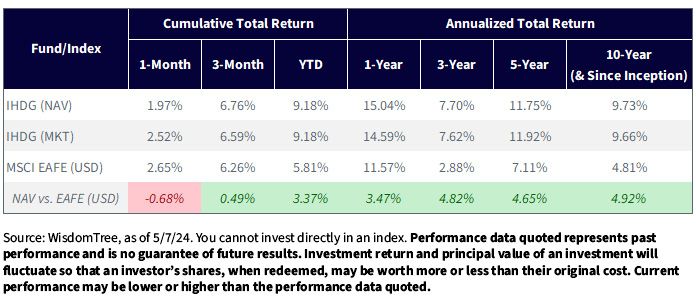
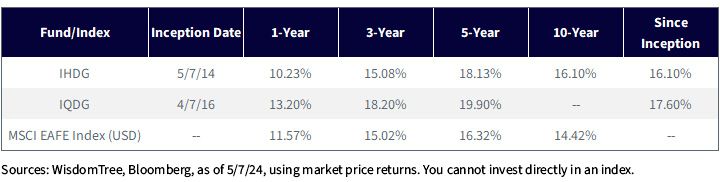
The strategy has outperformed broad developed international equity markets since inception, especially when coupled with a static currency hedge to eliminate long foreign currency exposure for a U.S. dollar-based investor.
As of May 7, IHDG has added nearly 5% per year over the trailing three-, five- and 10-year/since inception periods versus the MSCI EAFE Index, quoted in dollar terms. This speaks volumes about the efficacy of a quality and dividend emphasis in international equity markets.
For the most recent month-end performance, please click here.
But its currency hedge has also had a meaningful performance impact amid the strong-dollar environment in the aftermath of the pandemic.
To quantify its effect, we can compare the performance for its Index versus that of its unhedged twin (WTIDG, the WisdomTree International Quality Dividend Growth Index).
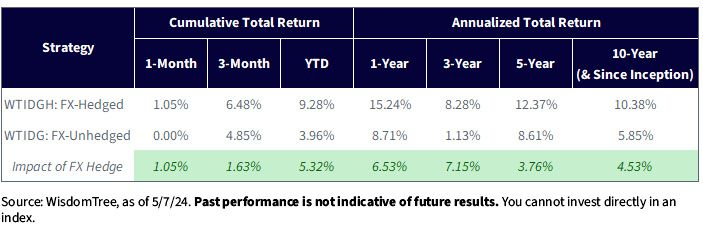
The static currency hedge has been universally additive over the life of the strategy, adding over 4.5% per year over the past decade and even more in recent periods.
But in our view, the essential benefit to the currency hedge lies in risk reduction rather than return generation. As pioneers in the currency-hedged equity space, WisdomTree has long believed that currency directions cannot be forecasted with much accuracy or reliability. Unhedged exposure from international investments may be additive for a USD-based investor during one period and then detract from performance shortly after. Thus, the only certainty within FX uncertainty is incremental volatility.
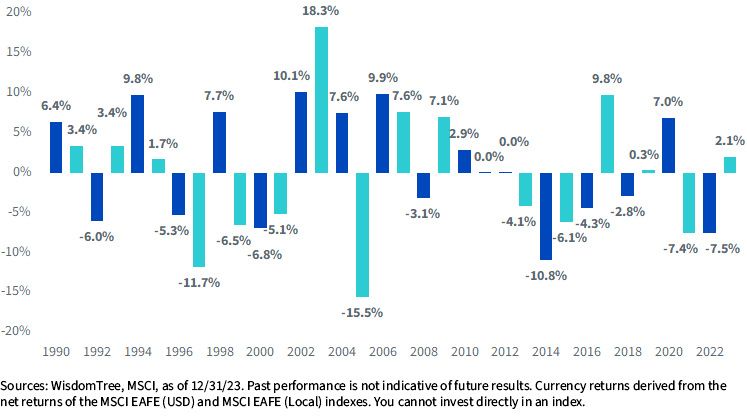
Over the past 30+ years, unhedged currency exposure was additive for returns about 56% of the time and harmed them in the other 43% of calendar year observations. During the negative periods, the average decline was about 6.9%. During the positive ones, the average benefit was about 6.1%. That means, over the past few decades, the average expected value from currency exposure in a one-year period was a measly 35-basis point benefit to returns.
But incremental volatility is a constant and currency bets, therefore, are a gamble where you “pay” the casino through added volatility in your portfolio for essentially coin flip odds to enhance returns by a negligible amount. IHDG's risk reduction compared to IQDG illustrates this well.
Though the strong-dollar environment continues to suppress foreign currencies, IHDG’s hedge helps insulate it from declines in developed international equity markets. Since inception, it’s only captured about two-thirds of the MSCI EAFE’s downside (in USD), while its unhedged stock basket has been more sensitive to both equity and currency declines.
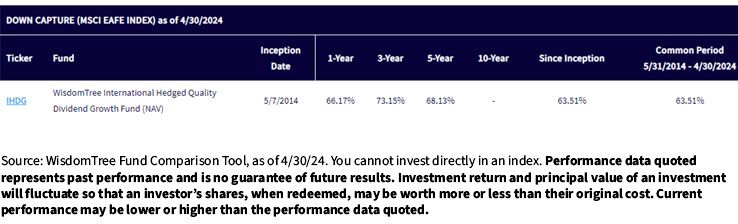
For the most recent month-end performance, please click the respective ticker: IHDG, IQDG.
Meanwhile, IHDG's beta to the MSCI EAFE Index hovers around 0.7. Since the beta of its stock basket without the hedge is closer to 1 (and even higher in more recent periods), then the hedge’s beta must be negative, making it valuable by definition.
But for a U.S. investor, the hedge goes even further than simply negating the fluctuations of foreign currencies against the dollar.
Though we prefer to think of static currency hedges as risk reducers without any directional exposure, they are inherently permanent bullish bets on the dollar when compared to an unhedged position that was established previously. And recently, the dollar has been one of the best diversifiers for U.S. equity markets.
In the piece above, my colleague Jeremy Schwartz explains how there is a weak dollar bias embedded in S&P 500 earnings due to multinational companies doing business in currencies all over the world. As each company’s global revenue footprint grows, so does the influence of currency effects in quarterly earnings, where a weaker dollar is beneficial. If a strong dollar results in poor FX translation effects from the revenues received, or worse, prevents that business from being done in the first place, then earnings may suffer and equity prices would likely follow.
Hence the changing relationship between stocks, bonds and the dollar that we’ve observed for the past few years.
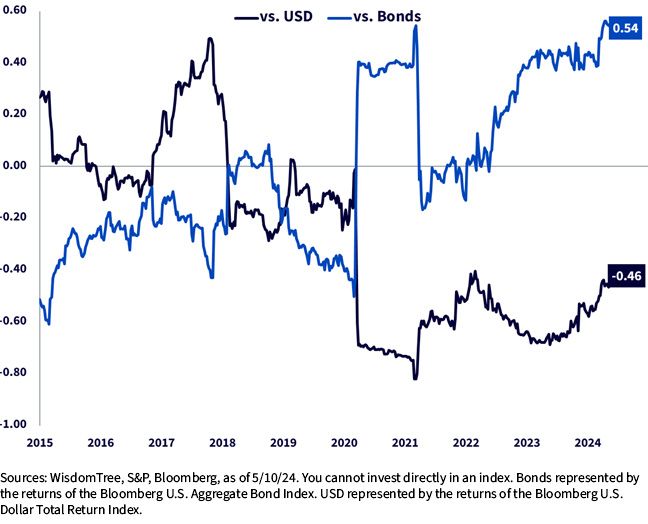
For definitions of terms in the graph above, please visit the glossary.
While bonds were once the conventional equity hedge asset, today that role has been assumed by the dollar. When the dollar spikes due to economic data releases or geopolitical events, equity markets and bonds have recently fallen in tandem.
This has important implications for global portfolio construction and the international equity allocations within. Today, a U.S.-based investor can benefit from an international equity investment like IHDG, “at home and abroad,” for a few reasons:
Now that IHDG has wrapped up its first decade, we have ample evidence to prove it is a valuable addition to a global equity portfolio both over the short- and long-term holding periods.
There are risks associated with investing, including the possible loss of principal. Foreign investing involves special risks, such as risk of loss from currency fluctuation or political or economic uncertainty. To the extent the Fund invests a significant portion of its assets in the securities of companies of a single country or region, it is likely to be impacted by the events or conditions affecting that country or region. Dividends are not guaranteed and a company currently paying dividends may cease paying dividends at any time. Investments in currency involve additional special risks, such as credit risk and interest rate fluctuations. Derivative investments can be volatile and these investments may be less liquid than other securities, and more sensitive to the effect of varied economic conditions. As this Fund can have a high concentration in some issuers, the Fund can be adversely impacted by changes affecting those issuers. The Fund invests in the securities included in, or representative of, its Index regardless of their investment merit and the Fund does not attempt to outperform its Index or take defensive positions in declining markets. Due to the investment strategy of this Fund it may make higher capital gain distributions than other ETFs. Please read the Fund’s prospectus for specific details regarding the Fund’s risk profile.

Equity Strategist
Brian Manby is an Equity Strategist at WisdomTree and part of the Investment Strategy team.
He is responsible for developing and communicating equity market insights, investment themes, and portfolio strategies that support the firm’s ETF and investment solutions platform. He evaluates sectors, valuations, fundamentals and equity styles to identify investment opportunities and provide actionable perspectives to clients and advisors. He also helps investors understand how WisdomTree’s equity strategies can be used to achieve long-term investment objectives in evolving market environments.
Brian joined WisdomTree in October 2018 as an Investment Strategy Analyst after a few years as a Consultant for FactSet Research Systems, Inc. He earned a B.A. in Economics and Political Science from the University of Connecticut in 2016 and has been a Chartered Financial Analyst since 2022.
