


The Answer to the Curve Steepener: Active/Passive Barbell
Published December 24, 2025

Kevin Flanagan
Head of Investment and Fixed Income Strategy
Key Takeaways
- After a sluggish start, the Treasury yield curve steepening gained momentum in late 2025 as the Federal Reserve cut rates by 75 basis points over three months, driving short-term yields lower.
- With moderate economic growth and inflation likely to stay above 2% in 2026, longer-term yields could rise while short-term rates stay flat, further steepening the curve.
- An active/passive bond barbell strategy offers investors a timely way to lock in income while maintaining a shorter duration than the benchmark Agg, aligning with evolving yield curve dynamics.
As we get ready to close out 2025, one stand-out trend in the U.S. Treasury (UST) market has been the steepening of the yield curve. The question now is whether this trend will continue into 2026, and if it does, how should investors position their bond portfolios? The answer: the active/passive barbell.
U.S. Treasury Yield Curves
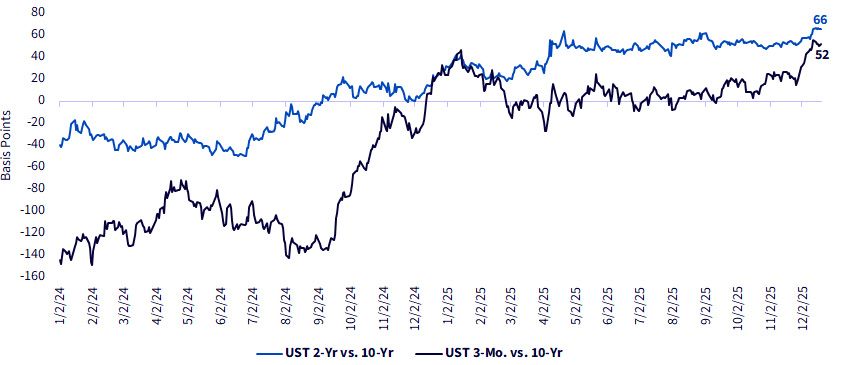
Source: Bloomberg, as of 12/19/25
When examining the Treasury yield curve, the two prominent measures to be analyzed are the 3-month/10-year and 2-year/10-year constructs. As the graph clearly illustrates, calendar year 2025 finally brought both spreads into positive territory. As one would expect, the reversal in the trade from curve inversion, or negative differentials, to readings on the plus side of the ledger began with the Federal Reserve’s first rate cuts in September 2024.
However, as you can see, the initial steepening trade following the 2024 Fed rate cuts kind of ran out of gas. It really wasn’t until the Fed kick-started round two of rate cuts in this easing cycle that the curve steepener trade returned in a more visible fashion. Specifically, it was the 3-mo/10-yr construct that has recently experienced this trade. Given the direct correlation of the 3-month t-bill yield to the Fed Funds Rate, this should come as no surprise, given the fact the Fed has now cut rates by 75 basis points over the last three months. The 3-month yield was catching up to what the 2-year note had already discounted regarding where the Fed Funds Rate was headed. As a result, the spreads between these two curves are now closer to being aligned.
What Will 2026 Have in Store?
For next year, it appears as if the path of least resistance would be for the curve steepener trade to continue. Perhaps the most intriguing question is how it will steepen. Remember, it really is just math. The yield curve direction will be predicated on the two maturities you are measuring in terms of yield. Our baseline for next year is that the economy is going to post moderate growth and inflation will remain above the Fed’s 2% target. Against this backdrop, and one of a Fed with a ”house divided,” short-term yields, or the front-end of the curve, would probably be flattish or perhaps could drift a bit lower. Longer-dated maturities (the back-end of the curve), however, could witness an increase in yields. Hence, the yield curve steepens.
Conclusion
So, back to the beginning. The active/passive bond barbell allows investors to have flexibility in their income and duration positioning. It provides a means to lock in income while keeping the duration profile below that of the benchmark Agg.
Categories

About the contributor

Kevin Flanagan
Head of Investment and Fixed Income Strategy
Kevin serves as the Head of Investment and Fixed Income Strategy. In this role, he writes macro and fixed income-related content and works closely with the sales, research and marketing teams. In addition, Kevin conducts client-facing webinars and meetings, providing expertise on WisdomTree’s existing and future bond ETFs. Prior to joining WisdomTree, Kevin spent 30 years at Morgan Stanley, where he was Managing Director and Chief Fixed Income Strategist for Wealth Management. He was responsible for tactical and strategic recommendations and created asset allocation models for fixed income securities. He was a contributor to the Morgan Stanley Wealth Management Global Investment Committee, primary author of Morgan Stanley Wealth Management’s monthly and weekly fixed income publications, and collaborated with the firm’s Research and Consulting Group Divisions to build ETF and fund manager asset allocation models. Kevin has an MBA from Pace University’s Lubin Graduate School of Business, and a B.S. in Finance from Fairfield University.