
QGRW
U.S. Quality Growth Fund

Published September 18, 2025

Director, Quantitative Research

Head of Indexes, U.S.
The Q2 2025 earnings season reaffirmed the market dominance of the Mag7. Collectively, the group delivered blended sales growth of 15.13% year on year, outpacing the rest of the S&P 500 (493 companies) by more than 10% as of August 15, 2025. From the April market lows, an index tracking these seven stocks advanced 44.46% as of August 19, a stark reflection of their continued leadership.
The April 2–4, 2025, sell-off, which was triggered by new White House tariffs, caused the S&P 500 and Nasdaq to drop 10% to 12% and erased $6.6 trillion in market cap within three days. A partial rollback of tariffs quickly stabilized markets, and by the end of April, the Zweig Breadth Thrust signaled recovery.
By May–June, the rally broadened significantly:
While the Mag7's valuations have soared, they remain supported by:
Importantly, the Mag7's PEG ratio suggests valuations are justified. Bridgewater analysis shows that 14% annual EPS growth over the next decade would be sufficient to sustain their equity premium relative to bonds, a level below their historic approximately 20% pace, but still robust enough to support current multiples.
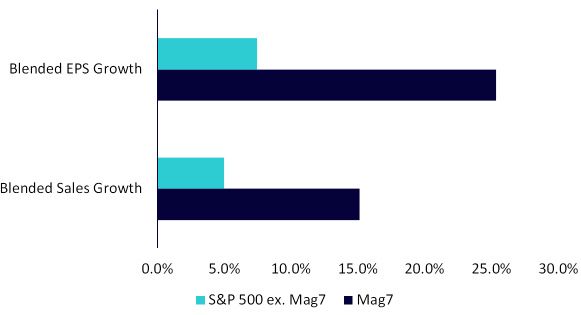
Sources: WisdomTree, FactSet, as of 8/15/25. Blended growth rates include estimates for companies where latest quarterly report isn't yet available.
Artificial intelligence is the defining growth driver for the Mag7, with each company leveraging AI in ways that reinforce its market leadership and profitability:
Crucially, AI is not just an investment theme but already yielding measurable returns:
In short, AI provides the Mag7 with a multi-dimensional growth engine, expanding revenues, protecting margins and strengthening competitive moats. Their AI dominance cements them at the center of long-term equity growth opportunities.
With elevated equity market capitalizations, Big Tech wields powerful "equity currency" for acquisitions. This allows them to preserve cash for organic growth and R&D and use stock valuations strategically in deal-making. In practice, this means they can issue shares at high multiples to acquire complementary technologies, talent pools or new platforms, often at a lower effective cost than if they relied on cash.
It also provides flexibility: by structuring deals with stock rather than debt, they avoid increasing leverage, maintain balance sheet strength, and still expand strategically. Importantly, equity-financed deals can align incentives with acquired management teams, as they participate in the long-term value creation of the combined entity.
The WisdomTree U.S. Quality Growth Index currently holds all the Mag7 stocks, not due to size, but because they meet stringent quality and growth fundamentals. The strategy selects stocks with robust profitability and strong growth metrics, and applies semi-annual rebalancing to ensure continued discipline:
This systematic, rules-based approach ensures that investors gain exposure to the quality and growth risk premiums that have historically been rewarded in equity markets.
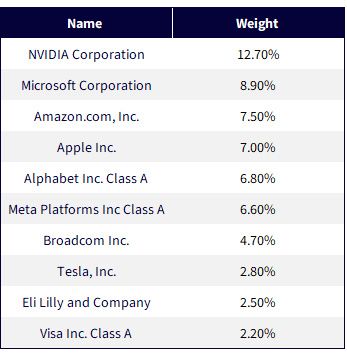
Sources: WisdomTree, FactSet, as of 7/31/25. Subject to change.
The Mag7 remains central to the U.S. Quality Growth Strategy, backed by operational efficiency, leadership in megatrends, massive AI investments and strategic M&A capacity. While valuations are elevated, they appear justified by strong fundamentals and sustained growth prospects.
For long-term investors, the rules-based, quality-focused framework of the WisdomTree U.S. Quality Growth Index provides a disciplined way to capture Mag7 leadership while also systematically rotating into other high-quality growth opportunities, enhancing both resilience and diversification.
References to specific securities and their issuers are for illustrative purposes only and are not intended to be, and should not be interpreted as, recommendations to purchase or sell such securities.
U.S. Quality Growth Fund

Director, Quantitative Research
Ayush Babel is the Director of Quantitative Research in WisdomTree's multi-asset quantitative research and index teams. In this role, he focuses on developing innovative quantitative strategies across various asset classes while supporting WisdomTree's diverse range of products. His expertise spans factor exploration, portfolio construction and optimization, quantitative investment research, and product development.
With over a decade of experience in the financial services industry, Ayush has held investment research roles at J.P. Morgan and Franklin Templeton. At these institutions, he was responsible for developing and managing equity and fixed income smart beta products, as well as cross-asset risk premia solutions for global institutional and retail clients. His experience covers a broad spectrum of asset classes and investment styles.
Ayush holds a bachelor's in Engineering Physics and a master’s degree in Nanoscience from the Indian Institute of Technology, Bombay.

Head of Indexes, U.S.
Alejandro Saltiel joined WisdomTree in May 2017 as part of the Quantitative Research team. Alejandro oversees the firm’s Equity indexes and actively managed ETFs. He is also involved in the design and analysis of new and existing strategies. Alejandro leads the quantitative analysis efforts across equities and alternatives and contributes to the firm’s website tools and model portfolio infrastructure. Prior to joining WisdomTree, Alejandro worked at HSBC Asset Management’s Mexico City office as Portfolio Manager for multi-asset mutual funds. Alejandro received his Master’s in Financial Engineering degree from Columbia University in 2017 and a Bachelor’s in Engineering degree from the Instituto Tecnológico Autónomo de México (ITAM) in 2010. He is a holder of the Chartered Financial Analyst designation.


