
NTSX
U.S. Efficient Core Fund

Published February 26, 2025

Head of Research, WisdomTree Europe.

Global Chief Investment Officer
Private market assets are projected to grow at more than twice the rate of public assets, reaching $60 trillion to $65 trillion by 2032.1 This anticipated expansion underscores investors' search for portfolio diversification, across all diversifiers like private equity, private credit, broad commodities, real estate, infrastructure and gold. Academic research consistently demonstrates that such diversification enhances a portfolio's risk/return profile. And such diversification is particularly pertinent now given the rising concentration in market cap-weighted indexes, where a handful of large tech companies dominate, thereby reducing diversification within these core portfolio components. However, achieving this additional diversification presents a significant challenge: how to incorporate these assets while maintaining exposure to core holdings like public equities and fixed income.
In recent years, WisdomTree has conducted extensive research on enhancing portfolios through alternative assets and diversifiers to improve overall long-term efficiency. Our analyses, both retrospective and prospective, indicate that:
Collectively, these assets could constitute 20% of a portfolio. Employing a delta-one approach would necessitate a substantial reduction in allocations to bonds and, predominantly, equities to accommodate these diversifiers. Clearly, investors require innovative tools to address this issue and unlock new opportunities for their portfolios.
Introducing Efficient Core: A New Era of Smart Investing
To tackle this challenge, WisdomTree has developed a range of Efficient Core strategies designed to enhance capital efficiency by stacking multiple assets within a single solution. This framework is very flexible, allowing us to provide a 90% exposure to large-cap equities and a 60% exposure to U.S. Treasury bonds for every $100 invested. Or to stack 90% of gold futures contracts on top of a 90% allocation to large-cap equities.
The WisdomTree U.S. Efficient Core Fund (NTSX), WisdomTree International Efficient Core Fund (NTSI) and WisdomTree Emerging Markets Efficient Core Fund (NTSE) are comprised of three key exposures:
Effectively, this approach delivers a capital-efficient 60/40 allocation, freeing up capital that can be allocated to diversifying assets without sacrificing core equity and bond exposures.
The WisdomTree Efficient Gold Plus Equity Strategy Fund (GDE) also has three key exposures:
Effectively, this approach allows the creation of a gold exposure in the portfolio without having to reduce the allocation to other risk assets such as gold.
By using the Efficient Core strategy, investors can maintain their desired exposure to traditional assets while freeing up capital to invest in diversifiers such as gold, private assets or broad commodities. This methodology facilitates the integration of alternative investments aimed at enhancing diversification and potential returns without compromising the foundational holdings of the portfolio. Additionally, it allows for the introduction of uncorrelated return streams, improved diversification, reduced portfolio volatility and more consistent performance across various market conditions.
Consider a practical example: starting with a 60/40 portfolio investing in global equities and U.S. Treasuries. Traditionally, incorporating commodities, gold or real estate would require reducing the equity allocation, as these diversifiers tend to exhibit volatility. However, by allocating 66.7% of the capital to Efficient Core Funds, an investor would achieve a 60% exposure to global equities, a 35% exposure to fixed income (via U.S. Treasury futures contracts) and 8% exposure to gold. This allocation leaves 28.3% of the capital available for investment in alternative assets and diversifiers of the investor's choice once 5% of U.S. Treasuries have been added to complete the 60/40.
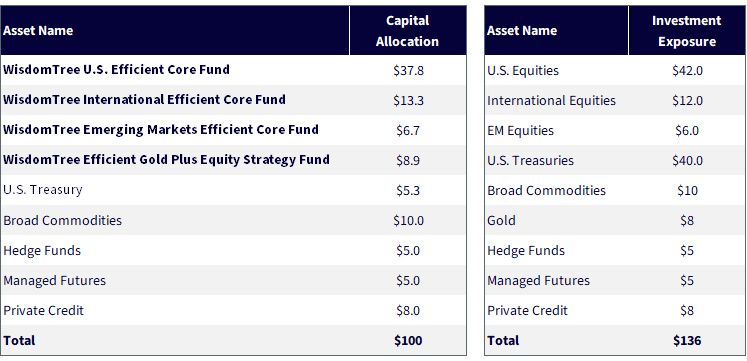
For illustration only.
Conclusion
Diversification is increasingly becoming a key driver of portfolio construction. With correlations rising within and across asset classes, it is imperative for investors to explore beyond core assets and consider new asset classes that are becoming more accessible. Conversely, creating space in the portfolio for these diversifiers must not come at the expense of the portfolio's long-term return potential. The Efficient Core strategies provide a viable pathway to achieve this balance, enabling portfolios to be both diversified and positioned for long-term growth.
1 Source: Bain & Company. August 2024. https://www.bain.com/about/media-center/press-releases/2024/private-market-assets-to-grow-at-more-than-twice-the-rate-of-public-assets-reaching-up-to-%2465-trillion-by-2032-bain--company-finds/?utm_source=chatgpt.com
Diversification does not eliminate the risk of experiencing investment losses.
There are risks associated with investing, including the possible loss of principal. Please read each Funds’ prospectus for specific details regarding the Fund’s risk profile.
NTSX: While the Fund is actively managed, the Fund’s investment process is expected to be heavily dependent on quantitative models and the models may not perform as intended. Equity securities, such as common stocks, are subject to market, economic and business risks that may cause their prices to fluctuate. The Fund invests in derivatives to gain exposure to U.S. Treasuries. The return on a derivative instrument may not correlate with the return of its underlying reference asset. The Fund’s use of derivatives will give rise to leverage and derivatives can be volatile and may be less liquid than other securities. As a result, the value of an investment in the Fund may change quickly and without warning and you may lose money. Interest rate risk is the risk that fixed income securities, and financial instruments related to fixed income securities, will decline in value because of an increase in interest rates and changes to other factors, such as perception of an issuer’s creditworthiness.
NTSI: Investments in non-U.S. securities involve political, regulatory and economic risks that may not be present in U.S. securities. For example, foreign securities may be subject to risk of loss due to foreign currency fluctuations, political or economic instability, or geographic events that adversely impact issuers of foreign securities. While the Fund is actively managed, the Fund’s investment process is expected to be heavily dependent on quantitative models and the models may not perform as intended. Equity securities, such as common stocks, are subject to market, economic and business risks that may cause their prices to fluctuate. The Fund invests in derivatives to gain exposure to U.S. Treasuries. The return on a derivative instrument may not correlate with the return of its underlying reference asset. The Fund’s use of derivatives will give rise to leverage and derivatives can be volatile and may be less liquid than other securities. As a result, the value of an investment in the Fund may change quickly and without warning and you may lose money. Interest rate risk is the risk that fixed income securities, and financial instruments related to fixed income securities, will decline in value because of an increase in interest rates and changes to other factors, such as perception of an issuer’s creditworthiness. Diversification does not eliminate the risk of experiencing investment losses.
NTSE: Investments in non-U.S. securities involve political, regulatory and economic risks that may not be present in U.S. securities. For example, foreign securities may be subject to risk of loss due to foreign currency fluctuations, political or economic instability, or geographic events that adversely impact issuers of foreign securities. Investments in securities and instruments traded in developing or emerging markets, or that provide exposure to such securities or markets, can involve additional risks relating to political, economic or regulatory conditions not associated with investments in U.S. securities and instruments or investments in more developed international markets. While the Fund is actively managed, the Fund’s investment process is expected to be heavily dependent on quantitative models and the models may not perform as intended. Equity securities, such as common stocks, are subject to market, economic and business risks that may cause their prices to fluctuate. The Fund invests in derivatives to gain exposure to U.S. Treasuries. The return on a derivative instrument may not correlate with the return of its underlying reference asset. The Fund’s use of derivatives will give rise to leverage and derivatives can be volatile and may be less liquid than other securities. As a result, the value of an investment in the Fund may change quickly and without warning and you may lose money. Interest rate risk is the risk that fixed income securities, and financial instruments related to fixed income securities, will decline in value because of an increase in interest rates and changes to other factors, such as perception of an issuer’s creditworthiness. Diversification does not eliminate the risk of experiencing investment losses.
GDE: The Fund is actively managed and invests in U.S.-listed gold futures and U.S. equity securities. The Fund’s use of U.S.-listed gold futures contracts will give rise to leverage, magnifying gains and losses and causing the Fund to be more volatile than if it had not been leveraged. Moreover, the price movements in gold and gold futures contracts may fluctuate quickly and dramatically, and have a historically low correlation with the returns of the stock and bond markets. U.S. equity securities, such as common stocks, are subject to market, economic and business risks that may cause their prices to fluctuate. The Fund’s investment strategy will also require it to redeem shares for cash or to otherwise include cash as part of its redemption proceeds, which may cause the Fund to recognize capital gains.

Head of Research, WisdomTree Europe.
Pierre Debru leads WisdomTree’s European research team and plays a pivotal role in the strategic direction of our European research efforts. His key areas of expertise extend across equity factors and quantitative strategies, portfolio construction and model portfolios, and thematic and crypto investments. Before joining the company in 2019, Pierre worked in Investment Research for DWS and the Xtrackers range for over five years. During this period, he focused on smart beta investments, model portfolio construction and thought leadership. Pierre has over 20 years of experience in investments and structured asset management. He graduated from Ecole Central Paris and obtained a Master of Science in Mathematics applied to Finance.

Global Chief Investment Officer
Jeremy Schwartz has served as Global Chief Investment Officer since November 2021 and leads WisdomTree’s investment strategy team in the construction of WisdomTree’s equity Indexes, quantitative active strategies and multi-asset Model Portfolios. Jeremy joined WisdomTree in May 2005 as a Senior Analyst, adding Deputy Director of Research to his responsibilities in February 2007. He served as Director of Research from October 2008 to October 2018 and as Global Head of Research from November 2018 to November 2021. Before joining WisdomTree, he was a head research assistant for Professor Jeremy Siegel and, in 2022, became his co-author on the sixth edition of the book Stocks for the Long Run. Jeremy is also co-author of the Financial Analysts Journal paper “What Happened to the Original Stocks in the S&P 500?” He received his B.S. in economics from The Wharton School of the University of Pennsylvania and hosts the Behind the Markets podcast. Jeremy is a member of the CFA Society of Philadelphia.

