


Battery Storage: Driving the Energy Transition
Published March 18, 2022

Wood Mackenzie
Wood Mackenzie
A radical energy transition is underway, driven by a combination of environmental, policy and technology factors. Our energy system is being electrified and decarbonized, switching away from fossil fuels to clean, renewable sources of energy. The effect will be transformational.
Power and road transport, which together contributed around two-thirds of carbon emissions in 2020 (source: IEA), are a clear area of focus for the energy transition. A great deal has been achieved in the development of renewable power generation and electric vehicles (EVs). Breakthroughs in battery energy storage technology have been a key enabler:
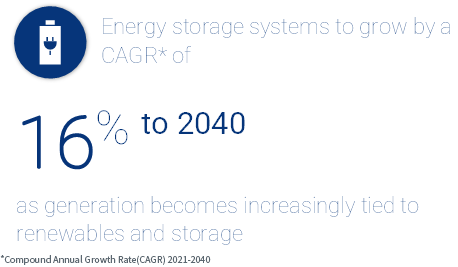
Power. The growth in intermittent renewable energy, such as wind and solar, creates a greater need for flexibility and reliability in power markets. Battery storage can help smoothen supply and improve grid stability. This type of energy storage is often called “stationary.”
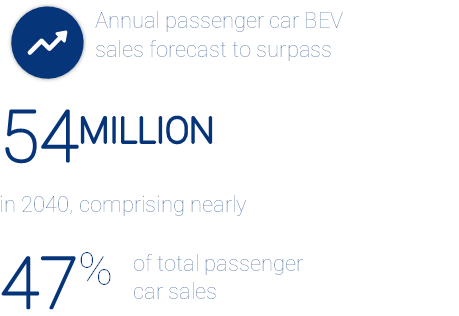
Road transport. A battery can either displace or be combined with an internal combustion engine to create hybrid or fully electric vehicles.
Lithium-Ion Technology Dominates the Market
The battery storage market is currently dominated by lithium-ion battery (LiB) technology. LiBs have useful attributes. They’re lightweight, have a high energy density and offer good charging and discharging properties.
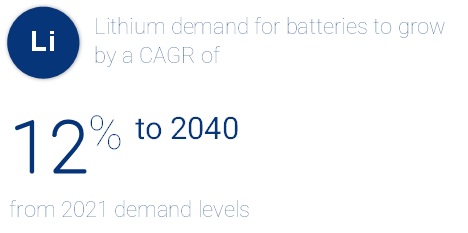
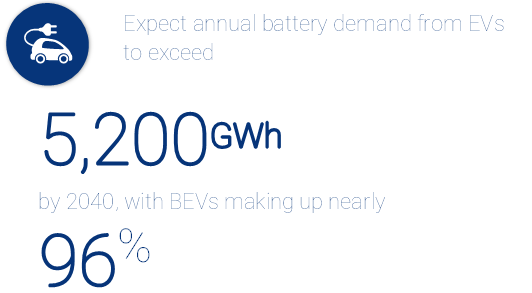
The first LiB was commercialized in 1991 by Sony after 20 years of research. Until recently, the primary use was in portable electronics, including mobile phones. As the technology has improved and scaled, it has been used in EVs and stationary storage solutions. Going forward, while stationary storage will grow significantly, the biggest driver will be EVs—which already constitute more than half of battery demand.
The rise in battery storage is fueled by falling costs. LiB costs have declined 80% this decade, primarily driven by two things.
Economies of scale. Every doubling of production capacity results in a 5%–8% reduction in cost.
Energy density improvements. Market competition accelerates improvements that lead to reductions in battery prices.
The speed of this cost decline has consistently been underestimated. Wood Mackenzie anticipates costs will continue to fall as economies of scale and energy densities further improve.
Next-Generation Technology Will Help Satisfy Growing Demand
The battery storage sector is constantly evolving. We expect next-generation lithium-ion batteries, notably solid-state batteries, will be commercialized in the coming decade.
A range of technologies will be required to fully satisfy storage demand. Flow batteries, liquid air, hydrogen and power-to-gas can all complement LiB—offering different properties to suit a range of applications.
The Battery Value Chain Is Also Evolving
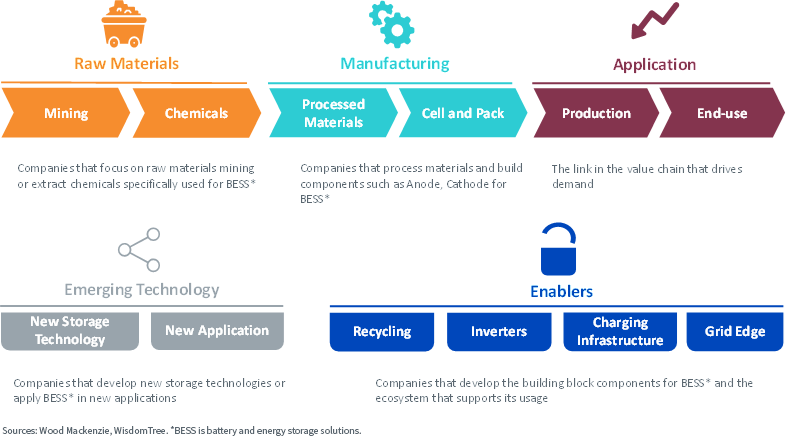
The battery value chain is made up of a myriad of industries across the globe. The mining and chemical industries each provide raw materials to manufacture battery cell components. Cells are then packed for different applications—such as the increasingly popular EVs. At the end of life, batteries are recycled or used for secondary applications, such as energy storage e-systems. Many companies stretch across different elements of the value chain, perhaps integrating the sourcing of raw materials with manufacturing.
In addition, a series of industries evolve symbiotically with this value chain. Charging infrastructure and smart grid software providers can both benefit from and support the growth of the EV industry.
Important Risks Related to this Article
Wood Mackenzie, a Verisk Analytics business, is a trusted source of commercial intelligence for the world’s natural resources sector. We empower clients to make better strategic decisions, providing objective analysis and advice on assets, companies and markets. For more information visit: www.woodmac.com
Categories
Related articles

Glass and Light: The Infrastructure Layer of the Quantum Market Is Missing
Can America Build Things? Tracking U.S. Progress in Robotics and Drone Manufacturing

Mind the Bottlenecks: How AI Infrastructure Exposure Separates Today's Technology Strategies
The Pure Plays: Five Companies Building Quantum from the Ground Up
The U.S. Government Just Became a Quantum Investor
From Quantum Promise to Portfolio Construction: The Evolution of WQTM’s May 2026 Rebalance

Trump, Xi, and the Strategic Processing Reserve

When AI Leaves the Screen and Enters the Physical World

Semiconductors OR Quantum Computing—or Semiconductors AND Quantum Computing?
About the contributor

Wood Mackenzie
Wood Mackenzie
Wood Mackenzie™ is the trusted provider of data, analytics, and insights, establishing us as the global research and consultancy business powering the natural resources industry. Our dedicated oil, gas & LNG, power & renewables, chemicals, and metals & mining sector teams are located around the world, giving our clients first-mover advantage. For more information visit: woodmac.com WOOD MACKENZIE is a trademark of Wood Mackenzie Limited and is the subject of trademark registrations and/or applications in the European Community, the USA and other countries around the world.