

What does improving sentiment mean for Italian banks?
Published 27 June 2018

Global Head of Research
May 2018 was a volatile month for Italian equities. Not only did news regarding US trade tariffs and the Iran nuclear deal impact sentiment, but Italian stocks also experienced significant volatility due to the uncertainty surrounding the formation of a new Italian government, with intensive political negotiations lasting until the very last minute.
However, Italy finally now has a new government in place after an agreement was reached between the Five Star Movement and the Northern League. So, what are the implications for Italian equities?
Italian banks to rebound?
After a strong performance between January and April, Italian banking stocks fell sharply in May, as investors discounted a much higher level of risk towards Italy. The FTSE MIB Banks Index fell in excess of 19% during the month, more than twice the drop of the broader MSCI Italy Index over the same time period. While the MSCI Italy Index delivered a small positive return for the first five months of 2018, the FTSE MIB Banks Index declined over 7% during the period.
Figure 1: Italian banks underperform the market
Source: Bloomberg, with full period from 31 December 2017 to 31 May 2018.
You cannot invest directly within an Index. Historical performance is not an indication of future performance and any investments may go down in value.
Yet, now that Italy has formed a new government, a critical source of risk has dissipated. Given that sentiment towards Italy tends to be strongly reflected in movements in the FTSE MIB Banks Index, could the next move for this index be up?
As of this writing, with the first two weeks of June 2018 performance on the books, the answer would appear to be “yes”1.
- FTSE MIB Banks Index: 5.72%
- MSCI Italy Index 2.72%
- MSCI EMU Index: 3.18%
Economic growth: is there a breakthrough around the corner?
While Italy’s economic growth has been underwhelming in recent years, data showed that in May, inflation was more than double the previous month, with prices up by 1.1% on an annual basis, compared to 0.5% in April, according to Istat's preliminary estimates2.
Inflation in Italy has historically been linked to two factors: higher commodity prices and purchase demand. The higher price of oil most likely had a role in the recent inflation increase, yet it appears that there has been a greater demand for the goods and services that make up the CPI ‘shopping basket’ too.
Even if we have not yet seen a turning point, we can see some interesting consumption patterns. And these may be enhanced by the government’s ‘Flat Tax’ program, which is aimed at stimulating growth.
Banking sector risks
Turning to risk, there are two primary risk gauges that we have been analysing in relation to Italy’s banking sector.
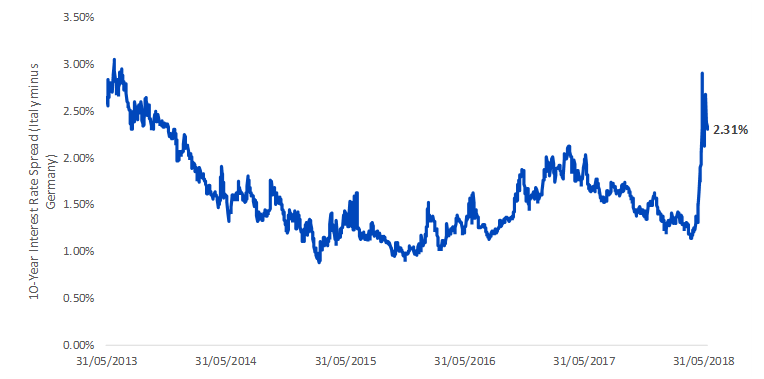
The first important measure of risk is the spread of BTP Italia bond yields to the yields of German Bunds. Looking at 10-year bonds, in 2013 the yield on Italy’s 10-year debt was 3% higher than that of Germany’s. It then took approximately five years—until the end of May 2018—before those levels were tested again.
The chart below shows that the market went from perceiving a fairly low degree of risk in Italy’s BTPs to perceiving a much higher level of risk in the space of just a day or so.
Figure 2: 10-Year BTP Italia spread over 10-year bunds
Source: Bloomberg, with data from 31 May 2013 to 14 June 2018.
You cannot invest directly within an Index. Historical performance is not an indication of future performance and any investments may go down in value.
However, since the announcement that a new government has been formed, the spread has dropped 70 basis points, from 3.0% to 2.3%, suggesting that risk has declined.
The other risk measure we have analysed is credit default swap (CDS) spreads on Italian banks.
CDS spreads for the three largest Italian banks over the past five years. We can see that while spreads did widen in May, the spreads did not come close to the levels seen in June 20133, indicating that risk levels are well below the levels seen five years ago.
Valuations are low
Of course, investing is never without risk, so the key is balancing risk and reward.
It’s worth noting that the FTSE MIB Banks Index is currently trading at an aggregate P/E ratio of 9.6x, with a price to book value ratio of 0.7x, as can be seen on Figure 3. These are very low valuation statistics, suggesting that a great deal of risk has already been priced into this part of the market.
Figure 3: Italian banks are inexpensive
Source: Bloomberg, as of 14 June 2018. Selected banks were constituents of the FTSE MIB Banks Index. Banco BPM Spa had negative trailing 12-month earnings as of 14 June 2018, so there was no P/E ratio.
You cannot invest directly within an Index. Historical performance is not an indication of future performance and any investments may go down in value.
Conclusion
In light of the above, we believe that Italian banks now represent an interesting investment opportunity.
Italy has a new government in place and new regulations aimed at improving Italian economic growth could have a positive impact on consumption and boost the demand for credit.
Related blogs
+ What can investors expect from Italy’s odd coalition
+ How to manage BTP risk ahead of the Italian election
1 Bloomberg. Performance is from 31 May 2018 to 14 June 2018.
2 Bloomberg, with data as of 31/05/2018.
Categories
About the contributor

Global Head of Research
Christopher Gannatti began at WisdomTree as a Research Analyst in December 2010, working directly with Jeremy Schwartz, CFA®, Director of Research. In January of 2014, he was promoted to Associate Director of Research where he was responsible to lead different groups of analysts and strategists within the broader Research team at WisdomTree. In February of 2018, Christopher was promoted to Head of Research, Europe, where he was based out of WisdomTree’s London office and was responsible for the full WisdomTree research effort within the European market, as well as supporting the UCITs platform globally. In November 2021, Christopher was promoted to Global Head of Research, now responsible for numerous communications on investment strategy globally, particularly in the thematic equity space. Christopher came to WisdomTree from Lord Abbett, where he worked for four and a half years as a Regional Consultant. He received his MBA in Quantitative Finance, Accounting, and Economics from NYU’s Stern School of Business in 2010, and he received his bachelor’s degree from Colgate University in Economics in 2006. Christopher is a holder of the Chartered Financial Analyst Designation.