
WSLV LN
WisdomTree Core Physical Silver

Published 30 October 2025

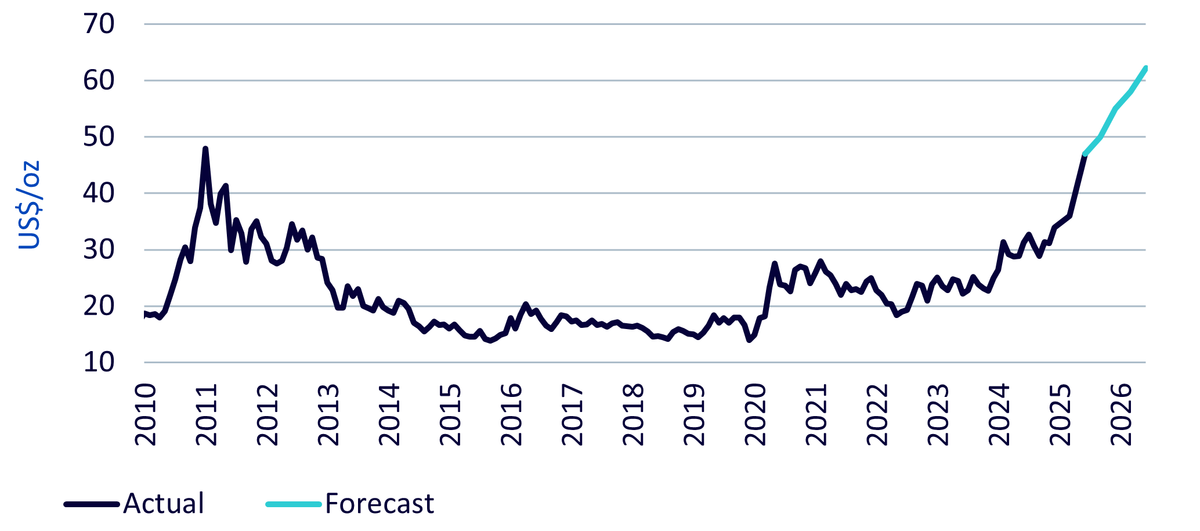
Silver prices surged to an all-time high of $53.89/oz on 16 October 2025, surpassing the previous 2011 peak. Unlike the fleeting rally of 2011, we believe today’s market is underpinned by strong fundamentals, setting the stage for further gains over the coming year.
Silver typically acts as a leveraged proxy for gold. Our models indicate a beta of 1.4 - meaning that if gold rises 1%, silver tends to climb around 1.4%, all else equal.
Gold remains well-supported by a depreciating dollar, falling bond yields, elevated inflation, and heightened policy uncertainty, particularly around trade and debt management. As we outlined in our recent Gold Outlook , gold prices are expected to reach $4,530/oz by Q3 2026 under our consensus scenario.
Using our gold-linked model, we forecast silver prices to rise to $62/oz by Q3 2026 (Figure 1), supported by robust industrial demand, even as some thrifting in photovoltaic (PV) silver usage occurs. Silver mine supply is unlikely to expand rapidly despite these price gains, as most silver is produced as a byproduct of other metals such as copper, nickel and zinc. Higher silver output will likely depend on broader strength in those base metals.
The silver market has been in deficit for four consecutive years (Figure 2), though the deficit’s size may narrow this year.
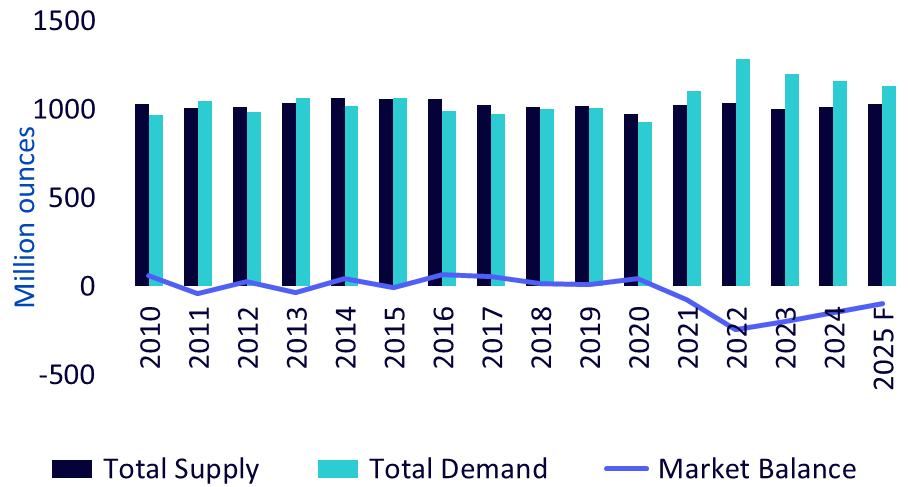
Source: WisdomTree, Metals Focus. Historical data: 2010 –2024. Forecast 2025. Forecasts are not an indicator of future performance and any investments are subject to risks and uncertainties
However, physical tightness has become evident in key markets, notably London and Mumbai. London spot prices are trading at a premium to front-month Comex futures (Figure 3), reaching their highest spread since the early 1980s, when the Hunt Brothers’ attempted market corner led to significant distortions.
Figure 3: COMEX - Spot Silver
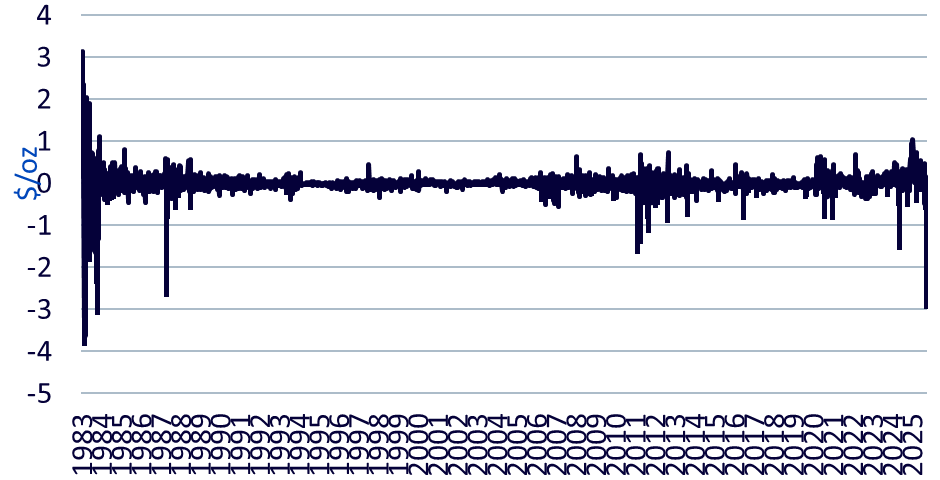
This tightness stems partly from silver outflows from London vaults to the US, a trend amplified by fears of potential US tariffs. Traders have pre-emptively relocated metal to the US, anticipating future restrictions. The resulting wide differential between London spot and COMEX front-month prices has sparked reverse arbitrage, with silver now being air-freighted back to Europe to capitalise on price gaps. This is an extraordinary situation for this market.
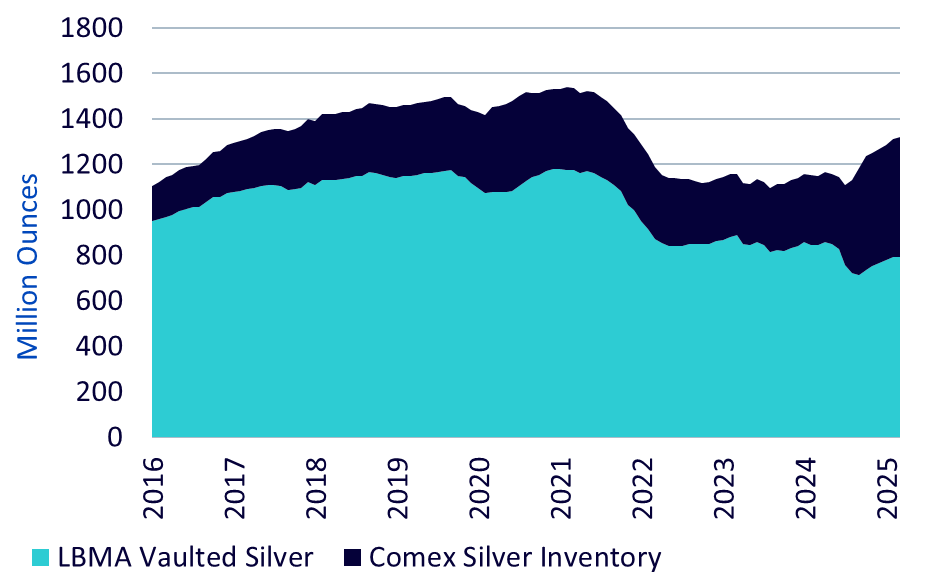
Figure 4 illustrates that the combination of London Bullion Markets Association (LBMA) and COMEX gold inventory is not necessarily low, relative to the past; it’s just that the metal is more concentrated in the US, and it has taken a spike in spot prices versus the front month future to move this metal.
Figure 4: LBMA and COMEX Silver Inventory
As long as tariff fears persist, physical markets are likely to remain constrained. The upcoming US Geological Survey’s critical minerals list, expected in early November 2025, could be pivotal. If silver is included, it may sustain tariff speculation; if excluded, it could alleviate those concerns.
Despite reports of long queues at pawnbrokers and scrap silver buyers, much of this reflects retail investors selling silver to realise profits, rather than a surge in new buying.
Industrial demand: PV innovation and thrifting
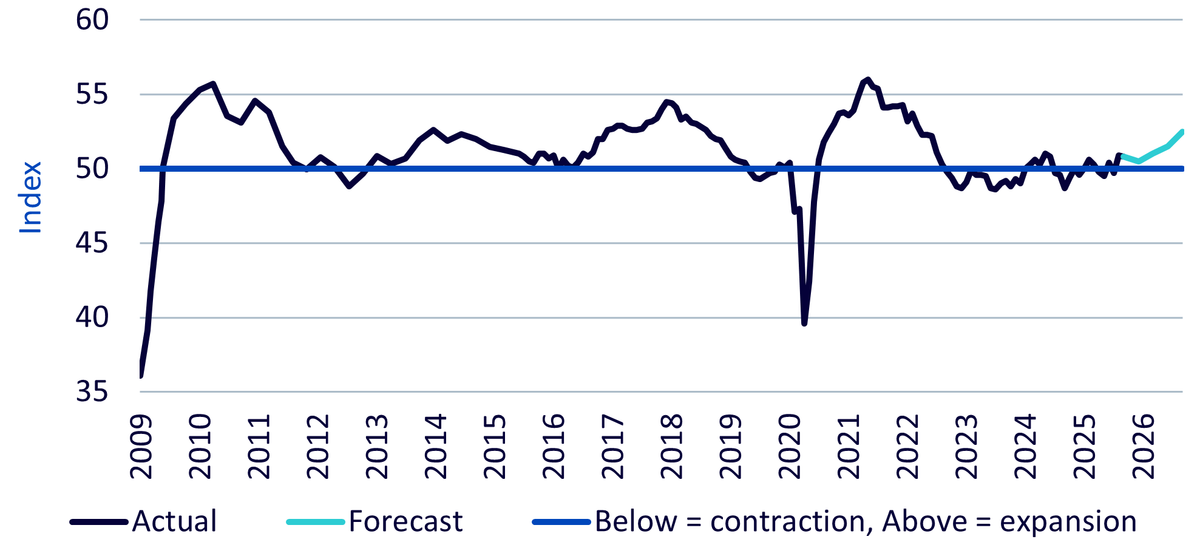
We expect industrial demand to rise this year as easing monetary policy fuels greater economic activity, with Global Purchasing Managers’ Indices already surpassing the 50 demarcation of contraction and expansion (Figure 5). That should be supportive for silver demand.
Figure 5: Global Manufacturing Purchasing Managers Index
Silver’s industrial demand has remained resilient in prior years despite the lacklustre broader industrial environment, largely due to its essential role in photovoltaic (PV) technologies. However, innovation within the PV industry is reshaping silver’s future usage profile.
Since 2022, manufacturers have increasingly adopted copper-cored silver pastes for heterojunction (HJT) and TOPCon cells, reducing silver content from over 50% in 2023 to just 10–15% by mid-2025, without compromising efficiency.
Further silver savings are emerging from:
Collectively, these developments could reduce silver consumption per watt by 15–20% in 2025, marking a pivotal shift toward cost-efficient, copper-based PV production.
Indian Demand Resilient Despite Record Prices
In India, local silver prices have approached ₹150,000/kg, yet demand has remained robust through September and early October. Premiums ranging from $0.50 to $1/oz signal strong physical buying.
Growth has been led by investment demand, with silver’s rally boosting investor confidence. Sales of bars and coins have risen, while silver ETPs continue to attract inflows, bringing loco-India holdings above 2,000 tonnes. Jewellery and silverware demand also improved ahead of the festive season, though gains were less pronounced than in investment categories.
Outlook
We believe silver’s record-breaking rally is fundamentally justified, not speculative. The combination of structural industrial demand, limited supply growth, and supportive macroeconomic drivers for gold point to further upside through Q3 2026. Short-term market tightness may ease if tariff fears abate, but the medium-term trajectory remains firmly bullish.
Implementation
WisdomTree Core Physical Silver (WSLV) provides a low-cost (0.19% management fee) access to silver. Being physically backed, investors don’t have to worry about future market roll drag or additional swap fees.
WisdomTree Silver EUR daily Hedged (ESVR) provides a synthetic exposure to rolling silver futures prices with a currency hedge. The currency hedge may be an attractive feature when part of the price gains in silver is generated by US Dollar depreciation.

Head of Commodities and Macroeconomic Research, WisdomTree Europe
@NiteshShahWTNitesh Shah is a seasoned financial professional with over 24 years of experience in research and investment strategy. As Head of Commodities & Macroeconomic Research at WisdomTree Europe, he leads market analysis and insights across asset classes, with a focus on commodities and exchange-traded products. Previously, he held roles at Moody’s, HSBC Investment Bank, The Pension Protection Fund, and Decision Economics, building expertise in market analysis and strategy. Nitesh earned a master’s degree in International Economics and Finance from Brandeis University and a bachelor's in Economics from the London School of Economics. His insights are frequently featured in financial media, and he is a sought-after speaker at industry events. He also hosts the ‘Commodity Exchange’ podcast, where he discusses trends shaping global markets. Passionate about guiding investors, Nitesh provides actionable insights to help them navigate complex financial landscapes.
