


What's Hot: A momentous week for Central Banks
Publié le 5 août 2024

Piergiacomo Braganti
Director, Research

Blake Heimann
Senior Associate, Quantitative Research

Dovile Silenskyte
Director, Digital Assets Research

Baoqi Zhu
Senior Associate, Quantitative Research and Multi Asset Solutions
Points clés
- Softer jobs data is shaping up to be the key driver for a September rate cut
- Bank of England cuts interest rates but loosening cycle will be gradual and shallow
Last week was crucial for 3 of the world's major Central banks. We witnessed a cocktail of rigor and a constructive approach towards the expansionary turnaround of interest rates. The Bank of Japan's (BOJ) raised interest rates, bringing the reference rate to 0.25%, the highest level since 20081. On Wednesday 31st it was the turn of the Federal Reserve (Fed), which did not make any decisions on rates but, implicitly opened the door to a 1st rate cut in September. Finally, on Thursday 1st August, it was the Bank of England's (BOE) turn to decide to start the "easing" phase of monetary policy, through a 0.25% cut2.
The BOJ has decided to start the "normalization" of monetary policy, which has been ultra-expansionary until now. The Monetary Policy Committee chaired by Governor Kazuo Ueda, also decided to halve the enormous Japanese Government Bond purchase plan (JGB). Mr. Ueda highlighted the persistent inflation risks, due to the higher costs of imported goods, therefore revising upwards the forecasts for consumer inflation (CPI) for 2025 from 1.9% to 2.1%1. The monthly value of purchases of bonds and exchange traded investment funds (ETF) will gradually decrease to ¥3trn, from the current ¥6trn, starting from the Q1 20251.
The double move by the BoJ comes just a few hours ahead of the decision of the FOMC (Federal Open Market Committee of the Federal Reserve), which, while leaving rates unchanged, has left the door open for their 1st cut in the September. The choices of the 2 Central Banks are going in the direction hoped for by the markets. The expectations of a narrowing of the interest rate differential between the US and Japan have triggered, in the last 2 weeks, a strengthening of the US Dollar/Yen cross compared to the recent 38-year lows, at 162x.
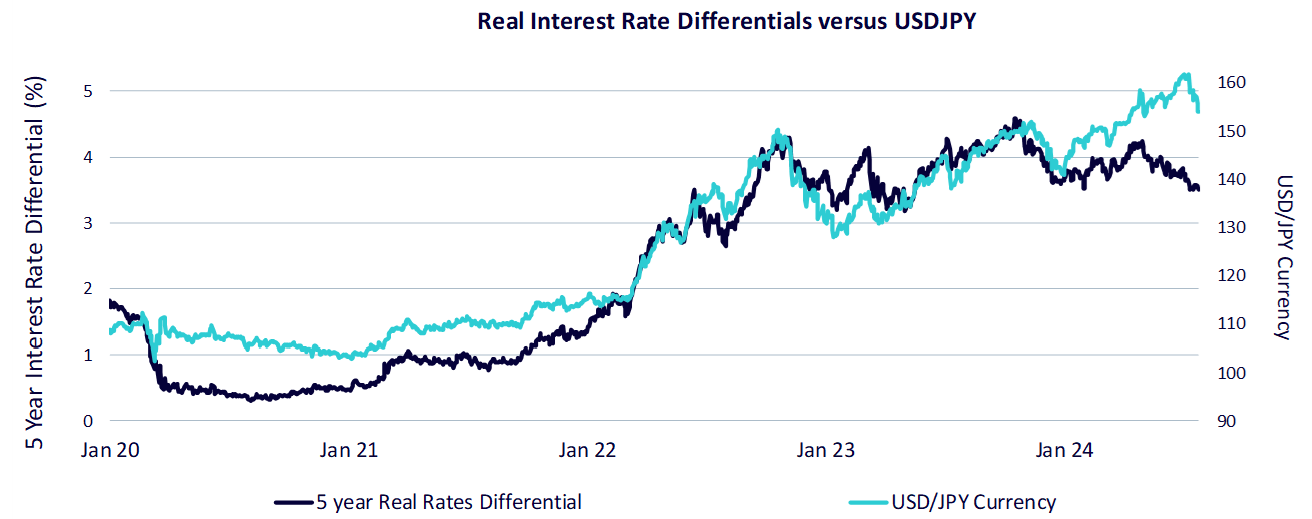
Source: Bloomberg, WisdomTree as of 25 July 2024. Historical performance is not an indication of future performance, and any investments may go down in value.
In the United States, inflation is falling, and growth still remains highest among G10 economies . Powell doesn’t hide a certain optimism but underlines that the Fed wants to see retail inflation that impacts families the most (i.e. PCE – Personal consumer expenditures) fall steadily to 2.0% before acting on the rate cut4.
Inflation has nevertheless fallen significantly and a change in monetary policy appears closer, probably in the September FOMC, which is the last before the American Presidential elections in early November.
However, at the end of July 31st meeting, the Fed preferred to leave the 5.25-5.50% range unchanged for the 8th time in a row, alias at the highest level in over 20 years, explaining that it "does not consider it appropriate to reduce rates until it has greater confidence that inflation is moving sustainably towards 2%"4.
Indeed, although the labour market continued to grow, the unemployment rate went from 3.7% in December 2023 to 4.3% in July 2024 . On the subject, Jerome Powell was clear: "for a long time, since inflation arrived, it was right to keep the main focus on it, but now that it has slowed, and the labour market has cooled we must try to look at both objectives". The "dual mandate" of the Federal Reserve, that is, to pursue both employment growth and price stability objectives, was therefore reaffirmed.
The BOE on August 1st decided to embark on the 1st rate cut since March 2020 from 5.25% to 5.00%, market expectations were not so clear, and equally so was the vote of the Board: 5 in favour and 4 against, with the decisive vote of Governor Bailey. Bailey was also quick to point out that further reductions will be carefully evaluated to avoid cutting too much or too quickly5.
The drop in consumer inflation in the United Kingdom to 2.0% in June contributed to supporting the hypothesis of a cut in July, although the “core” inflation (ex-food and energy) remained high, 3.5%, as had only happened in 2011 in the new millennium6. Inflation, moreover, could rise again as early as July due to a statistical effect, and then stall around 2.5% assuming that average monthly increases between now and December are between +0.1 and +0.2%7.
For the BoE, the biggest source of concern remains wages, whose growth rate has been close to +6% for several months, and which could have intuitive positive effects on personal spending, but negative effects on inflation dynamics in the remaining part of 20246.
2024, although later than expected, is the year of the turning point towards an expansionary monetary policy in those countries where the fight against inflation had been mainly based on the increase in the cost of borrowing. A gradual decline in interest rates could produce more favourable financial conditions, lower bond yields and better prospects for stock market performance.
Fierce rotation across large and small cap stocks
In the world of equities, mid and small-cap stocks responded positively to the expectation of rate cuts. When the US CPI for June was released on July 11, it came in lower than expected, which stabiles the market expectation on the rate cuts in September. As a result, the Russell 2000 index surged by 9.2% in the week following the CPI release9. This development also potentially benefits tech-focused ETFs that overweight mid-small caps.
Take, for instance, the WisdomTree Cloud Computing UCITS ETF (WCLD). WCLD focuses on companies providing cloud-based software and services. Around 62% of its exposure is to mid-small caps as of 31 July 2024. In the week after July 11, the mid-cap and small-cap components of WCLD delivered returns of 5.5% and 10.4%, respectively, while the large-cap holdings in the portfolio returned -1.7%.10 As the anticipation of rate cuts stabilizes, mid and small caps in the tech sector are likely to benefit due to reduced funding costs and improved valuations.
Cumulative Returns Since US June CPI Released
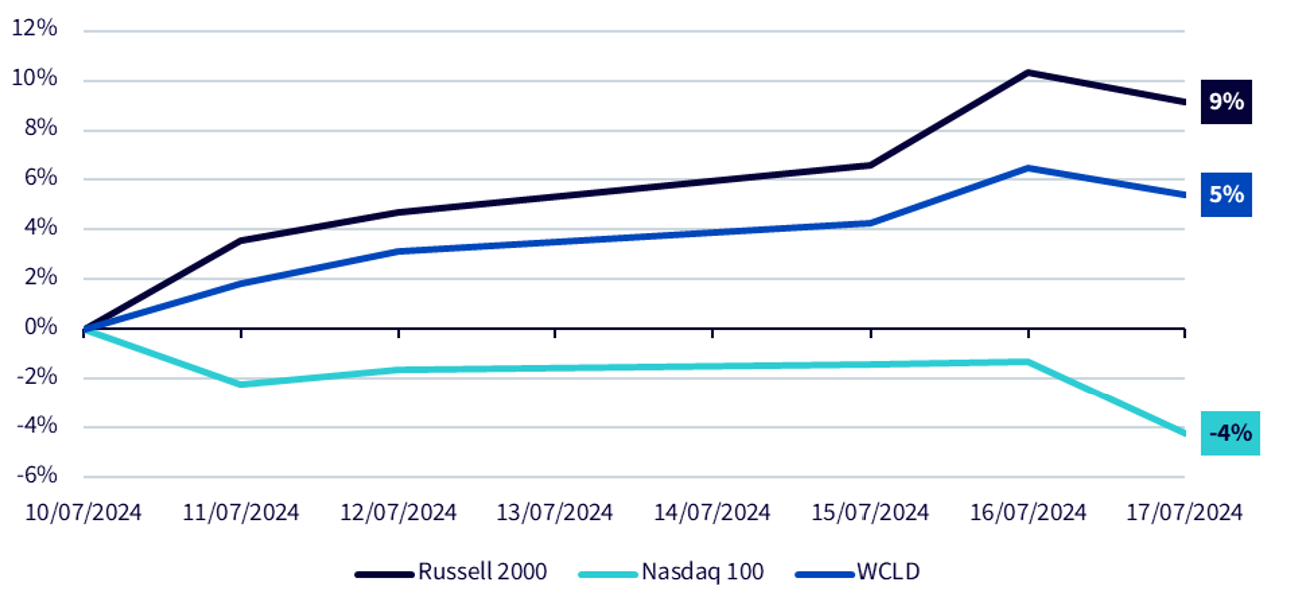
Source: Bloomberg. WCLD's return is based on the fund's NAV in USD. Historical performance is not an indication of future performance, and any investments may go down in value.
Yen correction can reverse
USD/JPY has corrected 7.4% off its highs11. The BOJ has made a political decision to support the Yen. This is evident as the Japanese economy’s growth in Q1 was weak and inflation has been falling. In such as scenario we would expect the BOJ to support the economy. Real wages have been falling owing to the relatively higher level of inflation and higher social security contributions. By raising interest rates, the BOJ expects the economy to remain robust and inflation to remain high. However, if these expectations fail to materialise the Yen could reverse its recent appreciation versus the US dollar.
Source
1 Bank of Japan as of 31 July 2024
2 Bloomberg as of 1 August 2024
3 Bloomberg as of 30 June 2024
4 Bloomberg as of 1 August 2024
5 Bloomberg as of 2 August 2024
6 Office for National Statistics as of 17 July 2024
7 Bloomberg, WisdomTree as of 31 July 2024
8 Bloomberg as of 31 July 2024
9 Bloomberg from 8 July to 12 July 2024
10 Bloomberg as of 31 July 2024
11 Bloomberg from 10 July to 1 August 2024
À propos des contributeurs

Piergiacomo Braganti
Director, Research
Piergiacomo is Director of Research at Wisdomtree. He has over 20 years of experience within the financial services industry, having served as the Head of Discretionary Portfolio Management at Banca Albertini Spa in Milan before joining WisdomTree. Prior to this, he held roles at Rasbank Spa (currently AllianzBank Financial Advisors) as Head of Equity Research and Head of Equity Desk. Piergiacomo has an M.Sc. in Financial Markets Economics from Bocconi University in Milan. He is also a chartered member of the Aiaf (Italian Association of Financial Analysts).

Blake Heimann
Senior Associate, Quantitative Research
Blake Heimann joined WisdomTree in 2020 and, in his current role as Senior Associate, supports the creation, maintenance, and reconstitution of our indices. Blake began his career in finance in 2017 as an Analyst at TD Ameritrade, and later a Quantitative Analyst with focuses on research and development of machine learning applications in finance. Blake has bachelor’s degrees in Mathematics and Economics from Iowa State University, as well as his Masters in Computer Science at Georgia Tech, with a specialization in Machine Learning. He is currently pursuing a Masters in Finance from the London School of Economics.

Dovile Silenskyte
Director, Digital Assets Research
Dovile Silenskyte is a director of digital assets research at WisdomTree. Before joining WisdomTree in May 2024, Dovile worked as an index equity product strategist at BlackRock. Currently, she is responsible for conducting analyses for in-house digital assets publications and assisting the sales team with client queries about products and markets. Dovile holds an MSc in Finance from Texas A&M University – Commerce, and she is also a chartered financial analyst (CFA).

Baoqi Zhu
Senior Associate, Quantitative Research and Multi Asset Solutions
Baoqi Zhu joined WisdomTree in 2023 as a Senior Associate on the Research team. Baoqi focuses on quantitative research on thematic equity indices and portfolio solutions. Prior to WisdomTree, Baoqi spent over two years at Ernst & Young (EY) in their Quantitative Advisory Services, where he was involved in the research and development of quantitative risk models. Earlier in his career, Baoqi served as a quantitative analyst within a multi-asset structuring team at Maven Global for more than three years. His responsibilities included designing and optimising bespoke hedging strategies based on derivatives. Baoqi holds a MSc in Financial Engineering & Risk Management from Imperial College London and a BSc in Actuarial Science from Nankai University, China. He is also a certified Financial Risk Manager (FRM).

Aneeka Gupta
Director, Macroeconomic Research, WisdomTree Europe
@AneekaGuptaWTAneeka Gupta is Director of Research at WisdomTree. Prior to the acquisition of ETF Securities in April 2018, Aneeka worked as an Equity & Commodities Strategist at the company. Aneeka has 17 years of experience working as a Research Analyst across a wide range of asset classes. In her current role she is responsible for conducting analysis for all in-house equity, commodity and macro publications and assisting the sales team with client queries around products and markets. Prior to WisdomTree, Aneeka began her career as an equity analyst at Bear Stearns International Ltd in London. She also worked as an Equity Sales Trader at Sunrise Brokers across US and Pan European Exchanges. Before that she worked as an Equity Derivatives Sales Manager at Mashreq Bank in Dubai. Aneeka holds a Masters in Mathematics from Oxford University and a BSc in Mathematics from the University of Delhi, India. She is also a CFA Charterholder.