

WisdomTree Multifactor: Not the Low Volatility You’re Used To…
Published October 3, 2018

Head of Indexes, U.S.
We recently wrote about why our multifactor strategies favor using the low-correlation factor instead of the low-volatility factor as part of our alpha-seeking stock selection composite multifactor scoring. In that piece we laid out two reasons for this. The first was that low volatility as a standalone factor did not generate absolute excess returns versus the market over the last 50-plus years. The second is that, historically, the low-volatility factor has been extremely sensitive to interest rates, generally underperforming in rising rate environments.
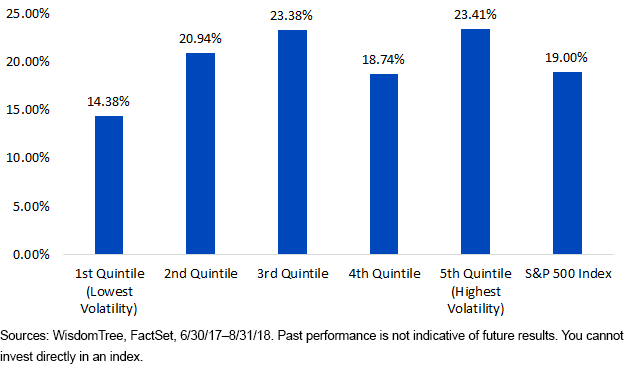
Since the inception of WisdomTree’s U.S. Multifactor Index (WTUSMF) just over 14 months ago, the yield on the 10-year U.S. government Treasury has increased 60 basis points (bps).1 As can be seen in the chart below, over this same period, the S&P 500 Index returned 19% annualized, led by its highest-volatility stocks, while low volatility has underperformed, in line with what we’ve seen in past rising interest rate periods.
S&P 500 Volatility Quintile Returns
Low Volatility Underperforms with Rising Rates
WTUSMF’s Implicit Tilt to Low Volatility
Despite not using low volatility as an alpha-seeking factor, we are aware of its prowess in risk-adjusted terms and therefore use it as part of our strategy’s weighting mechanism. Also, given some of our factor definitions, like risk-adjusted returns for momentum, the composite multifactor score rewards lower-volatility companies and implicitly tilts the strategy toward this factor. (For more on our multifactor methodology, please refer to this piece.)
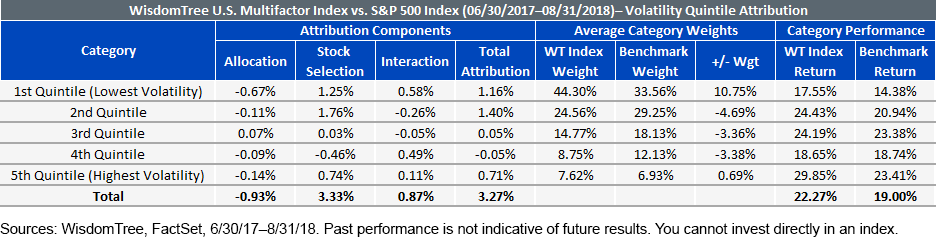
Stock Selection Value Added Within Lowest-Volatility Quintile
The table above shows the performance attribution of WTUSMF versus the S&P 500 Index in terms of volatility quintiles. It is interesting to see how, since its inception, WTUSMF has been over-weight the lowest-volatility quintile while being under-weight the rest.
The WTUSMF has outperformed the S&P 500, despite having its highest allocation and greatest over-weight in what was the worst performing segment for the S&P 500. Strong stock selection is evident throughout four of the five volatility quintiles, combining for 333 basis points of outperformance.
Typical single-factor low-volatility portfolios tend to naively over-weight the lowest-volatility stocks in the investment universe, resulting in significant deviations in active weight while not providing differentiated stock selection. As a result of their methodology, these pure low-volatility portfolios magnify their interest rate sensitivity, and their performance becomes heavily dependent on the path of rates, as they have no other means of factor diversification.
Conclusion
WisdomTree implements a composite multifactor blending approach targeting value-added stock selection. Although we do not explicitly target low volatility as an alpha-seeking factor, our methodology results in an implicit tilt toward it. This implicit tilt allows the stock selection benefits inherent in our methodology to persist and thus give alpha potential regardless of the path in interest rates.
1Source: Bloomberg, 6/30/17–8/31/18.
Categories
About the contributor

Head of Indexes, U.S.
Alejandro Saltiel joined WisdomTree in May 2017 as part of the Quantitative Research team. Alejandro oversees the firm’s Equity indexes and actively managed ETFs. He is also involved in the design and analysis of new and existing strategies. Alejandro leads the quantitative analysis efforts across equities and alternatives and contributes to the firm’s website tools and model portfolio infrastructure. Prior to joining WisdomTree, Alejandro worked at HSBC Asset Management’s Mexico City office as Portfolio Manager for multi-asset mutual funds. Alejandro received his Master’s in Financial Engineering degree from Columbia University in 2017 and a Bachelor’s in Engineering degree from the Instituto Tecnológico Autónomo de México (ITAM) in 2010. He is a holder of the Chartered Financial Analyst designation.