

Why We See Value in Something That Is No Longer Value
Published January 8, 2018

Director, Model Portfolios
Barring unforeseen circumstances, later this January marks the two-year anniversary of the start of the current emerging markets (EM) bull market. Since bottoming out on January 21, 2016, the MSCI Emerging Markets Index has rallied an impressive 70%.1 While some investors may be becoming hesitant on the asset class after the expansion in valuations, we see others remaining bullish on its outlook.
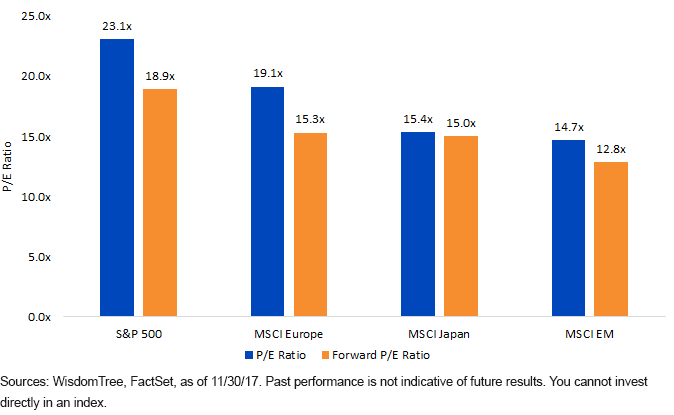
As value investors, we are constantly assessing asset valuations and searching for where the best opportunities exist. Looking across the globe right now, we think EM still represents the best equity valuation opportunity on an absolute and relative basis.
Global Equity Index Valuations
Value Is More Than Just a Number
That said, context is needed to tell the whole story. Value investing requires more than just looking at a group of numbers at a given point in time and selecting the smallest one.
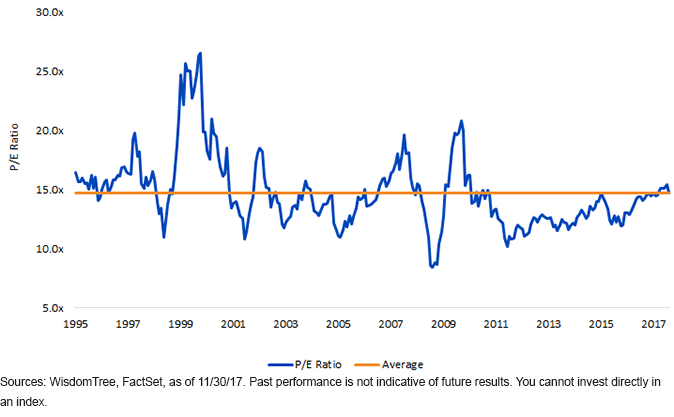
EM is currently trading almost exactly at its long-term average P/E ratio dating back to the mid-1990s—a span of time that includes periods of boom and bust for the asset class. Even with the 70% rally over the last two years, EM is right at its historical fair value.
MSCI EM Index Historical Valuations
Equity Transformation Leading Economic Transformation
While EM’s current valuation paints a picture of fair value, we think there’s a more important story taking place beneath the surface that isn’t receiving enough recognition. Much fanfare has been made about the gradual transition within EM from the old economies to new ones, but less ink has been spilled on the fact that the equity markets have already seen this transformation take place.
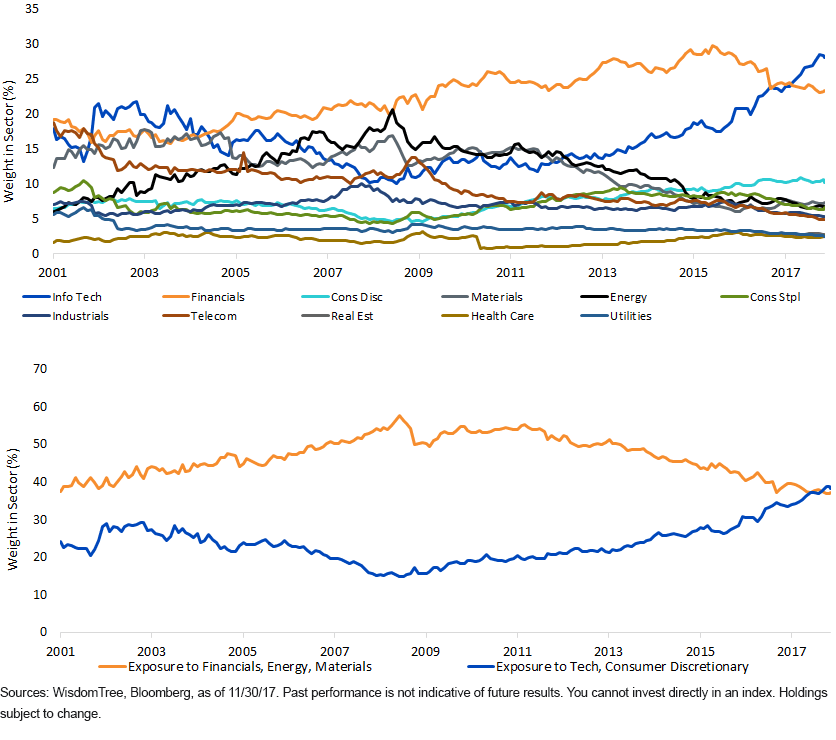
For much of its history, the EM equity asset class was dominated by some of the sectors that are traditionally associated with value investing—Financials, Energy and Materials (the latter two being the primary commodity-linked sectors). This was particularly true during the mid-2000s commodity super cycle, when those three sectors combined for a whopping 58% weight in the Index at their peak.2 In recent years, the asset class has matured to one with larger exposures in the new economy sectors that are more closely aligned with growth investing—namely Tech and Consumer Discretionary.
In fact, this past September, the combined weight in those two growth sectors surpassed that of the three value sectors for the first time—a trend that certainly looks like it may continue. What was long seen as a value asset class that was reliant on commodities has finally made the leap into the long-awaited play on the EM consumer growth story.
Composition of MSCI EM Index Dynamically Shifting
Buying Growth at Value Prices
Back to valuations. Today we find ourselves comparing EM’s current valuation to its own history—a history of being a value-dominated asset class. The composition of the Index has clearly changed to an equity market that is driven by growth, but the current and historical valuation levels are the exact same.
Therefore, we see value in EM because it is no longer value. Put another way, imagine if the Russell 1000 Growth Index were trading at the historical P/E ratio of the Russell 1000 Value Index.”
Given this evolution, in our view, historical valuation comparisons understate the real value being offered by EM. Even after the run since January 2016, we believe EM equities still represent a fantastic value opportunity on an absolute, relative AND historical basis.
And while valuation alone is not a catalyst, there are a few potential tailwinds in the coming months that we’re monitoring closely:
- Strong projected earnings growth this year (with consensus growth at around 13%)3
- Continued easy policy from most EM central banks
- Strengthening EM currencies that still look undervalued on a PPP basis
- Near-universal improvement in financial accounts from 2013 levels
- An expected acceleration in the global and EM GDP growth rates
With all that in mind, we have reason to remain bullish on EM going into 2018.
Best Ideas for 2018
In terms of portfolio implementation, we like a few themes for 2018. These include the continued rally in large tech names that have high expected earnings growth; accessing local economy exposure with the pickup in EM GDP growth; and India, arguably our favorite long-term story, as the impact of demonetization and the GST bill rolls off.
The WisdomTree Emerging Markets ex-State Owned Enterprises Fund (XSOE) has over-weight positions in Tencent, Alibaba and Baidu, each of which has long-term EPS growth expectations above 22%.4 The WisdomTree Emerging Markets SmallCap Dividend Fund (DGS) derives 81% of its revenues from within emerging markets5 and should benefit from a pickup in internal economic activity. Finally, The WisdomTree India Earnings Fund (EPI), which celebrates its 10-year anniversary in February, takes our patented earnings-weighted approach to magnify the impact the top earnings generators have on the total strategy. Looking ahead, we think each of these strategies is well positioned to effectively capture the changing dynamics of the asset class.
1Source: Bloomberg, as of 11/30/17.
2Source: Bloomberg, on 6/30/08.
3Source: Merrill Lynch, as of 11/28/17.
4Source: Bloomberg, as of 12/11/17. Over-weight positions compared to MSCI EM Index. Please click [here] for a list of XSOE holdings.
5Source: FactSet, as of 11/30/17.
Important Risks Related to this Article
There are risks associated with investing, including possible loss of principal. Foreign investing involves special risks, such as risk of loss from currency fluctuation or political or economic uncertainty. Investments in emerging, offshore or frontier markets are generally less liquid and less efficient than investments in developed markets and are subject to additional risks, such as risks of adverse governmental regulation, intervention and political developments. Funds focusing their investments on certain sectors, smaller companies, and/or regions increase their vulnerability to any single economic or regulatory development. This may result in greater share price volatility. Investments in currency involve additional special risks, such as credit risk and interest rate fluctuations. The Funds may invest in the securities included in, or representative of, its Index regardless of their investment merit and the Fund does not attempt to outperform its Index or take defensive positions in declining markets. As some of the Funds may have a high concentration in some sectors, they may be adversely affected by changes in those sectors. Due to the investment strategy of certain Funds it may make higher capital gain distributions than other ETFs. Please read each Funds’ prospectuses for specific details regarding each Funds’ risk profile.
About the contributor

Director, Model Portfolios
Joe Tenaglia joined WisdomTree as Asset Allocation Strategist in 2016. He is responsible for building and managing WisdomTree’s CIO-managed and custom model portfolios. In this role he focuses on asset allocation, security selection, and portfolio construction for the firm’s open architecture models, with objectives ranging from strategic to tactical. Joe sits on WisdomTree’s Model Portfolio Investment Committee, which oversees the firm’s ETF models and helps shape and communicate WisdomTree’s thoughts on the markets. Prior to joining WisdomTree, he held roles at Emerging Global Advisors (acquired by Columbia Threadneedle) and BNY Mellon. Joe received his B.S. in Finance and Marketing from Boston College. He is a holder of both the Chartered Financial Analyst designation and Chartered Market Technician designation.