

How to Access Shareholder Yield in U.S. Small Caps
Published January 5, 2018

Global Head of Research
In U.S. equities, investors love the idea of small-cap stocks. Some of these companies represent the entrepreneurial spirit, and it’s no secret that many investors dream of the “lottery-like” experience of finding the next Facebook, Amazon, Netflix or Google before it becomes a giant company—collecting stratospheric returns along the way.
More Realistic Strategies in U.S. Small Caps
Of course, the chance of finding such blockbuster firms early in their life cycles is extremely low, and we think it would be difficult for most investors to build strategic allocations with that type of thinking. Fortunately, history has shown that certain characteristics of U.S. small-cap stocks have been associated with long-term outperformance.
One tilt that has been associated with stronger returns is U.S. small caps that are buying back their shares—and it’s notable that traditional market capitalization-weighted benchmarks miss it.
Net Buybacks: Beneficial/Highest Net Issuance: Significantly Lower Returns
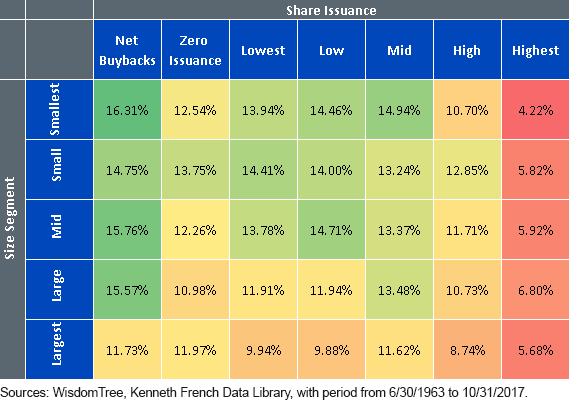
- The highest return (darkest shade of green) was found in the smallest companies with net buybacks. While the small cap or “size” premium has been followed for many years, newer thinking seeks to mix the concept of focusing on small stocks with other factors, such as quality. One avenue through which to create a small-cap exposure with high quality is small stocks that are buying back shares.
- Also noteworthy is that, across all the size segments, the worst returns were in those stocks with the highest share issuance. We think it could make a lot of sense—whenever thinking about a U.S. equity exposure—to at least be aware of the net buyback ratio of that exposure to try to avoid those firms that are issuing the most stock.
Market Capitalization-Weighted Small-Cap Indexes Miss This Focus
For definitions of indexes in the chart, visit our glossary.
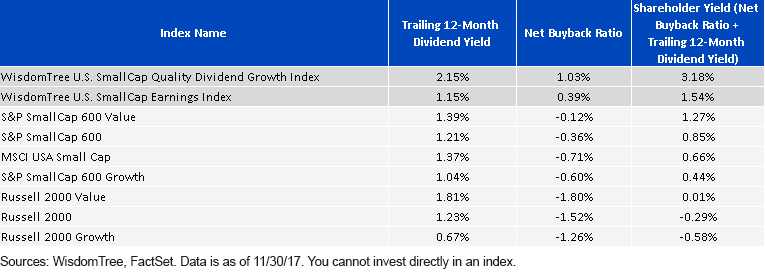
- Looking at the net buyback ratio for the S&P, MSCI and Russell Indexes shown in the table, we see they all have negative values, meaning that there is greater aggregate share issuance than share buybacks. It is clear that the Russell Indexes had the most issuance. We think it’s notable to point out that S&P does have a requirement that constituents have four quarters of positive generally accepted accounting principles (GAAP) net income prior to initial inclusion, and that firms that are profitable have less potential need to issue new shares, diluting their current ownership.
- The WisdomTree U.S. SmallCap Quality Dividend Growth Index directly focuses on long-term earnings growth, as well as three-year averages of return on equity (ROE) and return on assets (ROA). The WisdomTree U.S. SmallCap Earnings Index eliminates exposure to firms that did not display cumulative profitability over the prior four quarters leading up to the annual screening date. Both of these Indexes purposefully tilt away from the lowest quality, most speculative small-cap companies, and notably both of them had positive net buyback ratios.
Consistency: An Important Attribute for Any Active Manager
Now, we recognize that these non-market capitalization-weighted indexes that try to capture a version of “modern alpha” are newer and that most investors are far more familiar with analyzing active managers. A critical attribute that tends to be highly valued in any due diligence process is consistency—a record of live performance that shows that the current set of characteristics has been consistently achieved over more than just the most recent time frame.
WisdomTree’s Methodologies Have Consistently Increased Shareholder Yield
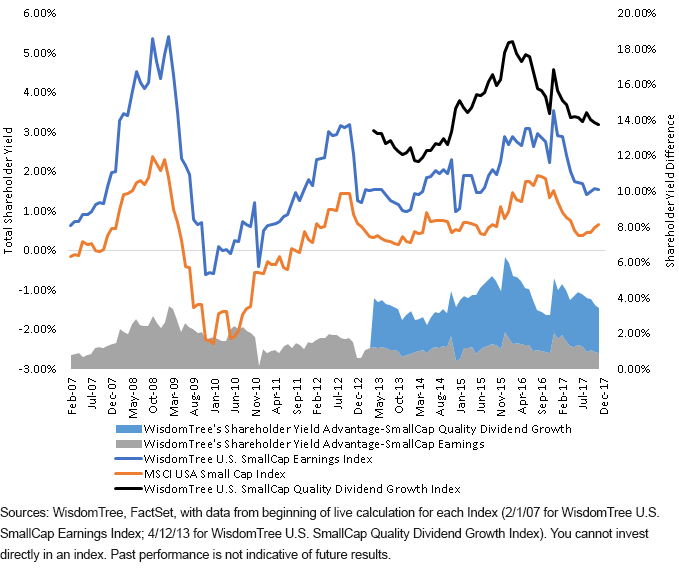
- The methodology of the WisdomTree U.S. SmallCap Earnings Index has led to a fairly stable improvement in shareholder yield compared to the MSCI USA Small Cap Index that has been persistent for almost 11 years. An annual rebalance during which firms that have become unprofitable are systematically removed has been critical in generating this advantage.
- In our opinion, we would expect the WisdomTree U.S. SmallCap Quality Dividend Growth Index to rival any U.S. small-cap equity index on a shareholder yield basis. First, it focuses on dividend payers and is weighted by the Dividend Stream®, thereby raising the dividend yield portion of the equation. Additionally, the focus on ROE/ROA tends to tilt away from those firms that have the highest share issuance and are more speculative in nature. While it hasn’t been around as long as the WisdomTree U.S. SmallCap Earnings Index, we don’t believe that the higher shareholder yield we’ve seen there represents a fluke.
Setting Up a Long-Term Strategic Allocation to U.S. Small Caps
While no one can say precisely what future returns will be, we think that well-known historical work supports the concept of small caps being combined with quality.1 Those companies that have been buying back shares, it’s no secret as well, have been performing more strongly than those companies that have been issuing the most shares. We think that both the WisdomTree U.S. SmallCap Earnings and Quality Dividend Growth Indexes offer interesting avenues to access the concept of small-cap quality.
1Example of historical research touching on theme: Clifford Asness, et al., “Size Matters, if You Control Your Junk,” SSRN, first draft written 1/15.
Important Risks Related to this Article
Investments focusing on certain sectors and/or smaller companies increase their vulnerability to any single economic or regulatory development.
Categories
About the contributor

Global Head of Research
Christopher Gannatti began at WisdomTree as a Research Analyst in December 2010, working directly with Jeremy Schwartz, CFA®, Director of Research. In January of 2014, he was promoted to Associate Director of Research where he was responsible to lead different groups of analysts and strategists within the broader Research team at WisdomTree. In February of 2018, Christopher was promoted to Head of Research, Europe, where he was based out of WisdomTree’s London office and was responsible for the full WisdomTree research effort within the European market, as well as supporting the UCITs platform globally. In November 2021, Christopher was promoted to Global Head of Research, now responsible for numerous communications on investment strategy globally, particularly in the thematic equity space. Christopher came to WisdomTree from Lord Abbett, where he worked for four and a half years as a Regional Consultant. He received his MBA in Quantitative Finance, Accounting, and Economics from NYU’s Stern School of Business in 2010, and he received his bachelor’s degree from Colgate University in Economics in 2006. Christopher is a holder of the Chartered Financial Analyst Designation.