

What Hidden Gem ETF Beat the MSCI Emerging Markets Index by Nearly 1,000 BPS in 2017?
Published March 23, 2018

Chief Investment Strategist
In January, I was invited to speak at the Inside ETFs conference in Florida about a WisdomTree exchange-traded fund (ETF) that the organizers had selected as one of the industry’s “hidden gems.” There was only one catch: I would, like the other nominees, be given only three minutes to explain why this ETF was a diamond in the rough. Here is a brief summary of those 180 seconds.
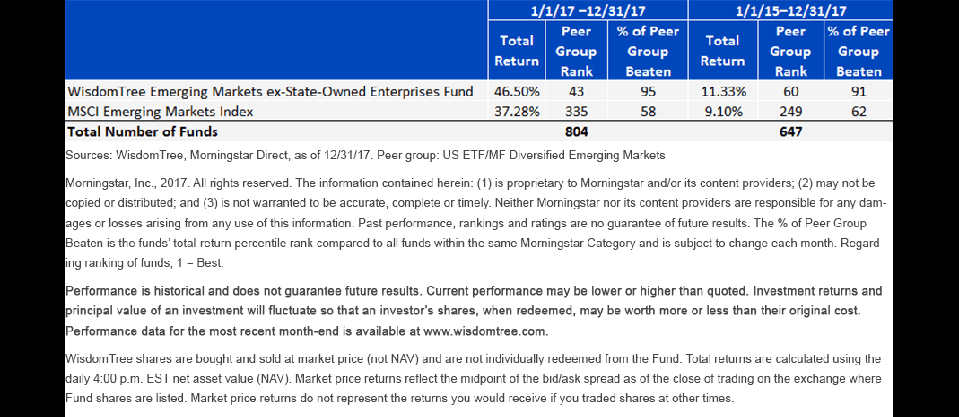
As many investors know, broad emerging markets were the best-performing major asset class last year. But what “hidden gem” emerging markets ETF beat the MSCI Emerging Markets Index by nearly 1,000 basis points (bps) in 2017?
The answer is XSOE, the WisdomTree Emerging Markets ex-State-Owned Enterprises Fund. How did it do so? And how did it manage to outperform the MSCI Index over the past three years, a period in which it also outperformed 91% of its Morningstar peer group?
Peer Group Performance Ranks Against Mutual Funds and ETFs
For XSOE standardized performance and expenses, please click here.
The short answer is that the Fund stayed true to its name—it avoided the state-owned enterprises (SOEs) in the emerging world. WisdomTree defines a SOE as a company where governments control at least 20% of the outstanding shares. In October, that represented some 300 emerging market companies with a combined market value of approximately $2 trillion. Much of that value is concentrated in the Chinese banking and Russian energy sectors, although SOEs can be found in most developing nations. WisdomTree estimates that about 25% to 35% of the market capitalization of broad emerging market indexes are typically made up of state-owned entities.
Why Does WisdomTree Believe State Ownership Is a Risk Factor in the Emerging World?
Managing an enterprise well is a far greater challenge when executives are asked to serve two masters: private shareholders and government stakeholders. SOEs not only need to maximize shareholder value, they may also need to be mindful of public interests, as defined by politicians and bureaucrats. Sometimes those two imperatives conflict—and this may, over time, lead to suboptimal investment results for investors.
We have seen anecdotal evidence that this has, indeed, occurred over the past decade. In Brazil, the large multinational energy company Petrobras became involved in a huge corruption scandal after the leftist Workers’ Party (PT) government of Luiz Inácio Lula da Silva appointed political allies to some of the company’s most important executive positions.1 As the scandal unraveled, Petrobras’ stock lost nearly 60% of its value between 2014 and 2016.2 Although we don’t typically see SOEs in the U.S., investors were introduced to the downside of publicly traded government sponsored enterprises when Freddie Mac and Fannie Mae saw 99% of their stock values wiped out during the housing crash and subsequent financial crisis of 2007–2009.
By screening once a year based on this metric, WisdomTree avoids SOEs and adds back companies within those countries so that country weights approximate comparable capitalization-weighted indexes. WisdomTree also weights individual stocks based on their market values, and it constrains sector tilts at the annual rebalance of the WisdomTree Index. This allows WisdomTree to isolate its bet on companies that are freer to compete globally. If non-state-owned enterprises continue to outperform state-owned enterprises in the future, this strategy is designed to tap into that differential in returns as a potential source of alpha for emerging market investors.
Conclusion
XSOE allows investors to gain broad exposure to emerging markets without assuming the risk of owning state-owned enterprises. Last year, that simple strategy returned 46.5% at NAV, outperforming the MSCI Emerging Markets Index by 912 bps in 2017, and by 220 bps annualized over the prior three years. We believe this innovative WisdomTree ETF sets a new standard for measuring the returns of “private sector beta” across emerging market equities.
1Joe Leahy, “What Is the Petrobras Scandal That Is Engulfing Brazil?,” The Financial Times, 3/31/16.
2Note: Petrobras is contained in other WisdomTree ETFs.
Important Risks Related to this Article
There are risks associated with investing, including possible loss of principal. Foreign investing involves special risks, such as risk of loss from currency fluctuation or political or economic uncertainty. Investments in emerging or offshore markets are generally less liquid and less efficient than investments in developed markets and are subject to additional risks, such as risks of adverse governmental regulation and intervention or political developments. Funds focusing their investments on certain sectors and/or regions increase their vulnerability to any single economic or regulatory development. This may result in greater share price volatility. Investments in currency involve additional special risks, such as credit risk and interest rate fluctuations. The Fund invests in the securities included in, or representative of, its Index regardless of their investment merit and the Fund does not attempt to outperform its Index or take defensive positions in declining markets. Please read the Fund’s prospectus for specific details regarding the Fund’s risk profile.
About the contributor
