

Japan Discounts Trade Wars—Now a Value Trap?
Published March 26, 2018

Senior Advisor
In Friday trading, Japan became the first casualty in the U.S.–China trade war. Market dynamics followed the standard pattern of “risk-off”—yen strength compounded by a sharp equity market drawdown. The timing could not have been worse: Japanese institutions are preparing for the March-end fiscal year book closing and are now forced into even greater repatriation of their depreciating dollar holdings. And more importantly, Japanese policy makers appear at a loss on how to counter the demand-deflation threat posed by a trade war between Japan’s largest trade partners. Unfortunately, the special relationship Japanese prime minister Shinzo Abe built with President Trump did not yield a positive return: unlike Europe or South Korea, Japan did not get any exemptions from the tariffs.
Of course, at this point, nobody can predict the magnitude of the hit to global growth. There is hope that cooler heads will prevail and a compromise is reached before a retaliatory trade battle really gets going. However, for the markets, hope is not a strategy. Certainty is rare, but it is an undisputable fact that Japanese earnings are highly geared toward global growth: about 25% of TOPIX profits are generated from sales to the U.S. market, and about 11% from selling to China (and an additional 11% from non-China Asia). All in all, a half-percent slowdown in global growth would cut profits by about 10%, and 10% of yen appreciation cuts profits by an additional 8%. So even without the threat to global growth from a trade war, an earnings recession would be unavoidable if the yen averages ¥103/dollar for the year (current consensus calls for an 8% rise in profits). That’s what the market discounted today.
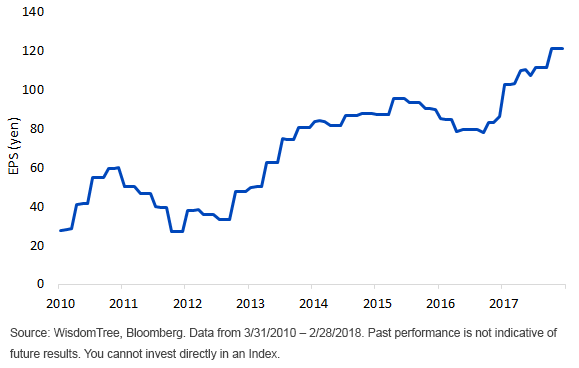
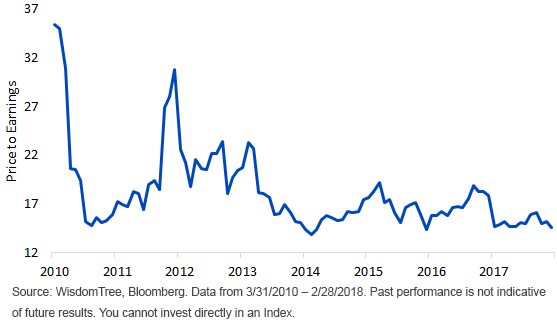
To wit: current TOPIX earnings per share (EPS) is 120, which puts the market at around 14x current earnings—assuming zero earnings growth. 14x is the bottom of the price-to-earnings (PE) trading range observed over the past decade (see charts).
Of course, value does not equal performance. While the negativity got discounted quickly, Japan will need a positive growth trigger to unlock the value. Hard to see what this trigger will be from today’s vantage point, but I have no doubt a positive trigger will come.
Possible candidates are:
- From the data front: a pick-up in U.S. car sales, a further acceleration in Chinese capital spending, an upturn in Japan’s housing market
- From the Japan policy front: a new, unorthodox but credible deregulation to force more non-yen investment, like, for example, the Japan Post Bank being allowed to offer U.S. dollar-denominated deposits;
- And, of course, a U.S.–China trade deal that ushers in a new era of U.S. –China competitive cooperation.
TOPIX EPS (current trailing)
TOPIX Price to Earnings
Important Risks Related to this Article
Investments focused in Japan increase the impact of events and developments associated with the region, which can adversely affect performance.
Categories
About the contributor
