

U.S. Treasuries: The Fed 'Wage'rs a Bet
Published January 11, 2017

Head of Investment and Fixed Income Strategy
With the release of the December Employment Situation Report last week, the U.S. Treasury (UST) market can now put a wrapper on the 2016 jobs data. Overall, the tenor of the report offered little in the way of any surprises, but what investors did begin to see was the potential transformation of what the Treasury arena is now focusing on as it relates to the employment data: wages first, job creation second.
This apparent new focus is the flip side of the usual point of emphasis as the nonfarm payroll figure typically captured the lion’s share of the headlines and the market’s attention. However, with the unemployment rate remaining below the 5% threshold for the last eight consecutive months (4.7% in December), Federal Reserve (Fed) rhetoric has begun to center on the notion that the economy is at, or close to, full employment and that the prospects for potential fiscal stimulus this year could increase the odds of a further decline in joblessness. This, in turn, could lead to upward pressure on wages. This potential “undershoot” in the unemployment rate was a point of discussion according to the December Federal Open Market Committee (FOMC) minutes and will no doubt be an area of close scrutiny for policy makers in the months ahead.
Average Hourly Earnings
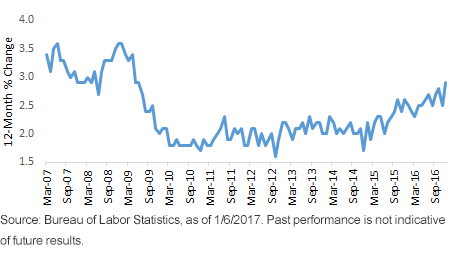
So let’s turn our attention to the “star” of this blog post, average hourly earnings (AHE). According to the Bureau of Labor Statistics, the year-over-year rate increase for AHE rose by 0.4 percentage points to +2.9%, the highest reading since mid-2009. As the graph above illustrates, since hitting a recent low of +1.7% in December 2014, wages have been on an upward trend over the last two years. It has not always been a “one-way ticket” to the upside, but an overall upward pattern has been clearly discernible. The data for this series goes back only about 10 years, and the average rate of increase is placed at +2.4%. Unfortunately, this figure is a bit skewed to the downside because of the lagged negative effects from the great recession of 2010–2012. For the record, the highpoint is +3.6%, which, coincidentally, was registered back in 2009 as well.
Conclusion
While it is highly unlikely that the Fed will raise rates at its next meeting on Feb 1, the policy makers will be watching wage trends closely. That being said, we believe fiscal policy expectations still “Trumps” wages for now, and the Fed will probably want to wait and see what comes out of Washington, D.C., on that front before making a move (unless incoming data surprisingly forces its hand earlier). If this scenario plays out and wages begin to accelerate more meaningfully, the UST discussion could turn to the Fed being behind the curve as 2017 progresses. As of this writing, the December 2017 Fed Funds Futures contract was still priced for only two rate hikes for this year. As far as a UST update, during the first week of January, the 10-Year yield had fallen as much as 25 basis points (bps) from its December 15 peak, as it appears the one-way “rates going up, bear steepener” trade got overly crowded and ran out of steam, at least for now.
Unless otherwise noted, source is Bloomberg, as of 1/6/2017.
Categories
About the contributor

Head of Investment and Fixed Income Strategy
Kevin serves as the Head of Investment and Fixed Income Strategy. In this role, he writes macro and fixed income-related content and works closely with the sales, research and marketing teams. In addition, Kevin conducts client-facing webinars and meetings, providing expertise on WisdomTree’s existing and future bond ETFs. Prior to joining WisdomTree, Kevin spent 30 years at Morgan Stanley, where he was Managing Director and Chief Fixed Income Strategist for Wealth Management. He was responsible for tactical and strategic recommendations and created asset allocation models for fixed income securities. He was a contributor to the Morgan Stanley Wealth Management Global Investment Committee, primary author of Morgan Stanley Wealth Management’s monthly and weekly fixed income publications, and collaborated with the firm’s Research and Consulting Group Divisions to build ETF and fund manager asset allocation models. Kevin has an MBA from Pace University’s Lubin Graduate School of Business, and a B.S. in Finance from Fairfield University.