

Analysis of the 2016 Earnings Index Family Rebalance
Published January 12, 2017

Global Chief Investment Officer

Director, Research
At WisdomTree, we believe strongly in relative value rebalancing. The act of rebalancing constituents of an Index to their fundamental values is important, given our belief that stocks often overshoot their underlying fundamentals. Consequently, investors run the risk of paying too much for stocks that have become more expensive. A disciplined strategy of reweighting allocations back to more attractively valued stocks, through the annual rebalance process, is an important element in managing market valuation risks. Typically, this results in the following:
•Companies whose share prices appreciated at a faster rate than their fundamental improvement would typically see a reduction in their constituent weight during the rebalancing process.
•Companies whose share prices did not appreciate or even dropped, but whose fundamentals were maintained or improved, would typically see an increase in their constituent weight during the rebalancing process.
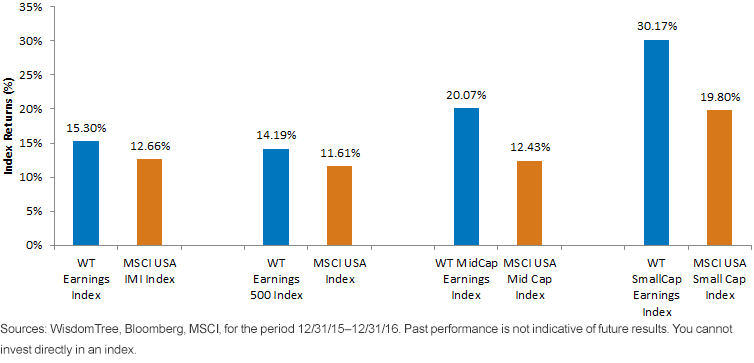
In the figure below, we analyze the 2016 calendar year for the WisdomTree Earnings Indexes and compare each to a comparable market capitalization-weighted benchmark.
Small Caps Led the Way in U.S. Equity Markets for 2016
For definitions of indexes in the chart, visit our glossary.
•WisdomTree Earnings Indexes Led Their Market Capitalization-Weighted Counterparts across the Size Spectrum: The WisdomTree Indexes beat their respective market capitalization-weighted benchmarks, represented by the relevant MSCI USA indexes, for the period displayed above. Similar to what we have seen over the past 10 years for the earnings indexes, outperformance for the small and mid-caps was the largest.
•Small Caps Led the Way with over 30% Returns: The WisdomTree SmallCap Earnings Index had a particularly successful year, up over 30%. This double-digit performance marks a good time to rebalance and take chips away from some of the really big winners and add weight to the stocks at lower multiples, the underperformers.
How Expensive Are the U.S. Equity Markets?
U.S. equity market participants find themselves adjusting to somewhat of a different reality as we enter 2017. Price-to-earnings (P/E) ratios are elevated, in some cases above 20x. When viewed through the longer lens of history, this appears high, but when viewed in the context of interest rates being extremely low, the case becomes less clear.
Higher valuations today mean a more challenging environment for future returns. Investors will not continue to pay ever-greater amounts for each dollar of earnings, and it becomes harder and harder for that P/E ratio to continue to rise. Stated differently, the market needs more positive earnings growth to continue gains. In this environment, we believe there are rewards for focusing on lower-valued parts of the market.
WisdomTree’s Earnings Strategies Are Designed to Mitigate Valuation Risk
As mentioned earlier, each one of our WisdomTree Earnings Indexes incorporates an annual rebalancing mechanism that functions to lower P/E ratios in a disciplined manner. This rebalancing process typically leads to a lower P/E ratio relative to market capitalization-weighted approaches.
Lowering P/E Ratio Relative to Cap-Weighted Benchmarks
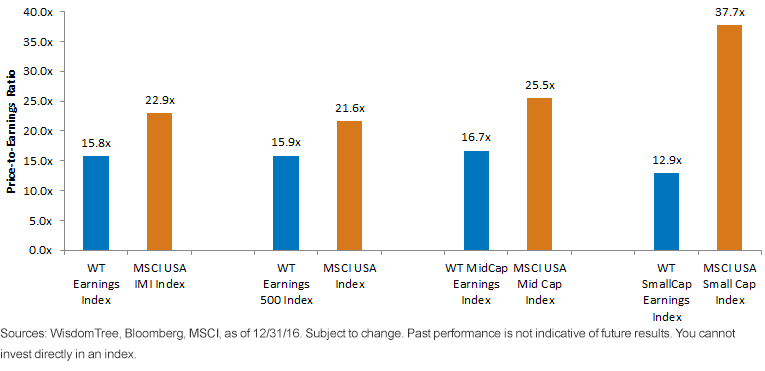
With rising equity prices, coupled with a slight contraction in the aggregate earnings of the market, it is critical to be mindful of valuations like P/E ratios. Of all the Indexes WisdomTree calculates, the lowest relative P/E ratios tend to be found in the WisdomTree Earnings Indexes. Following this rebalance, we saw these portfolio characteristics reinforced.
Certainly, some of President-elect Trump’s focus on cutting corporate tax rates and allowing companies to repatriate offshore cash might cause a positive impetus and stimulus for earnings growth in 2017. But after a surge in prices after the election, we believe this rebalance back to valuations comes at a perfect time and can help manage valuation risk if future earnings growth falls short of expectations.
Categories
About the contributors

Global Chief Investment Officer
Jeremy Schwartz has served as Global Chief Investment Officer since November 2021 and leads WisdomTree’s investment strategy team in the construction of WisdomTree’s equity Indexes, quantitative active strategies and multi-asset Model Portfolios. Jeremy joined WisdomTree in May 2005 as a Senior Analyst, adding Deputy Director of Research to his responsibilities in February 2007. He served as Director of Research from October 2008 to October 2018 and as Global Head of Research from November 2018 to November 2021. Before joining WisdomTree, he was a head research assistant for Professor Jeremy Siegel and, in 2022, became his co-author on the sixth edition of the book Stocks for the Long Run. Jeremy is also co-author of the Financial Analysts Journal paper “What Happened to the Original Stocks in the S&P 500?” He received his B.S. in economics from The Wharton School of the University of Pennsylvania and hosts the Behind the Markets podcast. Jeremy is a member of the CFA Society of Philadelphia.
