

U.S. Small Caps: Lurking Vulnerabilities
Published December 21, 2018

Director, Research
The Federal Reserve (Fed) released its inaugural financial stability report on November 28. In the report, the Fed highlighted two of the main vulnerabilities in the financial system1:
1. Elevated asset valuations
2. Historically high corporate leverage accompanied by a lowering of credit standards
We touched on both risks over the course of this year, in How to Avoid Leverage Risks in Small Caps and How to Manage Valuation Risk in U.S. Equities.
Coming into the year, elevated equity valuations in the U.S. were a major concern. At such high valuations, forward return estimates had become increasingly unattractive.
As a result of the December 2017 corporate tax reform, which bolstered profit growth in 2018, as well as the negative returns for U.S. equities thus far, valuations have become much more modest. This point was also conceded by the Fed in their report.
While there seems to have been improvement on vulnerability number one, the second point has been a vulnerability we have been closely watching, particularly as it relates to small caps.
Zombie Companies
Only time will tell the ultimate impacts of the Fed’s extraordinary easy money policies, which were initiated in the aftermath of the financial crisis. Amid the longest bull market in history, many investors would say the Fed has done an exceptional job.
A legitimate lingering concern, however, is the significant build-up in debt among U.S. corporations. Just as the monetary stimulus was intended to do, corporations have tapped the capital markets for cheap debt financing while rates have been at historically low levels.
Of utmost importance for equity investors is the ability of these corporations to repay their obligations. The increasing attention on identifying firms unable to pay debt servicing costs has resulted in a name for this distained class of profligate companies: zombies.
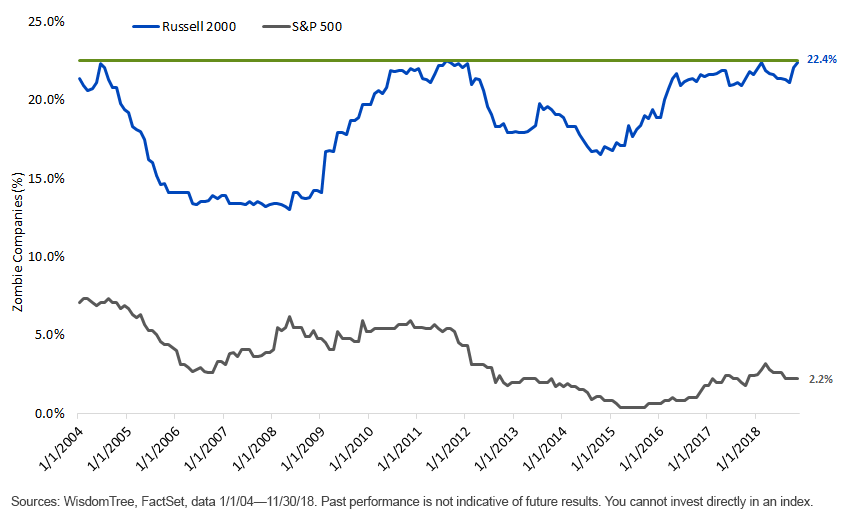
In the chart below, we plot the percentage of the constituents of the S&P 500 Index and the Russell 2000 Index that are classified as zombie companies. We define zombies as those with current trailing 12-month interest expenses that exceed the average of the past three years of earnings before interest and taxes (EBIT).
While the number of companies in the S&P 500 that have insufficient profits to cover their interest expenses is a negligible 2%, nearly 25% of Russell 2000 constituents have unsustainable debt burdens. This level of zombie companies is near an all-time high for the Russell index.
Percentage of Zombie Companies
Different Measures of U.S. Small Caps
The Russell 2000 Index is one of the broadest indexes of small-cap stocks. As a by-product of its inclusivity, it has about 21% of its weight in companies with negative earnings.
The WisdomTree U.S. SmallCap Earnings Index is similarly broad, currently containing 811 constituents. The one major differentiator from the Russell 2000 universe is the requirement of positive core earnings over the four quarters prior to the Index’s annual reconstitution each December.
The WisdomTree U.S. SmallCap Quality Dividend Growth Index is a more selective cut of small caps, containing 272 constituents. The Index screens for companies with attractive growth and profitability characteristics on an annual basis, also in December.
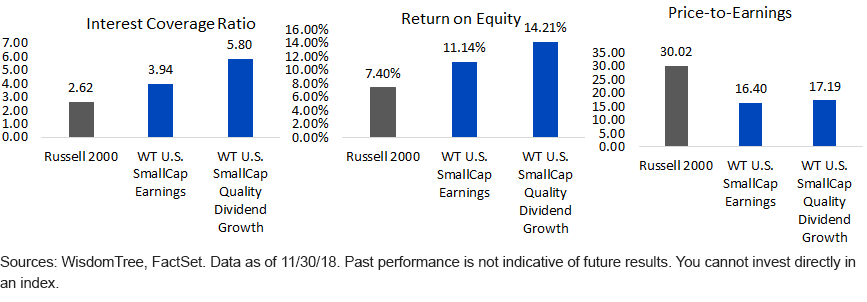
By slicing the universe of U.S. small caps in these different ways, the fundamental exposures that result for these Indexes are considerably different from the Russell 2000. The WisdomTree U.S. SmallCap Quality Dividend Growth Index offers an interest-coverage ratio of over twice that of the Russell 2000, while at a significant valuation discount based on price-to-earnings.
Typically, investors would be required to pay a significant premium to own more stable, quality companies. Uniquely for both the WisdomTree Indexes, higher quality metrics are offered at a significant discount to the Russell 2000.
Unless otherwise noted, all data from WisdomTree, FactSet as of November 30, 2018.
1https://www.federalreserve.gov/publications/files/financial-stability-report-201811.pdf
About the contributor

Director, Research
Matt Wagner joined WisdomTree in May 2017 as an Analyst on the Research team. He currently serves as a Director, where he supports the creation, maintenance, and reconstitution of WisdomTree’s indexes and actively managed ETFs. Matt began his career at Morgan Stanley, working as an analyst in Treasury Capital Markets from 2015 to 2017, focusing on unsecured funding planning, execution, and risk management. He graduated magna cum laude from Boston College in 2015 with a B.A. in International Studies, concentrating in Economics. In 2020, he earned a Certificate in Advanced Valuation from NYU Stern. He is also a Chartered Financial Analyst (CFA) charterholder.