

How to Manage Valuation Risk in U.S. Equities
Published May 4, 2018

Global Chief Investment Officer
Over a decade ago, WisdomTree launched a family of earnings-weighted Indexes that were designed to manage valuation risk and help protect from bubbles in asset pricing.
These Indexes appealed to my mentor, Professor Jeremy Siegel, under whom I studied at Wharton. He was concerned about the technology bubble in 1999 and 2000 and wrote an op-ed in the Wall Street Journal titled “Big-Cap Tech Stocks Are a Sucker Bet.” Siegel’s column listed nine stocks with triple-digit price-to-earnings (P/E) ratios that he thought could not justify their valuations, no matter how optimistic analysts were for earnings over the following decade.
The decade after the launch of these earnings-weighted Indexes was not particularly kind to a value-tilted indexing approach.
1. Growth beat value, particularly in large caps.
2. High P/E beat low P/E.
3. Market multiples rose.
Concerns about equity markets today often focus on elevated market valuation multiples. Usually, pessimistic prognosticators start with how high the CAPE (cyclically adjusted price-to-earnings) ratios are and how that dooms us to terrible forward-looking returns.
Having an index process that systematically and strategically rebalances back to underlying Earning Streams—one that incorporates a strategic sell discipline when stocks have rising P/E ratios and a buy discipline when stocks have falling P/E ratios—is a useful way to manage valuation risk.
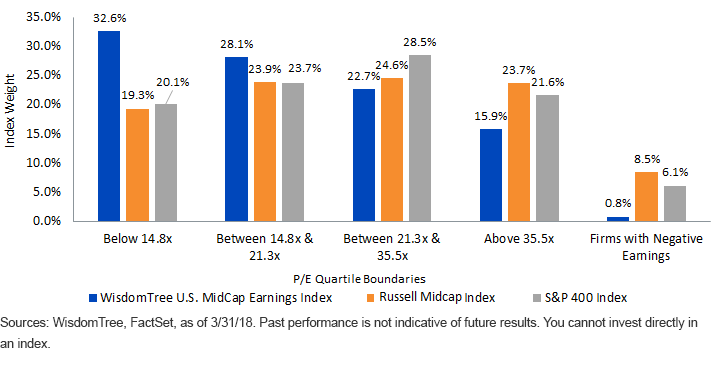
Where is this most interesting today? While large caps receive the bulk of attention, I think valuations in traditional market cap-weighted mid-cap and small-cap indexes, where more unprofitable companies also are found, are particularly worthy of focus. Below, I’ll focus on the mid-cap segment and how our earnings process results in a lower P/E portfolio.
To start, it is important to point out that valuations are not universally dramatically extended across the market. When we focus on profitable companies and weight by earnings, our current P/E ratios on the mid-cap series are 14x to 15x, whether looking at trailing or forward earnings. This contrasts sharply with the S&P 500, which is well over 20x trailing and at 17x forward 12-month earnings.1
Looking across the market-cap indexes, the Russell Midcap Index has the highest P/E ratio, and that is because a greater percentage of its companies are unprofitable.

Quantifying Tilt Toward Lower (or Higher) Price-to-Earnings (as of March 31, 2018)
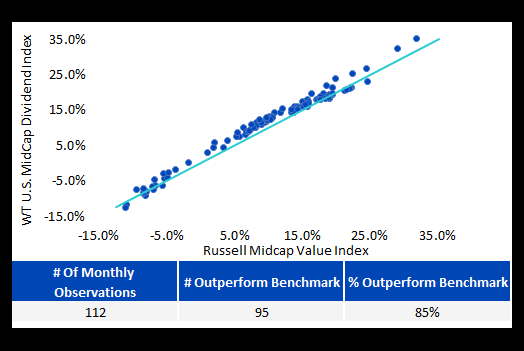
The disciplined screening and rebalancing process—devoid of human emotion affecting allocations—in this earnings-weighted strategy has resulted in very consistent performance over the last 11 years this index has been live.
The consistency chart below plots the returns of the Russell Midcap Index on the x-axis and the WisdomTree MidCap Earnings Index on the y-axis. Approximately 80% of the rolling three-year return periods the WisdomTree Index outperformed the Russell Midcap Index, and when the Index underperformed, it was usually very close to the market return. But you do find periods where the rolling three-year returns were meaningfully higher.
Manager Consistency 3-Year Rolling
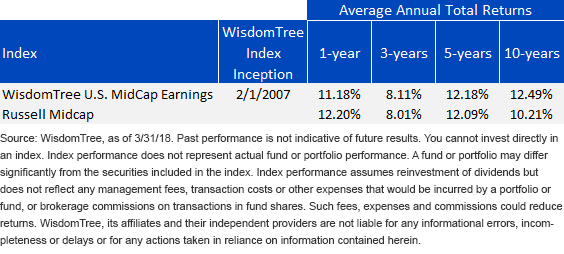
As interest rates have started to creep higher in 2018, markets have started to focus on the length of this bull market and the rising valuations and collapsing earnings yields—the declining equity risk premium, or compensation one receives for taking equity risk over bonds. Lowering the P/E ratio on the equity markets utilizing the earnings-weighted process is becoming even more important, in my view. And while WidomTree’s mid-cap earnings Index performed well, in a market environment where growth beat value, the decade ahead could come even more in this Index’s favor.
1Sources: WisdomTree, FactSet, as of 3/31/18.
Categories
About the contributor

Global Chief Investment Officer
Jeremy Schwartz has served as Global Chief Investment Officer since November 2021 and leads WisdomTree’s investment strategy team in the construction of WisdomTree’s equity Indexes, quantitative active strategies and multi-asset Model Portfolios. Jeremy joined WisdomTree in May 2005 as a Senior Analyst, adding Deputy Director of Research to his responsibilities in February 2007. He served as Director of Research from October 2008 to October 2018 and as Global Head of Research from November 2018 to November 2021. Before joining WisdomTree, he was a head research assistant for Professor Jeremy Siegel and, in 2022, became his co-author on the sixth edition of the book Stocks for the Long Run. Jeremy is also co-author of the Financial Analysts Journal paper “What Happened to the Original Stocks in the S&P 500?” He received his B.S. in economics from The Wharton School of the University of Pennsylvania and hosts the Behind the Markets podcast. Jeremy is a member of the CFA Society of Philadelphia.