
WDEF
Europe Defense Fund

Published August 10, 2026

Global Head of Research
European defense spending is rising at a pace not seen since the Cold War. The question for investors is not whether to have exposure, it is what kind of exposure they are actually getting.
The investment case for European defense has shifted from cyclical to structural. Russia's invasion of Ukraine made visible what had been building quietly for years.
Europe's defense capabilities had atrophied, its ammunition stockpiles were thin, and its reliance on U.S. security guarantees had left NATO's eastern flank1 dangerously exposed.
The political response has been emphatic. At the June 2025 NATO Summit in The Hague, alliance members formally committed to investing 5% of gross domestic product (GDP) annually on defense by 2035, structured as at least 3.5% on core military requirements and 1.5% on related infrastructure and industrial capacity, more than doubling the 2% benchmark that all 32 members met for the first time only in 2025. Progress is already accelerating ahead of schedule. By the 2026 meeting, five allies are expected to reach the 3.5% core defense threshold, with 17 meeting the 1.5% defense-related investment guideline.2
We can review a few specific country examples:
Germany's Zeitenwende, Chancellor Scholz's February 2022 declaration of a historic turning point in security policy, established a €100 billion special defense fund and a commitment to exceed NATO's 2% spending threshold. That trajectory has only accelerated. Germany's 2026 defense budget reaches approximately €108 billion in total, and spending is projected to climb toward €153 billion by 2029 as Berlin pursues what Chancellor Merz has described as "the strongest conventional army in Europe."3
Poland, now spending approximately 4.7% of GDP on defense in 2025, the highest share of any NATO member, has budgeted a further increase toward 4.8% in 2026, with the government having previously stated an ambition to reach 5%.4
The spending commitments now extend well beyond declarations.
This is not a temporary procurement spike. It reflects a fundamental reassessment of what European security requires, and it has years, likely decades, to run. An investor seeking to align with that thesis faces a choice that is less obvious than it appears.
Not all European aerospace and defense strategies are equally sensitive to the rearmament cycle.
EUAD tracks the total return performance of, before fees and expenses, the STOXX Europe Total Market Aerospace & Defense Index. The reason we are focusing on it here is that, as of July 31, 2026, the strategy had over $1.1 billion in assets under management, and it represented the largest ETF option for U.S. investors thinking about a specific European defense exposure.9 The methodology behind this index is straightforward.10
Importantly, it is not screening revenues, order backlogs or defense activities.
The result is a portfolio that reflects where European aerospace and defense equity value currently resides in the public markets. As of June 30, 2026, three companies, specifically Rolls-Royce, Safran, and Airbus, represented approximately 61% of the fund. The top ten holdings captured over 95%.11
This is the output of an uncapped market-capitalization approach applied to a market segment where a small number of very large, long-established franchises dominate publicly-listed equity value. These are exceptional businesses with deep engineering capabilities, loyal customer bases, and durable competitive advantages built over decades. The concentration simply reflects the reality of where the equity market has already assigned value.
But the composition of that value matters for investors who are specifically trying to gain exposure to the European rearmament cycle described earlier.
An investment in EUAD is, therefore, substantially an investment in the largest existing European aerospace and defense market capitalizations, with the commercial aviation cycle playing a significant and sometimes dominant role in driving portfolio returns.
The WisdomTree Europe Defense Fund (WDEF) takes a different approach. Rather than starting with an existing market-capitalization structure and accepting the resulting exposures, WDEF is constructed to reflect the thesis that European defense spending is entering a structural expansion, and to identify the companies most directly positioned to convert that spending into deployable military capability.
The construction methodology deliberately prevents any single company from consuming the portfolio.13
WDEF holds many of the same large franchises, and Rolls-Royce, Safran, and Airbus are represented, but in the range of 5-6% each rather than 18–22% each, as seen in Figure 1. That reduction in concentration is not an act of skepticism about those businesses. It is an allocation decision that creates room for the companies whose order books, production capacity, and revenues are being most directly reshaped by the trend of European rearmament that we described earlier in this piece.
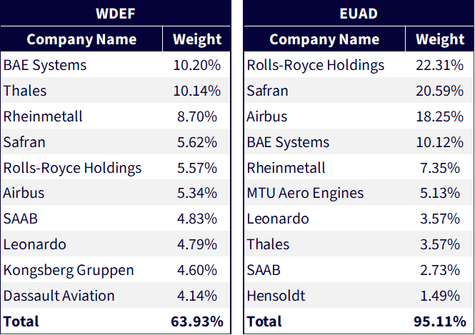
Sources: WisdomTree and Select Funds factsheets for WDEF and EUAD, with data as of June 30, 2026. Holdings subject to change.
To understand the difference, it helps to think about how a defense budget actually becomes military capability.
Each step in that chain has different listed-equity representation.
EUAD's concentration naturally emphasizes the first and largest node, represented as step 3, the established primes whose size already reflects decades of accumulated contract value. broader construction allows it to capture more of the chain of activity, including the specialists that may be experiencing the most acute order acceleration right now.
Consider several examples from the current data.
Rheinmetall holds 8-9% of WDEF versus 7-8% of EUAD, per Figure 1, both meaningful, but the WDEF weight is proportionally higher relative to the fund's overall construction. Rheinmetall's backlog reached €63.8 billion at year-end 2025, up 36% in a single year, and has continued accelerating through 2026, surpassing €73 billion by end of Q1 and breaching €80 billion following Q2 results released in late July, with Q2 revenue rising 69% year-on-year to €3.3 billion, beating the company's own guidance.14 This is not a mature defense incumbent enjoying normal cycle growth. It is a company moving through a pronounced demand and capacity inflection in ammunition, armored vehicles, air defense, and electronic systems.
Hensoldt, Europe's leading independent radar and electronic warfare specialist, sits at 4-5% of WDEF but only about 1.8% of EUAD. Hensoldt's 2025 order intake rose to €4.7 billion from €2.9 billion the prior year, a 62% increase, and its book-to-bill ratio reached 1.9x. The acceleration has continued. In H1 2026 alone, order intake doubled year-on-year to €2.8 billion, the backlog exceeded €10 billion for the first time in company history, and the book-to-bill ratio reached 2.4x for the half, and 3.0x in Q1 alone.15
Kongsberg Gruppen appears only in WDEF, at approximately 4.3% of the portfolio. Kongsberg provides exposure to missiles, air defense, naval systems, and remote weapon stations, each a priority area for European governments responding to the lessons of the Ukraine conflict. It is simply not large enough to register in a market-cap-weighted index dominated by Airbus and Rolls-Royce.
Saab holds roughly 4-5% of WDEF versus approximately 2-3% of EUAD. Saab's 2025 order intake rose 63% to SEK 96.8 billion, with a record-breaking Q4 alone generating SEK 100 billion in bookings and pushing total backlog to SEK 275 billion, roughly 3.5 times annual sales. By Q2 2026, the backlog had climbed further to a record SEK 318 billion, with Q2 order bookings rising 141% year-on-year, driven by a SEK 47 billion submarine contract with Poland and Gripen fighter contracts with Ukraine.16
Beyond the large primes, WDEF also holds companies that EUAD does not. Some examples include:17
These are smaller companies with narrower exposure, but their revenues are almost entirely driven by defense procurement. They represent the emerging and specialist layer of the European defense supply chain, the layer potentially most sensitive to the marginal amount of new spending.
Framed plainly, these strategies are answers to different questions.
EUAD answers: What does the publicly traded European aerospace and defense sector look like when weighted by current free-float market capitalization?
WDEF attempts to answer: Which listed companies provide the most relevant and broadly distributed exposure to Europe's ongoing defense spending cycle?
Neither question is wrong. Investors entering the European defense space in 2025 and 2026, motivated by NATO's structural shift, the ongoing Ukraine conflict, and the European Commission's defense investment agenda, are almost certainly asking the second question. They want to know how much of their portfolio is genuinely sensitive to the European rearmament thesis, not how much is influenced by the commercial aviation cycle or the aftermarket economics of civil jet engines.
The portfolio-level data on driver sensitivity reinforces this. EUAD carries high sensitivity to global passenger aviation, commercial aircraft production, and civil engine aftermarket economics. WDEF carries higher sensitivity to European ammunition replenishment, ground-based air defense, radar and electronic warfare, naval recapitalization, and soldier systems modernization. Both portfolios share meaningful exposure to large diversified primes, for example, BAE Systems, Rheinmetall, Leonardo, and Thales, but WDEF is less dependent on those names dominating the return profile.

Sources: WisdomTree, Morningstar, FactSet, specifically data from the Fund Comparison Tool in the PATH suite of tools, accessed August 1, 2026 with returns for Figure 2 as of June 30, 2026. NAV denotes total return performance at net asset value. MP denotes market price performance. Past performance is not indicative of future results. Investment return and principal value of an investment will fluctuate so that an investor’s shares, when redeemed, may be worth more or less than their original cost. Current performance may be lower or higher than the performance data quoted. For the most recent month-end and standardized performance and to download the respective Fund prospectuses, click the relevant ticker: WDEF, EUAD.
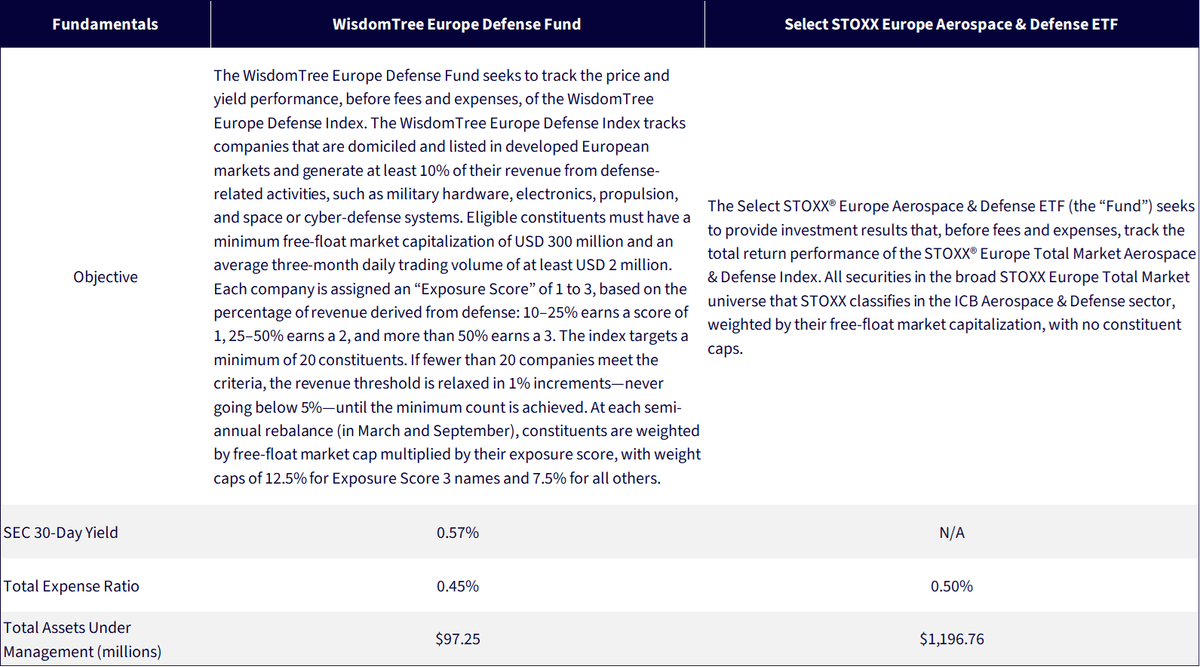
Sources: WisdomTree and Select Funds websites and fund pages. The SEC 30-Day Yield for EUAD did not appear on the 6/30/2026 fund factsheet and did not appear on the fund’s website as of July 31, 2026.
1 NATO stands for North Atlantic Treaty Organization.
2 Source: North Atlantic Treaty Organization. (2026, July 7). Defence investment update: Record spending in Europe and Canada.
3 Source: Bundesministerium der Verteidigung. (2022). Over EUR 100 billion for the Bundeswehr – and for our security.
4 Source: Notes From Poland. (2025, August 29). Poland plans record defence spending of 4.8% GDP in 2026 budget along with lower deficit.
5 Source: Breaking Defense. (2025, July). France to raise military spending to $75B in 2027, three years earlier than planned.
6 Source: House of Commons Library. (2026). Defence Investment Plan: Key decisions.
7 Source: Swedish Ministry of Defence. (2025, September 15). The government presents defence investments for a stronger Sweden.
8 Source: MilitarySpend. (2026). Norway military spending 2026: $17B defense budget.
9 Source: EUAD fund page on the Select Funds website. Data as of July 31, 2026. Subject to change.
10 Source: STOXX Ltd. (2026, July). STOXX® index methodology guide (portfolio based indices).
11 Source: EUAD factsheet, holdings subject to change.
12 Source: Airbus SE. (2026, July 29). Airbus reports half-year (H1) 2026 results.
13 Companies earning more than 50% of their revenues from defense would face a cap of 12.5% exposure, representing the highest single company exposure within the methodology as of a rebalance.
14 Sources: Rheinmetall AG. (2026, May 7). Financial report for Q1 2026 – Profitable growth and full order books; Global Banking and Finance. (2026, July 29). Rheinmetall Q2 revenue surges 70% as profit beats expectations.
15 Sources: HENSOLDT AG. (2026, May 6). HENSOLDT starts financial year 2026 with record order intake and rising profitability; HENSOLDT AG. (2026, July 31). HENSOLDT doubles order intake in the first half of 2026 – revenue and earnings rise significantly.
16 Sources: Quartr. (2026). SAAB Q1 2026 summary; Investing.com. (2026, July). Saab Q2 2026 slides: record backlog, 141% order growth on major wins.
17 Source: WisdomTree, WDEF fund page, as of July 31, 2026. Holdings subject to change.
There are risks associated with investing, including potential loss of principal. This Fund focuses its investments in Europe, thereby increasing the impact of events and developments associated with the region which can adversely affect performance. Foreign investing involves specific risks, such as risk of loss from currency fluctuation or political or economic uncertainty. A Fund focusing its investments on certain sectors and/or regions increases its vulnerability to any single economic or regulatory development. This may result in greater share price volatility. The Fund invests in the securities included in, or representative of, its Index regardless of their investment merit and the Fund does not attempt to outperform its Index. The composition of the Index is governed by an Index Committee and the Index may not perform as intended. Please read the Fund’s prospectus for specific details regarding the Fund’s risk profile.
Europe Defense Fund

Global Head of Research
Christopher Gannatti began at WisdomTree as a Research Analyst in December 2010, working directly with Jeremy Schwartz, CFA®, Director of Research. In January of 2014, he was promoted to Associate Director of Research where he was responsible to lead different groups of analysts and strategists within the broader Research team at WisdomTree. In February of 2018, Christopher was promoted to Head of Research, Europe, where he was based out of WisdomTree’s London office and was responsible for the full WisdomTree research effort within the European market, as well as supporting the UCITs platform globally. In November 2021, Christopher was promoted to Global Head of Research, now responsible for numerous communications on investment strategy globally, particularly in the thematic equity space. Christopher came to WisdomTree from Lord Abbett, where he worked for four and a half years as a Regional Consultant. He received his MBA in Quantitative Finance, Accounting, and Economics from NYU’s Stern School of Business in 2010, and he received his bachelor’s degree from Colgate University in Economics in 2006. Christopher is a holder of the Chartered Financial Analyst Designation.
