
GCC
Enhanced Commodity Strategy Fund

Published January 20, 2026

Director, Quantitative Research

Global Chief Investment Officer
Commodities have been on a roll over the past few months, with strong and persistent trends emerging across several sectors. Performance, however, has been uneven beneath the surface.
Precious metals have led the rally over the past six months, significantly outperforming other commodity sectors. From late June through year-end 2025, the Bloomberg Precious Metals Subindex gained over 40%, driven by heightened geopolitical risks, strong central bank demand, and sustained investor appetite for safe-haven assets.
Industrial metals also delivered solid gains, rising around 10% over the same period, supported by structural demand from electrification, infrastructure spending, and supply constraints in key metals such as copper. In contrast, energy was the clear laggard, with the Bloomberg Energy Subindex down roughly 11% in the second half of 2025. Softer demand expectations, ample supply conditions, and persistent weakness in natural gas outweighed geopolitical risk premia that had previously supported prices. Going forward, our geopolitical outlook indicates to relatively limited upside for oil.
Overall, the dispersion across commodity sectors highlights the need for diversification while maintaining strategic and tactical tilts and harnessing the trends that exist in commodity markets.
WisdomTree's two differentiated offerings in commodities navigated complex commodity cycles using very different approaches. The WisdomTree Inflation Plus Fund (WTIP) delivered positive returns in every full month of its live history; likewise, the WisdomTree Enhanced Commodity Strategy Fund (GCC) posted positive returns in each month during the second half of last year. The two ETFs outperformed the Bloomberg Commodity Index (BCOM) by more than 6% during the period despite taking very different approaches.
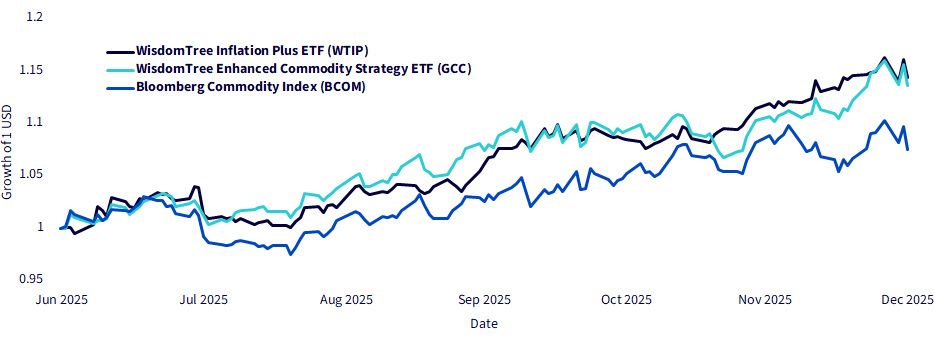
Source: WisdomTree, Bloomberg. From 30 Jun 2025 to 31 Dec 2025. Based on earliest common month end of the live history. You cannot invest in an Index. Past performance is not indicative of future results. Investment return and principal value of an investment will fluctuate so that an investor's shares, when redeemed, may be worth more or less than their original cost. Current performance may be lower or higher than the performance data quoted. For the most recent month-end and standardized performance, click the respective ticker: WTIP, GCC.
WTIP is built on a simple but powerful objective: to provide a robust and comprehensive hedge against inflation. The strategy combines commodity exposure with U.S. Treasury Inflation-Protected Securities (TIPS). While TIPS are designed to hedge expected inflation and tend to respond with a lag, commodities have historically been effective at hedging unexpected inflation and often lead inflationary regimes. By combining these two asset classes, WTIP seeks to deliver a more complete and balanced inflation hedge.
Commodity markets are inherently cyclical, often experiencing extended uptrends followed by prolonged periods of mean reversion. To improve return consistency across these cycles, WTIP employs systematic, momentum-based models that evaluate each commodity relative to its own price history to determine whether to take a long or short position. To enhance robustness, two independent momentum signals—moving-average crossover and trend breadth—are used, with positions initiated only when both signals align in the same direction. Recognizing the structural role of precious metals in investor portfolios, gold and silver are maintained as permanent long exposures in fixed, equal proportions.
The strategy is further enhanced through the use of a maximum-carry contract selection process, investing in futures contracts with the highest implied carry rather than defaulting to front-month contracts. This approach seeks to capture roll returns that are often missed by traditional commodity benchmarks.
The commodity allocation within WTIP is structured as follows:
In addition, 5% of the portfolio is allocated to bitcoin exposure, implemented through a momentum-driven model, reflecting its potential role as an alternative, inflation-sensitive asset.
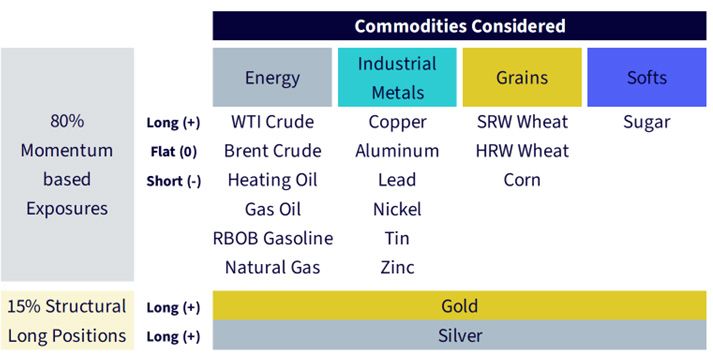
Source: WisdomTree
So far, the strategy has successfully navigated the commodity markets and harnessed the trend to deliver positive returns in all six complete months since its launch (Jul 2025 to Dec 2025). By contrast, the Bloomberg Commodity Index (BCOM) was up in only four of the six months. Overall, WTIP (+14.42%) outperformed BCOM (+7.52%) by 6.91 percentage points during this period.
The WisdomTree Enhanced Commodity Strategy Fund is a forward-looking, strategic commodity allocation designed to harness the historically low correlation of commodities with traditional asset classes, helping to enhance diversification within multi-asset portfolios.
Each year, WisdomTree's investment team, in collaboration with in-house commodity specialists, sets the fund's strategic commodity weights based on a long-term market outlook. This strategic allocation is complemented by a second layer of monthly rebalancing, which allows the portfolio to adapt to evolving market conditions through tactical tilts around the strategic weights.
The strategic framework seeks broad diversification while expressing conviction in the key structural themes shaping commodity markets. Currently, the portfolio is positioned around four core pillars:
In addition, the fund employs an enhanced roll methodology, investing in futures contracts with the highest implied carry rather than defaulting to front-month contracts. By selectively investing further out on the futures curve, the strategy seeks to enhance returns while helping to reduce short-term volatility.
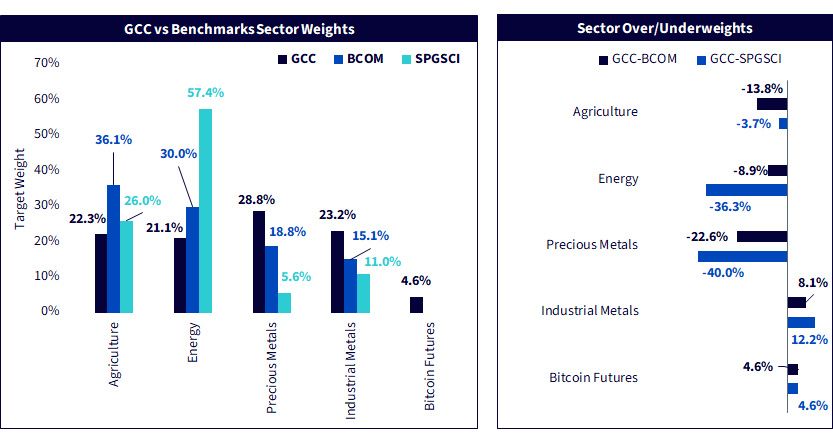
Source: WisdomTree, Bloomberg, as of 12/31/25. You cannot invest in an Index.
Overall, this approach has also delivered strong recent performance, with positive returns in each month of the second half of last year, outperforming BCOM by over 6% during the period.
WTIP and GCC represent two distinct yet complementary approaches to commodity investing, each designed to address different investor objectives.
WTIP is purpose-built as a comprehensive inflation hedge, combining the defensive properties of TIPS with the ability of commodities to respond to unexpected inflation. Its momentum-driven, long–short commodity framework, enhanced by dual trend signals, dynamic contract selection and structural allocations to precious metals and bitcoin, allows it to actively navigate commodity cycles and reduce/reverse the impact of prolonged drawdowns. The strategy's strong performance since launch highlights the benefits of an adaptive, rules-based approach in volatile inflationary environments.
GCC, in contrast, serves as a strategic, forward-looking commodity allocation. Through a combination of annually set strategic weights, monthly tactical rebalancing and an enhanced roll methodology, GCC seeks to capture long-term commodity themes while managing risk and volatility. Its emphasis on industrial metals, precious metals and reduced energy exposure reflects structural shifts such as electrification and energy transition, while maintaining the diversification benefits commodities offer.
In summary, WTIP is best suited for investors seeking an active inflation-focused solution aimed at harnessing trends in commodity markets and delivering consistent returns with lower risk, whereas GCC offers a strategic, diversified commodity exposure aligned with long-term thematic drivers. Together, they demonstrate how different portfolio objectives can be addressed through thoughtful and differentiated commodity strategy design.
There are risks associated with investing including possible loss of principal. Because of the frequency with which the Funds expect to roll futures contracts, the impact of such contango or backwardation may be greater than the impact would be if the Funds experienced less portfolio turnover. Please read the Funds’ prospectus for specific details regarding the Fund's risk profile.
GCC: An investment in this Fund is speculative, involves a substantial degree of risk, and should not constitute an investor's entire portfolio. One of the risks associated with the Fund is the complexity of the different factors which contribute to the Fund's performance. These factors include use of commodity futures contracts. In addition, bitcoin and bitcoin futures are a relatively new asset class. They are subject to unique and substantial risks, and historically, have been subject to significant price volatility. While the bitcoin futures market has grown substantially since bitcoin futures commenced trading, there can be no assurance that this growth will continue. In addition, derivatives can be volatile and may be less liquid than other securities and more sensitive to the effects of varied economic conditions. The value of the shares of the Fund relate directly to the value of the futures contracts and other assets held by the Fund and any fluctuation in the value of these assets could adversely affect an investment in the Fund's shares. Because of the frequency with which the Fund expects to roll futures contracts, the price of futures contracts further from expiration may be higher (a condition known as “contango”) or lower (a condition known as “backwardation”) and the impact of such contango or backwardation may be greater than the impact would be if the Fund experienced less portfolio turnover.
WTIP: Inflation-protected U.S. Treasury Bonds (“TIPS”), can provide a hedge against inflation, as the inflation adjustment feature helps preserve the purchasing power of the investment. Because of this inflation adjustment feature, inflation protected bonds typically have lower yields than conventional fixed rate bonds and will likely decline in price during periods of deflation, which could result in losses. Fixed income securities are subject to interest rate, credit, inflation, and reinvestment risks. Generally, as interest rates rise, the value of fixed-income securities falls. The value of commodities and commodity-linked derivative instruments typically is based upon the price movements in other asset classes. An active trading market may not exist for certain commodities. The Fund is subject to risks related to rolling futures contracts. The price of futures contracts further from expiration may be higher (“contango”) or lower (“backwardation”), which can impact the Fund’s returns. Because of the frequency with which the Fund expects to roll futures contracts, the impact of such contango or backwardation may be greater than the impact would be if the Fund experienced less portfolio turnover. In addition, bitcoin and bitcoin futures are a relatively new asset class. They are subject to unique and substantial risks, and historically, have been subject to significant price volatility. While the bitcoin futures market has grown substantially since bitcoin futures commenced trading, there can be no assurance that this growth will continue. The Fund may invest in the WisdomTree Bitcoin Fund, a bitcoin exchange traded product, sponsored by an affiliate of the Fund’s adviser.
Enhanced Commodity Strategy Fund

Director, Quantitative Research
Ayush Babel is the Director of Quantitative Research in WisdomTree's multi-asset quantitative research and index teams. In this role, he focuses on developing innovative quantitative strategies across various asset classes while supporting WisdomTree's diverse range of products. His expertise spans factor exploration, portfolio construction and optimization, quantitative investment research, and product development.
With over a decade of experience in the financial services industry, Ayush has held investment research roles at J.P. Morgan and Franklin Templeton. At these institutions, he was responsible for developing and managing equity and fixed income smart beta products, as well as cross-asset risk premia solutions for global institutional and retail clients. His experience covers a broad spectrum of asset classes and investment styles.
Ayush holds a bachelor's in Engineering Physics and a master’s degree in Nanoscience from the Indian Institute of Technology, Bombay.

Global Chief Investment Officer
Jeremy Schwartz has served as Global Chief Investment Officer since November 2021 and leads WisdomTree’s investment strategy team in the construction of WisdomTree’s equity Indexes, quantitative active strategies and multi-asset Model Portfolios. Jeremy joined WisdomTree in May 2005 as a Senior Analyst, adding Deputy Director of Research to his responsibilities in February 2007. He served as Director of Research from October 2008 to October 2018 and as Global Head of Research from November 2018 to November 2021. Before joining WisdomTree, he was a head research assistant for Professor Jeremy Siegel and, in 2022, became his co-author on the sixth edition of the book Stocks for the Long Run. Jeremy is also co-author of the Financial Analysts Journal paper “What Happened to the Original Stocks in the S&P 500?” He received his B.S. in economics from The Wharton School of the University of Pennsylvania and hosts the Behind the Markets podcast. Jeremy is a member of the CFA Society of Philadelphia.

