
WTIP
Inflation Plus Fund

Published June 18, 2025

Director, Quantitative Research

Head of Indexes, U.S.
In the current environment of elevated inflation uncertainty and policy asymmetry, traditional inflation hedges are being re-evaluated. WisdomTree Senior Economist Jeremy Siegel has long argued stocks offer the best long-term inflation hedge because companies often pass along price increases to consumers and see profits and earnings growth with inflation.
Elevated inflation has its biggest impact on traditional nominal bond portfolios that offer fixed coupon payments. With this new market backdrop and fears of debt, deficits and inflation risk, WisdomTree sought to create a new overlay strategy designed to better navigate evolving inflationary regimes. Today, WisdomTree launched the WisdomTree Inflation Plus Fund (WTIP), a modern, multi-asset ETF designed to provide adaptive inflation protection through a blend of TIPS, long-short commodities futures, precious metals and investments that provide exposure to Bitcoin.
WTIP offers a differentiated, multi-asset approach to mitigating inflation risk by combining time-tested instruments such as U.S. TIPS (Treasury Inflation-Protected Securities) with systematic commodity futures strategy, long-term store-of-value precious metals like gold and silver and emerging store-of-value assets like bitcoin.
This construct provides investors with broad-based inflation and purchasing power protection—targeting both expected and unexpected inflation, while maintaining diversification and risk-adjusted return potential.
WTIP employs a capital-efficient structure by overlaying commodity futures on top of a TIPS portfolio, allowing simultaneous exposure to both asset classes without requiring additional capital outlay. This design enhances return potential per unit of capital deployed, making it well-suited for adding strategies like commodities on top of traditional asset classes like bonds.
The core architecture of the ETF is built around two primary inflation-sensitive exposures:
By combining these two components, the Fund provides a more comprehensive and flexible hedge than single-asset strategies.
Recognizing the structural shortcomings of traditional long-only commodity allocations—such as negative roll yield, volatility clustering and prolonged drawdowns—WTIP adopts a multi-factor, rules-based approach to commodity investing:
This marks an important evolution in institutional commodity investing—replacing static exposure with active signals and systematic factors, while maintaining transparency and liquidity.
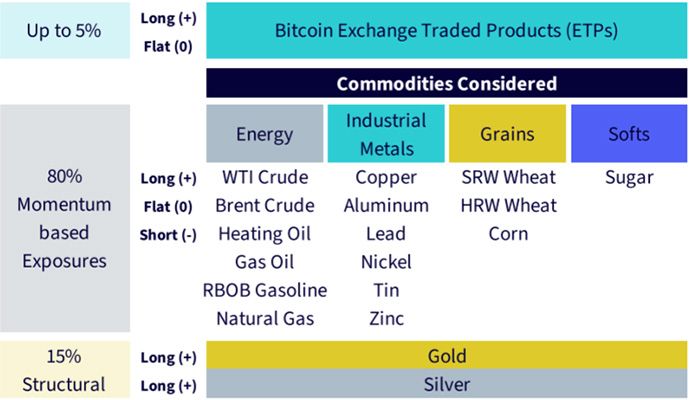
Source: WisdomTree. Presented for illustrative purposes only. Representative of the managers' current thinking, as of 5/31/25, and subject change.
To further enhance diversification and introduce exposure to non-traditional inflation-hedging assets, WTIP can allocate up to 10% in bitcoin ETPs, driven by a risk sensitive momentum model. Bitcoin is increasingly regarded as a potential hedge against monetary debasement and fiat dilution.
For institutions seeking exposure to digital assets within a structured framework, this allocation provides a measured and risk-aware entry point.
WTIP's risk-managed real asset allocation is structured as follows:
This structure balances systematic alpha sources with macroeconomic hedging characteristics, in a liquid and transparent ETF wrapper.
WTIP reflects a new paradigm in inflation protection—one that acknowledges the limitations of legacy strategies and responds with a modern, factor-informed and multi-asset solution. It offers:
As the global macro backdrop continues to evolve, inflation-aware portfolio construction demands precision, innovation and flexibility—qualities embedded in the design of this ETF.
There are risks associated with investing, including the possible loss of principal.
TIPS can provide a hedge against inflation, as the inflation adjustment feature helps preserve the purchasing power of the investment. Because of this inflation adjustment feature, inflation-protected bonds typically have lower yields than conventional fixed rate bonds and will likely decline in price during periods of deflation, which could result in losses.
Fixed income securities are subject interest rate, credit, inflation and reinvestment risks. Generally, as interest rates rise, the value of fixed income securities falls.
The value of commodities and commodity-linked derivative instruments typically is based upon the price movements in other asset classes. An active trading market may not exist for certain commodities.
Generally, derivatives are sophisticated investments that may pose risks that are different from or greater than those posed by investing directly in the underlying reference asset.
The Fund is subject to risks related to rolling futures contracts. The price of futures contracts further from expiration may be higher (“contango”) or lower (“backwardation”), which can impact the Fund’s returns. Because of the frequency with which the Fund expects to roll futures contracts, the impact of such contango or backwardation may be greater than the impact would be if the Fund experienced less portfolio turnover.
An investment in bitcoin ETPs involves significant risks and may not be suitable for all shareholders. Extreme volatility of trading prices that many digital assets, including bitcoin, could have a material adverse effect on the value of the Shares and the Shares could lose all or substantially all of their value.
Please read the Fund’s prospectus for specific details regarding the Fund’s risk profile.
The Fund does not invest in Bitcoin directly.
There are risks associated with investing, including the possible loss of principal. Crypto assets, such as bitcoin and ether, are complex, generally exhibit extreme price volatility and unpredictability, and should be viewed as highly speculative assets.
Crypto assets are frequently referred to as crypto “currencies,” but they typically operate without central authority or banks, are not backed by any government or issuing entity (i.e., no right of recourse), have no government or insurance protections, are not legal tender and have limited or no usability as compared to fiat currencies. Federal, state or foreign governments may restrict the use, transfer, exchange and value of crypto assets, and regulation in the U.S. and worldwide is still developing.
Crypto asset exchanges and/or settlement facilities may stop operating, permanently shut down or experience issues due to security breaches, fraud, insolvency, market manipulation, market surveillance, KYC/AML (know your customer / Anti-Money Laundering) procedures, non-compliance with applicable rules and regulations, technical glitches, hackers, malware or other reasons, which could negatively impact the price of any cryptocurrency traded on such exchanges or reliant on a settlement facility or otherwise may prevent access or use of the crypto asset.
Crypto assets can experience unique events, such as forks or airdrops, which can impact the value and functionality of the crypto asset. Crypto asset transactions are generally irreversible, which means that a crypto asset may be unrecoverable in instances where: (i) it is sent to an incorrect address, (ii) the incorrect amount is sent, or (iii) transactions are made fraudulently from an account. A crypto asset may decline in popularity, acceptance or use, thereby impairing its price, and the price of a crypto asset may also be impacted by the transactions of a small number of holders of such crypto asset. Crypto assets may be difficult to value and valuations, even for the same crypto asset, may differ significantly by pricing source or otherwise be suspect due to market fragmentation, illiquidity, volatility and the potential for manipulation.
Crypto assets generally rely on blockchain technology and blockchain technology is a relatively new and untested technology which operates as a distributed ledger. Blockchain systems could be subject to internet connectivity disruptions, consensus failures or cybersecurity attacks, and the date or time that you initiate a transaction may be different then when it is recorded on the blockchain. Access to a given blockchain requires an individualized key, which, if compromised, could result in loss due to theft, destruction or inaccessibility. In addition, different crypto assets exhibit different characteristics, use cases and risk profiles.
Information provided by WisdomTree regarding digital assets, crypto assets or blockchain networks should not be considered or relied upon as investment or other advice, as a recommendation from WisdomTree, including regarding the use or suitability of any particular digital asset, crypto asset, blockchain network or any particular strategy. WisdomTree is not acting and has not agreed to act in an investment advisory, fiduciary or quasi-fiduciary capacity to any advisor, end client or investor, and has no responsibility in connection therewith, with respect to any digital assets, crypto assets or blockchain networks.
Inflation Plus Fund

Director, Quantitative Research
Ayush Babel is the Director of Quantitative Research in WisdomTree's multi-asset quantitative research and index teams. In this role, he focuses on developing innovative quantitative strategies across various asset classes while supporting WisdomTree's diverse range of products. His expertise spans factor exploration, portfolio construction and optimization, quantitative investment research, and product development.
With over a decade of experience in the financial services industry, Ayush has held investment research roles at J.P. Morgan and Franklin Templeton. At these institutions, he was responsible for developing and managing equity and fixed income smart beta products, as well as cross-asset risk premia solutions for global institutional and retail clients. His experience covers a broad spectrum of asset classes and investment styles.
Ayush holds a bachelor's in Engineering Physics and a master’s degree in Nanoscience from the Indian Institute of Technology, Bombay.

Head of Indexes, U.S.
Alejandro Saltiel joined WisdomTree in May 2017 as part of the Quantitative Research team. Alejandro oversees the firm’s Equity indexes and actively managed ETFs. He is also involved in the design and analysis of new and existing strategies. Alejandro leads the quantitative analysis efforts across equities and alternatives and contributes to the firm’s website tools and model portfolio infrastructure. Prior to joining WisdomTree, Alejandro worked at HSBC Asset Management’s Mexico City office as Portfolio Manager for multi-asset mutual funds. Alejandro received his Master’s in Financial Engineering degree from Columbia University in 2017 and a Bachelor’s in Engineering degree from the Instituto Tecnológico Autónomo de México (ITAM) in 2010. He is a holder of the Chartered Financial Analyst designation.