


The Year of the NarrVol
Published December 15, 2025

Samuel Rines
Macro Strategist, Model Portfolios
FaST (Few Sentence Takeaway): Looking ahead at the narratives set to emerge in 2026, two begin to surface when digging through the details—margins and "NarrVol" (narrative volatility). NarrVol is a familiar beast at this point—narratives have become volatile. Margins are in question. But there are reasons to suspect these narratives could get flipped on their head. Welcome to the Year of the NarrVol.
"No sir, it is evidently a gigantic narwhal."
–Jules Verne, Twenty Thousand Leagues Under the Sea
Not going to regurgitate the history of the 2025 narratives. That is both dull and useless. What happened, happened. What is intriguing is if/how they will meld into something intriguing in 2026. The AI narrative is not about to magically disappear, for better or worse. Alphabet does not like to lose, and Meta and Microsoft are not keen to be left behind. The tariff narrative is not going to evaporate into the ether. The Trump administration is not going to back away from one of its primary geopolitical weapons. The consumer is not going to be less important. And the NarrVol is here to stay.
There will be unicorns, but they will be real.
Starting with AI:
- AI infrastructure capex is not going away (if you believe the guides of the hyperscalers). But the narrative of the AI gains might pivot.
- It is all about "Chips to Margins." As AI becomes increasingly embedded in day-to-day life, there may/should/will be more emphasis on who is getting the "most margin for the buck."
- Companies able to show margin expansion because of AI implementation are the new NarrVol winners.
"Yes. I mean, again, I think we're able to measure our own engagement directly, and what we can measure is, again, that we are seeing very healthy trends broadly that the product improvements and AI recommendations are driving incremental engagement as we would expect.
And we talked about some of those things on the call. The AI recommendation system is driving 5% more time spent on Facebook and 10% on Threads, and generally growth in family DAP was healthy at 8% year-over-year in Q3 and daily usage continues to grow across each of Facebook, Instagram, and WhatsApp."
— Meta Results Follow-Up Call, 10/29/25 (emphasis added)
Chad Heaton:
"On the second part of your question about the penetration of Andromeda and GEM, so starting with Andromeda, so, in Q3, we focused on improving Andromeda's performance by consolidating retrieval and early-stage ranking runtime models into a single model. So that drove a 14% increase in ads quality on Facebook ad surfaces that we introduced it to, which were Feed, Reels, and Marketplace."
— Meta Results Follow-Up Call, 10/29/25 (emphasis added)
More time spent on Facebook = more ads served = more revenue
Better ads served during the more time spent = higher ad pricing = more revenue
AI Is Already Working
No kidding. Better margins tend to be positive for risk assets. That is where the NarrVols begin to mingle.
There is also the tariff NarrVol. And tariffs are far from dead.
- After being caught off guard by the extent and depth of Tariff Day, companies did not stay "apathetic." Supply chains were reworked to defend margins alongside AI experimentation.
- Now, the Supreme Court is set to rule on the legality of the IEEPA tariffs—which account for much of the current broad tariff implementation.
- If the IEEPA tariffs are ruled against, it is instantly margin positive. If they are not, there is no additional margin hit. That is beautifully asymmetrical.
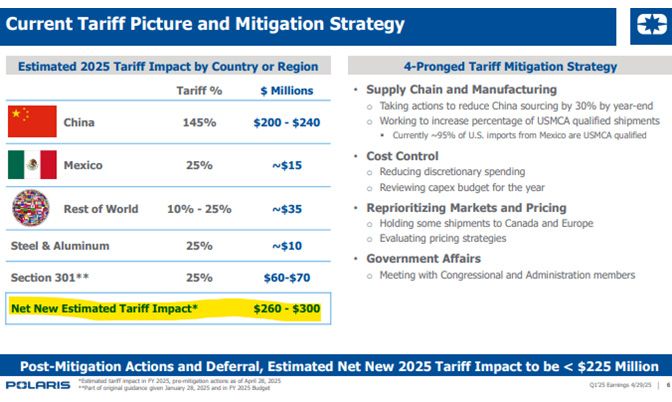
Source: Polaris Investor Presentation, 4/28/25 (emphasis added)
Source: Polaris Investor Presentation, 10/27/25 (emphasis added)
Margins are the story. NarrVol is the opportunity.
Then comes the consumer. And who knows there. What we do know:
- There Will Be Angst. There is a seemingly perpetual desire to be the next Burry to call the end to the U.S. consumer.
- That is a dangerous game to play. The U.S. consumer is a feral beast. Trying to time its demise is a classic example of "do not try."
- The real question is—"What if consumption goes to 2% real?" Is that enough? Probably.
A Tale of Two Consumers
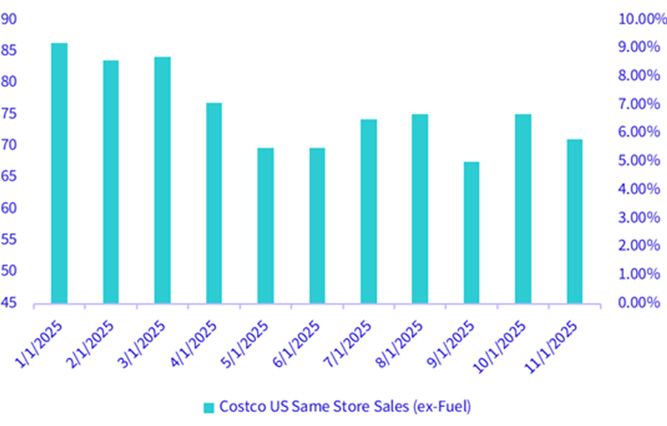
Source: Costco
Yes, the lower end of the income spectrum is under pressure. No, that does not mean consumption is falling apart.
The 2026 narrative is different but the same. Focused on AI. But tweaked. Tariff-centric. But asymmetrically positive. Consumer-dependent. But not to a debilitating degree.
The Narrative Nexus is not a blanket "risk on." It is not for everyone. But—where the narratives collide—it is difficult to be pessimistic. Not (necessarily) on the index level—on a company-by-company basis.
That is the NarrVol.
This is the era of NarrVol. Some days, A will be winning the AI race. Other days it will be B. Tariffs—whether struck down by SCOTUS or upheld—are not going away. There will be a large body of firms left behind. But there will also be many that are "tip of the tooth" and ahead of the rest in the margin expansion game. If you are missing the tooth, the tooth fairy is not going to come to your rescue.
Margins are the nexus of the 2026 narratives. NarrVol will provide opportunities to pivot.
About the contributor

Samuel Rines
Macro Strategist, Model Portfolios
Samuel Rines is a Macro Strategist at WisdomTree, where he extends the firm's custom model portfolio management capabilities. Before joining WisdomTree in 2024, he was the Managing Director at CORBU, LLC, leading the PolyMacro advisory product. With over a decade of experience in economics and finance, Samuel has held significant roles such as Chief Economist at Avalon Investment & Advisory and Economist and Portfolio Manager at Chilton Capital Management LLC. He is also the author of "After Normal: Making Sense of the Global Economy," and holds a Master’s degree in Economics from the UNH Peter T. Paul College of Business and Economics, as well as having studied Economics at the University of Oxford.