

The Unexpected Opportunity for 2019: Japan
Published February 19, 2019

Global Head of Research
There is a massive divergence in today’s markets:
- We believe Japan is an interesting market, with many positive things occurring at the policy level and with very inexpensive and improving fundamentals.
- Market participants outside Japan often don’t pay as much attention to Japan, because they think that the hype over Abenomics and the subsequent investment opportunity have both passed.
With Japan so far out of favor among investors, is it a contrarian opportunity, or are we continuing to be fooled by the false allure of Japan’s potential?
Progression of Flows: Massive Excitement to Massive Pessimism
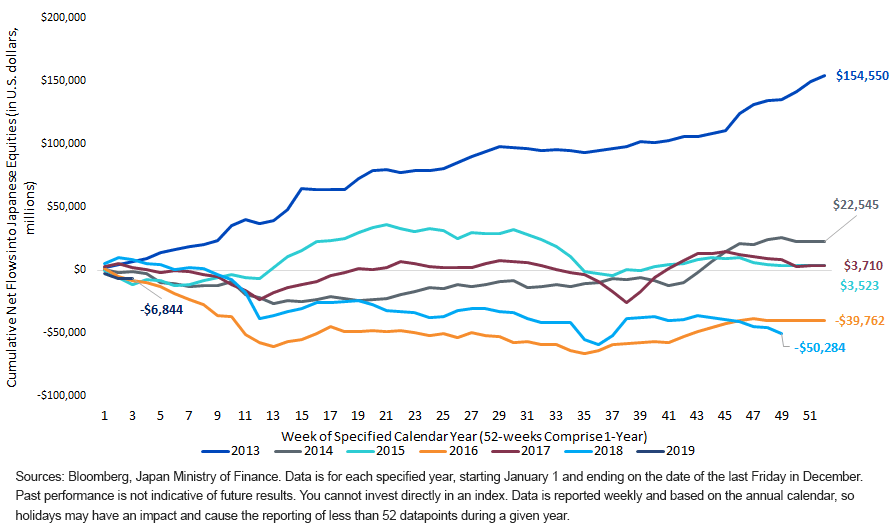
Going back to late 2012, it is true that Japan represented massive potential for reform and excitement that many viewed as almost certain to contribute to strong equity returns. Figure 1 indicates that:
- Non-Japanese investors plowed nearly $155 billion into Japan’s equity market in 2013, based largely on the initial excitement of prime minister Shinzo Abe’s election and agenda, as well as the initiation of Japan’s own massive quantitative easing (QE) policy under the leadership of Bank of Japan (BOJ) governor Haruhiko Kuroda.
- Since 2013, the pattern of foreign investor flows has become progressively more volatile. 2018 was the worst year of Prime Minister Abe’s tenure from an investor flow perspective, as foreign investors pulled more than $50 billion out of Japan’s equity market.
Figure 1: Calendar Year Flows
Investors Assumptions May Differ from Reality
While we’d like to think that each investor is studying Japan’s market, poring over financial data and becoming as excited as we are when Japan implements what we consider innovative tax and incentive policies (not to mention the central bank buying equities), the reality is different.
Investor Flows Frequently Follow Performance
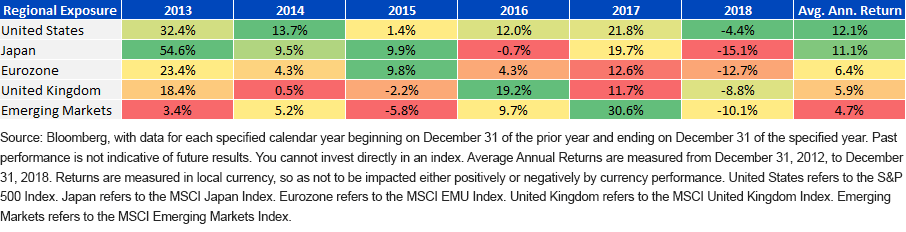
Japan has had substantial volatility during the Abenomics period (which started in December 2012), meaning investors could have caught Japanese equity exposure at the wrong time. However, for comparative purposes, we frequently resign ourselves to using more standardized periods of time, such as calendar years. Figure 2 indicates:
- Last year, when more than $50 billion was taken out of Japan by foreign investors, we saw that Japan’s equity returns were poor, ranking behind the United States, the eurozone, the United Kingdom and even emerging markets. As a result, outflows during that particular year made sense based on our behavioral assumption that poor performance correlates positively to investor outflows.
- If we extend the horizon and look at the full period of Abenomics, calendar year by calendar year, based on investors’ sentiment about Japanese equities, we’d assume that Japanese stocks would be at the bottom of the pack. In 2016 and in 2018, Japanese equities were the worst performers of the regions we show. But, importantly, in 2013 and in 2015, they were the top performing, and in 2014 and 2017, they were in the middle of the pack. Even the U.S. equity market, viewed frequently as possessing unassailable performance supremacy in recent years, only led the other regions in two of those years.
- During the full period, only two markets achieved double-digit returns. The U.S. equity market was at the top of the range, which likely surprises no one. Japan came in second, beating the eurozone, the United Kingdom and emerging markets. That, we would predict, surprised almost everyone.
Figure 2: Japanese Equities Have Done Reasonably Well during the Abenomics Period
The Case for Japan as a Contrarian Investment
Of course. But the possibility would be true for any contrarian investment. In a way, the definition implies that the consensus view would be for further negative returns.
One of WisdomTree’s core principles is that valuation matters. Unfortunately, the data doesn’t suggest that valuation always matters equally across all markets, because nothing in investing is that simple. On the other hand, trying to say “valuation doesn’t matter” leaves one back in the U.S. tech sector in 1999 and 2000, when suddenly it did matter in a big way.
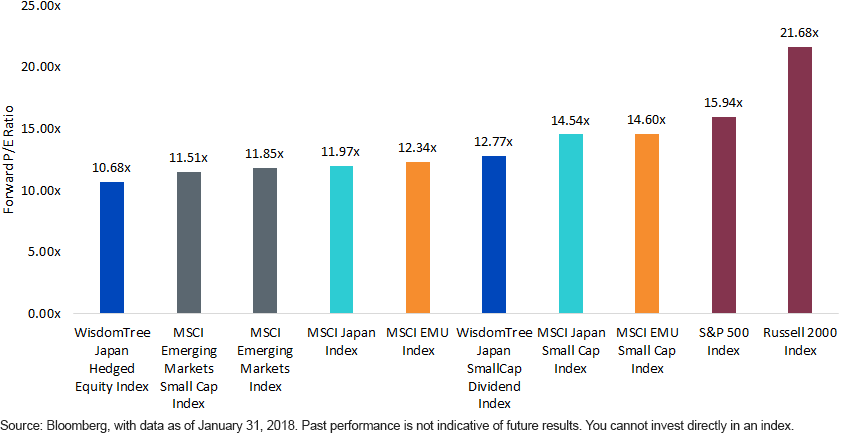
In figure 3, we see that the risk of Japan’s largest and most global companies could be close to being “priced in,” likely due to uncertainty surrounding global trade tensions and a challenging domestic market environment. As a result, Japan’s forward P/E ratio is at about two-thirds that of the S&P 500 Index. The risks of emerging markets, for example, are widely known, yet these businesses are trading at even lower valuations.
Figure 3: Japan’s Global Companies Are Trading at Very Low Valuations
Sometimes the Strongest Returns Are Those That Surprise the Consensus
There is no question that Japan and Japanese equities are hard allocations to position today.
There is also no question that most investors are not focusing on Japan right now.
This tells us that there is an opportunity for a surprise in 2019. And surprises to the consensus have historically been some of the best return opportunities.
About the contributor

Global Head of Research
Christopher Gannatti began at WisdomTree as a Research Analyst in December 2010, working directly with Jeremy Schwartz, CFA®, Director of Research. In January of 2014, he was promoted to Associate Director of Research where he was responsible to lead different groups of analysts and strategists within the broader Research team at WisdomTree. In February of 2018, Christopher was promoted to Head of Research, Europe, where he was based out of WisdomTree’s London office and was responsible for the full WisdomTree research effort within the European market, as well as supporting the UCITs platform globally. In November 2021, Christopher was promoted to Global Head of Research, now responsible for numerous communications on investment strategy globally, particularly in the thematic equity space. Christopher came to WisdomTree from Lord Abbett, where he worked for four and a half years as a Regional Consultant. He received his MBA in Quantitative Finance, Accounting, and Economics from NYU’s Stern School of Business in 2010, and he received his bachelor’s degree from Colgate University in Economics in 2006. Christopher is a holder of the Chartered Financial Analyst Designation.