

Fade the Strong Euro Consensus
Published February 15, 2019

Head of Equity Strategy
You wouldn’t know it from the stock market’s gut-wrenching fourth-quarter decline and 2019’s snapback, but the euro has been downright sleepy.
Be careful because that can change quickly.
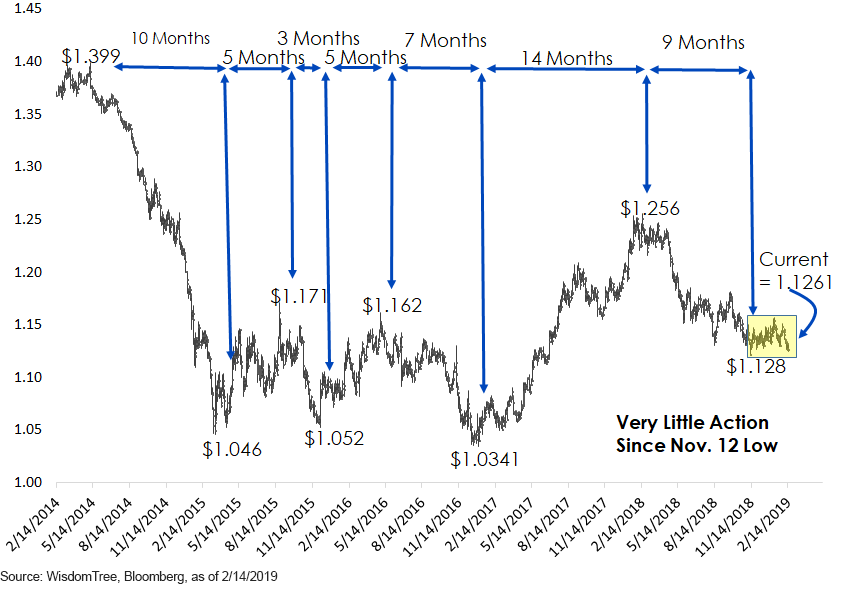
EUR/USD touched a recent low of $1.128 in November and has been moving in a 3-cent range ever since, flirting with that level right now. The currency was oblivious to the panic that sent the VIX volatility index for equities to a Lehman-like level of 36 during the lazy days around Christmas.
Figure 1 shows that, over the last five years, EUR has moved a dime or twenty cents as a matter of routine. However, I wouldn’t be complacent; things could get interesting, and soon.
Figure 1: EUR vs. USD
The Lopsided Street
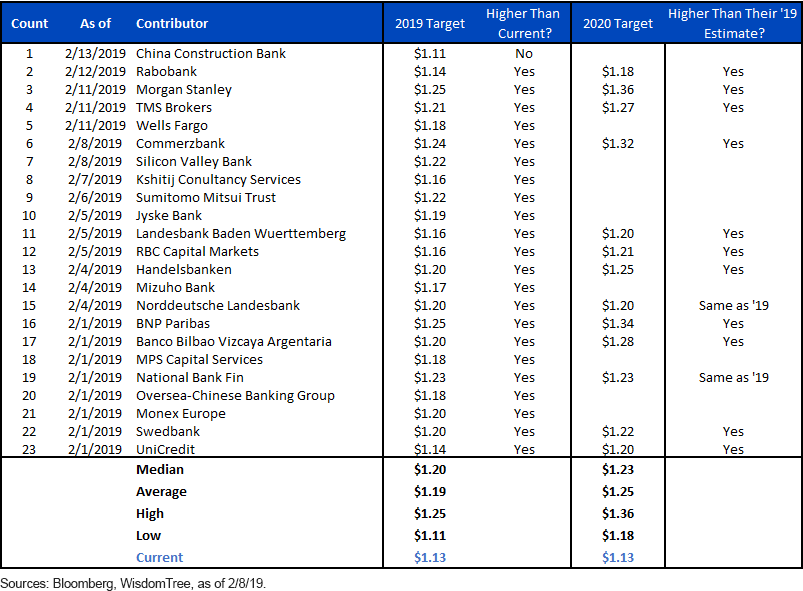
To figure 2, we say “wow.” All but one of the 23 economists who have published a FY19 EUR estimate in February has penciled in strength relative to the USD. As a group, they are also estimating even more strength in 2020.
Figure 2: Wall Street Estimates, EUR/USD
Fade Them
But look at the politics, starting with Italy. The European Commission downgraded its forecast for Italy’s 2019 GDP growth to 0.2%, just inches above the red ink of Q3 and Q4.
Italy’s coalition government of protest party leftists and the anti-immigrant right are together attacking French president Emmanuel Macron. The left decries Macron’s “Jupiterian” regime for favoring the rich and being out of touch, a similar charge to the one that brought down former president Nicolas Sarkozy. The right is relentless too, hitting on Macron’s europhilic bona fides and his indifference to immigration grievances in first-port-of-entry countries.
Many Italians claim that EU officialdom is taking a hard line on the Maastricht Treaty’s 3% budget deficit-to-GDP ratio limit—when it comes to them—but is being more lenient with France.
After all, Macron was allowed to do an about-face after he miscalculated car-centric rural France’s rage against his 2018 gasoline taxes. The gilet jaunes (yellow vest) protests were effective—Macron crawled back to the Élysée with his tax plan scrapped and an extra €11 billion in fiscal largesse thrown in for good measure.
To supporters of Italy’s Five Star Movement and The League parties (who, by the way, are going to be competing against each other in the May EU parliament elections), France is getting off scot-free. The verbal attacks on Macron are incessant, and Jupiter is not happy about it. This is no minor spat; France just withdrew its ambassador to Rome for the first time since 1940.
Let’s not end without mentioning Germany’s place amid the Street’s consensus for EUR strength.
Finance minister Olaf Scholz says the budget surpluses that have been standard in Germany since 2014 are ending this year, and that business-focused tax cuts are policy now.
The country could use the stimulus, given its nasty 3.9% year-over-year fall in industrial production. Keep your eyes on credit default swaps from Deutsche Bank and Commerzbank too. These are only back to November and December levels, respectively. If they stay ugly, we may see more tax cuts or spending from Berlin.
We have been saying that fiscal wars would be the next stage in this generation’s evolution from currency wars to trade wars.
The fiscal wars are Stage Three.
It appears to be playing out. The signs of expansionary fiscal policy for 2019 are there, if you care to look. From China’s recent tax cuts to India’s giveaway to rural farmers in an attempt to stave off the Gandhis, to the trio of Italy, France and Germany throwing goodies at the wall—if you’re still thinking about trade wars, then you’re stuck on last year’s story.
If you’re still not convinced that Germany and its neighbors are open to fiscal stimulus, just remember that Trump is here until January 2021 at least. And just about every non-U.S. NATO member, save Greece of all countries, is failing to keep their end of the military spending bargain.
Tax cuts, pension goodies, defense boosts, whatever. It’s dandy for GDP growth, but tell it to the budget hawks, and tell it to the euro. The entire Street is piled on EUR strength.
Fade it.
Categories
About the contributor

Head of Equity Strategy
Jeff Weniger, CFA, has been with WisdomTree since 2017 and serves as the Head of Equities. He shapes the firm’s market outlook through a combination of macroeconomic and fundamental analysis. With more than two decades in investment strategy, Jeff is known for his work on market cycles and valuations. Before joining WisdomTree, Jeff was with BMO Private Bank and BMO Global Asset Management for 11 years. At BMO, he sat on the firm’s Asset Allocation Committee and co-managed ETF model portfolios across the U.S. and Canada. In 2013, at age 32, he became the youngest member of BMO’s Global Investment Forum. When he left BMO to come to WisdomTree, his final role was Director, Senior Strategist in the Office of the CIO in 2017.
Jeff is a frequent television guest on networks such as CNBC, Bloomberg, and Schwab, with regular print appearances in The Wall Street Journal, Barron’s and Reuters. He also appears weekly on the Behind the Markets podcast and is a regular on SiriusXM’s The Business Briefing. On X, Jeff has developed one of the larger followings in financial media. He earned a B.S. in Finance from the University of Florida and an MBA from the University of Notre Dame. He has held the CFA charter since 2006.