

The Most Diligent Analyst You’ll Never Meet: How AI Is Rethinking International Value
Published May 28, 2025

Global Head of Research
Key Takeaways
- As cracks in U.S. exceptionalism emerge in 2025, international markets—especially Europe—are drawing renewed investor attention given policy easing and infrastructure stimulus.
- The WisdomTree International AI Enhanced Value Fund (AIVI) leverages proprietary AI to identify mispriced value stocks globally, outperforming benchmarks like the MSCI EAFE Index over the past year.
- AIVI's sector-specific AI model minimizes human bias, adapts to changing market signals and emphasizes quality over hype, making it a compelling option for value-focused international equity exposure.
For over a decade, the investing world was dominated by the gravitational pull of U.S. exceptionalism—a regime powered by world-leading tech innovation, expansive fiscal policy, a dollar-centric financial system and a stock market that seemed to defy global cycles. Allocators were rewarded for staying over-weight in U.S. equities and under-weight in almost everything else. But in 2025, cracks in that regime have grown more visible. From market performance to policy stability, international markets—especially in Europe and parts of Asia—are beginning to assert themselves in ways that challenge long-held assumptions about global investing.
This is not just a story about U.S. vulnerability. It is also a story of transformation abroad. In Europe, for example, we are witnessing what could be a structural regime shift. Years of tight monetary and regulatory conditions are easing. Germany has launched a €50bn infrastructure stimulus plan, the European Central Bank is cutting rates, and climate regulations are being recalibrated in favor of growth.1 Investors, previously apathetic, are taking notice. As of early 2025, European equity fund inflows are the strongest in years.2 What began as a "relief rally" following the U.S. election is now being reassessed by some as the early innings of "Europe 2.0"—a potential restart of domestic growth dynamics that had been dormant since the global financial crisis.
At the same time, the narrative of U.S. supremacy has begun to unravel—not through catastrophe, but through the slow erosion of its foundational advantages. The U.S. stock market remains expensive on a relative basis.3 The federal government is running large deficits with less room to maneuver, and monetary tightening has cooled consumption and confidence. Meanwhile, political volatility and unpredictable trade policies are prompting some global investors to rethink their exposure. Even with tech leadership intact, U.S. equities now face higher hurdles for future outperformance given elevated valuations and increasingly concentrated market gains.
In this evolving global context, international diversification is no longer a contrarian call—it is a forward-looking response to a rebalancing world. The question investors must now ask is not whether to go global, but how. In the next section, we explore one strategy designed to do just that, capturing the upside potential from regions currently undergoing structural renewal while mitigating the risks associated with legacy assumptions baked into passive global benchmarks. For instance, as of April 30, 20254:
- The MSCI ACWI Index was more than 63% weighted toward U.S. equities
- The MSCI World Index was more than 71% weighted toward U.S. equities
The Most Diligent Analyst You'll Never Meet
As of May 19, 2025, the WisdomTree International AI Enhanced Value Fund (AIVI) was among the top-performing WisdomTree ETFs for 2025.5 This is a unique strategy, in that the primary input to stock selection comes from a proprietary, quantitative artificial intelligence (AI) model developed by Voya Investment Management Co., LLC.
How can we think about such an approach?
Imagine an analyst who never sleeps, forgets nothing and is unshaken by emotion. Now imagine giving that analyst access to 20 years of global market data, 10,000 variables per company and asking them to search—without ego—for signals of value hidden beneath the noise.6 That's what powers the aforementioned AI model under the hood of AIVI. It's not artificial intelligence for buzzword's sake. It's AI as a tool to scale the best parts of fundamental investing: discipline, consistency and a sharp eye for mispriced opportunity. This isn't automation replacing expertise. It's expertise multiplied.
Why Patterns Matter More than Predictions
Markets don't reward prediction; they reward preparation. The AI doesn't try to forecast tomorrow's headlines. Instead, it hunts for patterns that have paid off over time—patterns in capital allocation, sentiment reversals, governance changes and valuation misalignments that humans might overlook, especially across countries and sectors. It uses more than 250 distinct features that stretch from core fundamentals to alternative signals like greenhouse gas intensity or earnings manipulation indicators.7 Where most strategies cling to a static definition of value, AIVI adapts—because the market itself is a moving target.
The Quiet Advantage of No Ego
A common challenge in stock selection is that conviction can cloud judgment. You fall in love with a narrative. You double down. You hesitate when the facts change. The AI at the core of AIVI has no such bias. When a company's risk/reward profile deteriorates—even subtly—it trims or exits. When short interest spikes, sentiment collapses or filings are delayed, virtual traders adjust sizing or hold off buying altogether. And yet, there's still a human at the wheel. Portfolio managers review trades before execution—not because the system fails, but because real-world investing still demands a final gut check.
Not a Black Box—A Smarter Dashboard
Skepticism about machines managing money is fair. But here's the twist: AIVI is a glass box, not a black one. Every decision the system makes can be interrogated—why it bought, why it sold, what features drove that decision. There's no magic formula hidden behind a curtain. What you get is a process that's auditable, explainable and—importantly—improving over time. This stands in contrast to traditional indexes that follow rigid formulas, unable to adapt even when their rules stop working. In a market defined by change, the ability to evolve is not just useful—it's essential.
Seeing the Developed International Picture in High Definition
International investing is hard because the signals are noisier. Headlines in Germany. Policy shifts in Japan. Differing accounting standards. AIVI's AI engine treats all of it as data. It doesn't favor the familiar; it tests everything. That means it can spot when a UK energy company is underpriced relative to its historical earnings and has improving governance metrics, even if the sell side is pessimistic. It looks at the world the way great investors do—through both a microscope and a telescope, balancing the short term with the long arc of capital compounding. That's what turns a fund into a strategy, and a strategy into a philosophy.
Figure 1: Standardized Performance

Sources: WisdomTree, FactSet, specifically data from the Fund Comparison Tool in the PATH suite of tools, accessed 5/3/25, with returns as of 3/31/25. NAV denotes total return performance at net asset value. MP denotes market price performance. The Fund's objective and strategies changed effective 1/18/22. Prior to 1/18/22, Fund performance reflects the investment objective of the Fund when it was the WisdomTree International Dividend ex-Financials Fund (DOO) and tracked the performance, before fees and expenses, of the WisdomTree International Dividend ex-Financials Index. Past performance is not indicative of future results. Investment return and principal value of an investment will fluctuate so that an investor's shares, when redeemed, may be worth more or less than their original cost. Current performance may be lower or higher than the performance data quoted. For the most recent month-end and standardized performance, click here.
In the age of information overload and increasingly global markets, the challenge for investors isn't lack of data—it's knowing what to do with it. That's exactly where AI comes in.
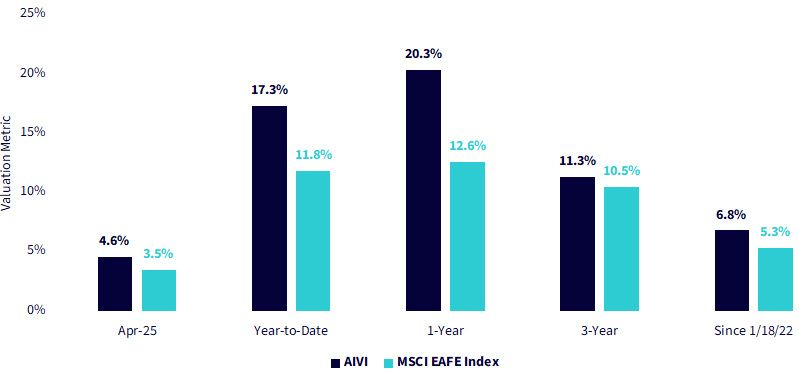
Figure 2 shows that, from April 30, 2024, to April 30, 2025, AIVI beat the MSCI EAFE Index by a significant margin.
Figure 2: AIVI vs. the MSCI EAFE Index
Sources: WisdomTree, FactSet, specifically data from the Fund Comparison Tool in the PATH suite of tools, accessed 5/3/25, with returns as of 4/30/25. NAV denotes total return performance at net asset value. MP denotes market price performance. The Fund's objective and strategies changed effective 1/18/22. Prior to 1/18/22, Fund performance reflects the investment objective of the Fund when it was the WisdomTree International Dividend ex-Financials Fund (DOO) and tracked the performance, before fees and expenses, of the WisdomTree International Dividend ex-Financials Index. Past performance is not indicative of future results. Investment return and principal value of an investment will fluctuate so that an investor's shares, when redeemed, may be worth more or less than their original cost. Current performance may be lower or higher than the performance data quoted. For the most recent month-end and standardized performance, click here.
Let's unpack how this worked.
The Machines Got It Right: Where AIVI Delivered Relative Outperformance
AIVI's AI model didn't just ride the tide—it outmaneuvered the benchmark through targeted stock selection:
- Betting Big on Quality Compounders:
Take SIEMENS ENERGY AG, for example. Looking back to April 30, 2024, the stock was trading near a 52-week low. Since that point, its return has been above 100% over the year that followed.
This wasn't just luck—it was pattern recognition, identifying turnaround potential where human analysts may have been hesitant.
- Avoiding Pain Trades:
NOVO NORDISK, an example of a benchmark heavyweight, was down over the period. AIVI had zero exposure.
AI's edge? Likely recognizing a combination of valuation compression, momentum deceleration and fundamental deterioration ahead of consensus. As humans, we can see intensifying competition in GLP-1 drugs, and AI can help in getting around the hype in that topic and back to the fundamentals.
Now, it would be incorrect to think AI only makes value-added investment inputs.
- AIVI did not allocate to SAP, Sony or Roche. These companies, particularly SAP, did have a good return over the one-year period. If we were to indicate a common situation where AIVI's model might miss a subsequent stronger performer, it would be that the current valuation appears high relative to fundamentals. This is a value strategy, and the model is tuned to more value-oriented opportunities even if the typical investor is more likely to measure performance against the broader MSCI EAFE Index.
What This Tells Us about AI Investing
AI in AIVI isn't about wild speculation—it's about systematic intelligence applied to fundamental investing. The model looks across thousands of signals, from price momentum and volatility to earnings quality and macro exposure, in real time. It evaluates which companies are likely to outperform based on historically predictive patterns, many of which escape the naked eye.
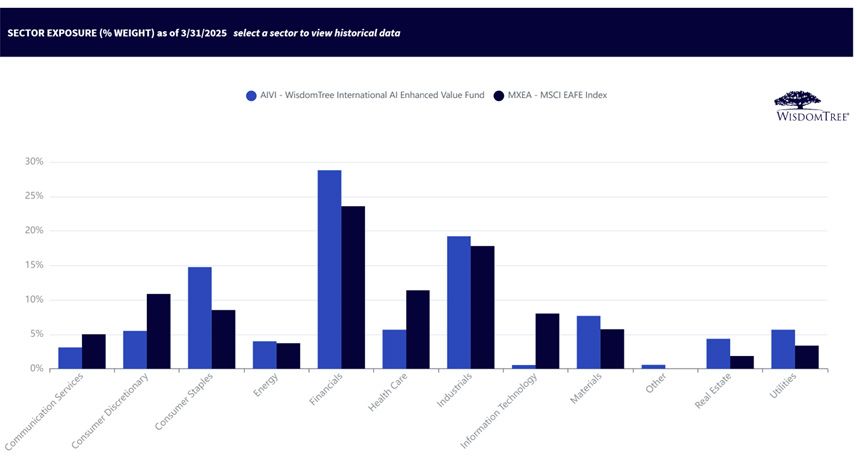
As we have mentioned, AIVI is focusing on the value side of the investment style box, and we see that in figure 3's sector comparison:
Figure 3: AIVI's Sector Positioning vs. the MSCI EAFE Index
Sources: WisdomTree, FactSet, with data accessed through WisdomTree's Fund Comparison Tool on 5/3/25. Subject to change.
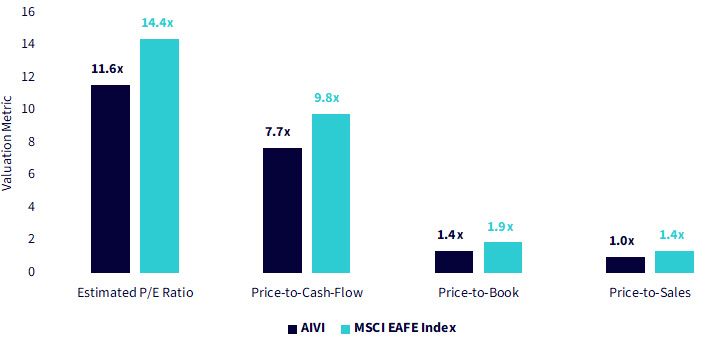
We began this article considering the narrative that the investing public is potentially moving from a world of U.S. exceptionalism in equity market returns to a world where geographic diversification is carrying a bigger benefit. It's useful to understand how a strategy like AIVI is constructed to manage the risk of undue exposure to more highly valued pockets of the international market. From figure 4, it's clear we are discussing a value exposure, but not necessarily taking the risk inherent with seeking a deep value approach.
Figure 4: Value, but Not Deep Value
Sources: WisdomTree, FactSet, with data accessed through WisdomTree's Fund Comparison Tool on 5/3/25, and as of 3/31/25. Subject to change.
Conclusion: Take Human Biases Out of International Equity Exposure
AIVI has started 2025 with strong performance. With any methodology, it's important to understand what is being directly controlled and what is a consequence. Performance is always a consequence—we never know for sure what it will bring. However, we do know that the strategy is designed to remove human biases from investment decision-making. This is where AIVI is designed to really shine.
1 Source: R. Wigglesworth, "European (Fund Flow) Exceptionalism," Financial Times, 3/7/25.
2 Source: Wigglesworth, 2025.
3 Source: R. Sharma, "Debunking American Exceptionalism," Financial Times, 2/16/24.
4 Sources: MSCI World Index (USD): Index Factsheet, MSCI Inc., 4/30/25. https://www.msci.com/documents/10199/294164/MSCI+World+Index+Factsheet.pdf ; MSCI ACWI Index (USD): Index Factsheet, MSCI Inc., 4/30/25. https://www.msci.com/documents/10199/294164/MSCI+ACWI+Index+Factsheet.pdf
5 Source: WisdomTree, specifically in the PATH set of tools, as of 5/19/25, where AIVI was ranked number 5 by total return, NAV returns.
6 Source: Voya Investment Management.
7 Source: Voya Investment Management.
Important Risks Related to this Article
There are risks associated with investing, including possible loss of principal. Investments in non-U.S. securities involve political, regulatory, and economic risks that may not be present in U.S. securities. For example, foreign securities may be subject to risk of loss due to foreign currency fluctuations, political or economic instability, or geographic events that adversely impact issuers of foreign securities. Funds focusing their investments on certain sectors increase their vulnerability to any single economic or regulatory development. This may result in greater share price volatility. While the Fund is actively managed, the Fund’s investment process is expected to be heavily dependent on a quantitative model and the model may not perform as intended. Please read the Fund’s prospectus for specific details regarding the Fund’s risk profile.
About the contributor

Global Head of Research
Christopher Gannatti began at WisdomTree as a Research Analyst in December 2010, working directly with Jeremy Schwartz, CFA®, Director of Research. In January of 2014, he was promoted to Associate Director of Research where he was responsible to lead different groups of analysts and strategists within the broader Research team at WisdomTree. In February of 2018, Christopher was promoted to Head of Research, Europe, where he was based out of WisdomTree’s London office and was responsible for the full WisdomTree research effort within the European market, as well as supporting the UCITs platform globally. In November 2021, Christopher was promoted to Global Head of Research, now responsible for numerous communications on investment strategy globally, particularly in the thematic equity space. Christopher came to WisdomTree from Lord Abbett, where he worked for four and a half years as a Regional Consultant. He received his MBA in Quantitative Finance, Accounting, and Economics from NYU’s Stern School of Business in 2010, and he received his bachelor’s degree from Colgate University in Economics in 2006. Christopher is a holder of the Chartered Financial Analyst Designation.