
WDNA
BioRevolution Fund

Published August 5, 2026

Global Head of Research
Sitting in July 2026, we noticed something.
The WisdomTree BioRevolution Fund (WDNA) delivered a dramatic acceleration in performance over the S&P 500 Index, thereby drawing attention to this particular investment theme.
We see this acceleration in Figure 1a, where WDNA has clearly jumped upwards in the Year-to-Date and 1-Year periods, even if the 3-Year and 5-Year periods remain lackluster at best.
We wanted to explore the relevant narratives across some of the larger holdings to better understand the drivers of this performance and whether there might be a logical case where it could continue.
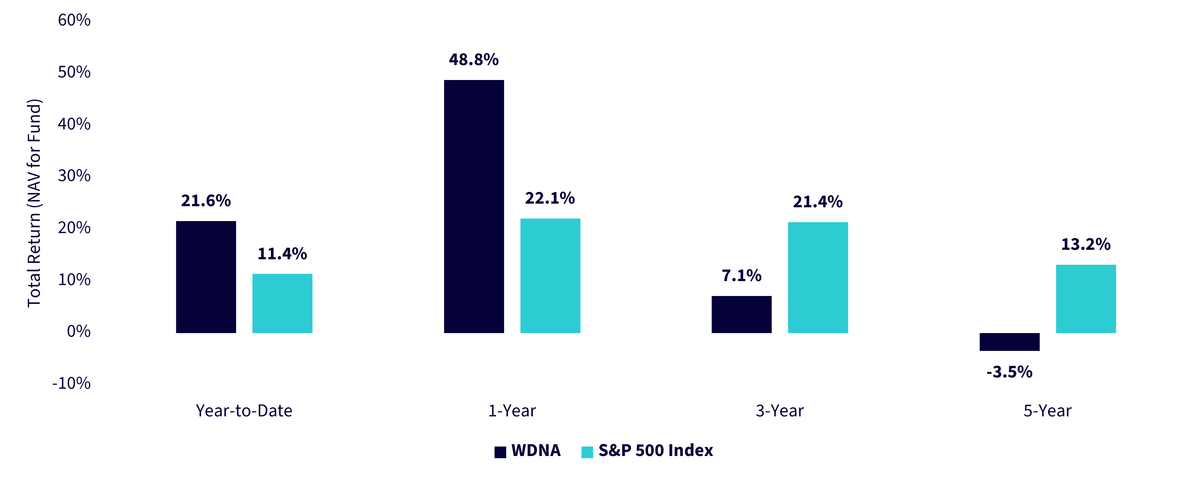

Sources: Morningstar, FactSet and WisdomTree, specifically data is from the PATH Fund Comparison Tool, accessed as of July 11, 2026, but showing returns for the period ended July 10, 2026 for Figure 1a and June 30, 2026 for 1b. NAV denotes total return performance at net asset value. MP denotes market price performance. Past performance is not indicative of future results. Investment return and principal value of an investment will fluctuate so that an investor’s shares, when redeemed, may be worth more or less than their original cost. Current performance may be lower or higher than the performance data quoted. For the most recent month-end and standardized performance and to download the respective Fund prospectuses, click here.
Across the top names in the portfolio, a striking number of company-specific events have landed positively since May 2026. These have included such things as:
What follows is a look at the companies that, in our view, have done the most to explain why this theme has delivered its recent performance acceleration.1
The fund's largest position, Twist Bioscience (5.25% weight), kicked things off with fiscal Q2 2026 results in early May that came in above expectations. More importantly, Twist simultaneously launched an expanded clonal gene synthesis offering capable of handling longer and more complex sequences. For investors watching synthetic biology as an infrastructure theme, the idea that the tools enabling biological engineering matter as much as the end applications, that combination of financial execution and product expansion was exactly the kind of signal that supports a rerating. Twist is not a drug company; it is closer to the picks-and-shovels layer of the BioRevolution, and when it shows it can grow revenue while expanding its technical moat, the thesis strengthens.2
Eli Lilly (4.05% weight) is the clearest example of a company whose recent catalysts were both commercial and clinical at once. In late May, Lilly announced that all three major pharmacy benefit managers would cover its obesity portfolio, including Zepbound and Foundayo, a milestone that directly expands the addressable patient population for what is already shaping up to be one of the most commercially significant drug franchises in decades. Almost simultaneously, Phase 3 data for retatrutide, Lilly's next-generation triple agonist, showed powerful weight-loss efficacy, reinforcing that the pipeline has depth well beyond the current product cycle. When you can point to both improving real-world access and a clinical program that could extend commercial leadership, investors pay attention.2
If Lilly represents the established obesity leader, Structure Therapeutics (2.11% weight) represents the speculative but increasingly credible challenger. In March 2026, the company reported positive topline data from the ACCESS II Phase 2 trial for aleniglipron, its once-daily oral small molecule GLP-1 receptor agonist, showing placebo-adjusted mean weight loss of 16.3% at 44 weeks, a number that would be competitive in an injectable world, and is striking for an oral compound. By early May, the company had confirmed positive end-of-Phase 2 FDA feedback and put Phase 3 initiation on track for Q3 2026, and in June the ACCESS II data were published in Nature Medicine, adding a layer of peer-reviewed scientific credibility to the program. Oral GLP-1 obesity drugs have been the white whale of metabolic medicine for years; when a small-cap name produces efficacy data that suggests the oral route is genuinely viable, and then backs it with an FDA-aligned Phase 3 plan and a peer-reviewed publication, the market tends to reward that aggressively. Structure has laid out a clear roadmap of further readouts, ACCESS OLE data expected in Q3 and body composition data in Q4, keeping the story in motion well into the second half of 2026.4
Immunome (2.49% weight) illustrated a pattern that recurred throughout the portfolio, which is to say a strong data event followed by a regulatory milestone that transformed a story from "interesting science" to "tangible near-term catalyst." The company first reported positive topline RINGSIDE results in December 2025, then presented the full detailed Phase 3 data for varegacestat in desmoid tumors in an oral abstract session at ASCO on May 30, 2026, a presentation venue that itself signals clinical significance. The NDA had already been submitted to the FDA in April, and on July 8 the agency formally accepted it for review, assigning a PDUFA target action date of April 28, 2027. That sequence, rigorous Phase 3 data presented at the field's leading oncology conference, followed within weeks by formal FDA review acceptance, is precisely what moves a clinical-stage company from the speculative column into the credible-commercial-candidate column, with a defined regulatory clock now running.5
Two positions that sit close together in weight, Natera (2.31% weight) and Tempus AI (2.30% weight), reflect a broader thesis within the BioRevolution that genomics-driven diagnostics and data networks are becoming structural parts of cancer care, not optional add-ons.
On May 26, Natera announced a major enhancement to its Panorama NIPT platform, powered by novel SNP-informed deep sequencing technology that reduces the no-call rate to 0.5% and delivers clinically validated performance even in samples with low fetal fraction, a longstanding competitive limitation for counting-based approaches. Two days later, the company announced enrollment of the first patients in SIGNAL-ER 101, a prospective, multi-center study in which Signatera MRD testing is used to guide treatment de-escalation in intermediate-risk early-stage breast cancer, a disease setting where current standard-of-care CDK4/6 inhibitor therapy benefits only around 3% of eligible patients. That sequence, a competitive upgrade to the women's health franchise followed almost immediately by an interventional oncology trial launch, reinforced two distinct growth vectors within the same week, which is precisely why investors tend to view Natera as more than a single-product story.6
On June 1, Tempus announced the upcoming clinical availability of xH, its first whole-genome sequencing assay, developed for use in hematologic malignancies including acute myeloid leukemia and myelodysplastic syndromes, with analytical validation data simultaneously presented at ASCO. Two days later, on June 3, Tempus and founding academic members Yale New Haven Hospital and Memorial Sloan Kettering Cancer Center launched the IMS Open-Source Consortium, designed to standardize digital pathology infrastructure and accelerate AI deployment across academic medical centers. For a company whose core argument is that a large and growing data network creates compounding advantages in precision oncology, those two moves in the same week told a coherent story: expanding the clinical product footprint while simultaneously embedding Tempus infrastructure more deeply into the institutions that generate the data.7
The honest answer is that performance acceleration built on company-specific catalysts is inherently lumpy, and we know that regulatory approvals and clinical data often do not arrive on a schedule, and some of the events that drove May through July will not repeat. What the recent period does demonstrate, however, is that the BioRevolution theme is not a story waiting to happen; it is a story that is actively happening across multiple modalities simultaneously. Gene editing is moving from proof-of-concept to multi-program franchises. Oral obesity drugs are producing data that was considered speculative two years ago. AI-enabled diagnostics platforms are securing hospital and cancer center partnerships at scale.
The structural case, that biological engineering, genomic medicine, and precision diagnostics are reshaping healthcare in ways that create durable equity opportunities, is strengthened, not weakened, by a period where the data catches up with the thesis. Whether the specific pace of recent performance continues depends heavily on what emerges from late-stage clinical readouts and regulatory decisions in the second half of 2026. But investors who have waited for evidence that this theme has real-world momentum now have considerably more of it than they did six months ago.
1 Selected companies are sourced from the WDNA fund page, with data as of July 10, 2026. Each % represents the weight of that company within WDNA as of this date. Holdings subject to change.
2 Sources: Twist Bioscience Corporation. (2026, May 4). Twist Bioscience expands clonal genes offering to include long and complex sequences [Press release]. Business Wire; Twist Bioscience Corporation. (2026, May 4). Twist Bioscience reports fiscal second quarter 2026 financial results [Press release].
3 Sources: Eli Lilly and Company. (2026, May 28). Foundayo and Zepbound now covered for millions of Americans [Press release]; Eli Lilly and Company. (2026, May 21). Lilly's triple agonist, retatrutide, delivered powerful weight loss in pivotal Phase 3 obesity trial [Press release].
4 Sources: Structure Therapeutics Inc. (2026, March 16). Structure Therapeutics reports positive topline data from Phase 2 ACCESS II trial with once-daily oral small molecule GLP-1 receptor agonist, aleniglipron [Press release]. SEC EDGAR; Structure Therapeutics Inc. (2026, May 7). Structure Therapeutics reports first quarter 2026 financial results and recent highlights [Press release]. GlobeNewswire.
5 Sources: Immunome, Inc. (2026, May 30). Immunome announces detailed Phase 3 RINGSIDE data for varegacestat in adults with progressing desmoid tumors at the 2026 ASCO Annual Meeting [Press release]; Immunome, Inc. (2026, July 8). Immunome announces U.S. FDA acceptance of new drug application for varegacestat for the treatment of adults with desmoid tumors [Press release]. Business Wire.
6 Sources: Natera, Inc. (2026, May 26). Natera to launch enhanced Panorama™ NIPT, powered by novel SNP-informed deep sequencing technology [Press release]. Business Wire; Natera, Inc. (2026, May 28). Natera enrolls first patients in SIGNAL-ER 101, a prospective, interventional study evaluating MRD-guided therapy in breast cancer [Press release].
7 Sources: Tempus AI, Inc. (2026, June 1). Tempus announces the upcoming clinical availability of its first whole-genome sequencing assay, xH [Press release]. Business Wire; Tempus AI, Inc. (2026, June 3). Tempus launches open-source digital pathology consortium, names Yale New Haven Health and leading cancer center as founding members [Press release]. Business Wire.
There are risks associated with investing, including possible loss of principal. The Fund invests in BioRevolution companies, which are companies significantly transformed by advancements in genetics and biotechnology. BioRevolution companies face intense competition and potentially rapid product obsolescence. These companies may be adversely affected by the loss or impairment of intellectual property rights and other proprietary information or changes in government regulations or policies. Additionally, BioRevolution companies may be subject to risks associated with genetic analysis. The Fund invests in the securities included in, or representative of, its Index regardless of their investment merit and the Fund does not attempt to outperform its Index. The composition of the Index is governed by an Index Committee and the Index may not perform as intended. Please read the Fund’s prospectus for specific details regarding the Fund’s risk profile.
BioRevolution Fund


Global Head of Research
Christopher Gannatti began at WisdomTree as a Research Analyst in December 2010, working directly with Jeremy Schwartz, CFA®, Director of Research. In January of 2014, he was promoted to Associate Director of Research where he was responsible to lead different groups of analysts and strategists within the broader Research team at WisdomTree. In February of 2018, Christopher was promoted to Head of Research, Europe, where he was based out of WisdomTree’s London office and was responsible for the full WisdomTree research effort within the European market, as well as supporting the UCITs platform globally. In November 2021, Christopher was promoted to Global Head of Research, now responsible for numerous communications on investment strategy globally, particularly in the thematic equity space. Christopher came to WisdomTree from Lord Abbett, where he worked for four and a half years as a Regional Consultant. He received his MBA in Quantitative Finance, Accounting, and Economics from NYU’s Stern School of Business in 2010, and he received his bachelor’s degree from Colgate University in Economics in 2006. Christopher is a holder of the Chartered Financial Analyst Designation.