

Subsidizing China’s Superpower Aspirations
Published April 27, 2018

Head of Equity Strategy
Christine Lagarde, head of the International Monetary Fund (IMF), is warning that China’s Belt and Road Initiative—the potentially multitrillion-dollar network of roads, rails, pipelines and other infrastructure across Eurasia—risks saddling unstable governments with unpayable debt. Because of the IMF’s concerns, it plans to fund the China-IMF Capacity Development Center (CICDC) to train the Chinese to minimize the headaches caused by this century’s Marshall Plan. If all goes according to plan, the Belt and Road project will connect land- and sea-based trading routes to cement China as the center of global commerce in a decade or two.
While China appears to be ascending into world superpower status in the coming decades, a $100 investment in “global” equities allocates just $3.51 to the country, if we track an index like the MSCI All Country World (ACWI).1 That seems remarkably low for a country that is going head-to-head with the U.S. on the global stage.
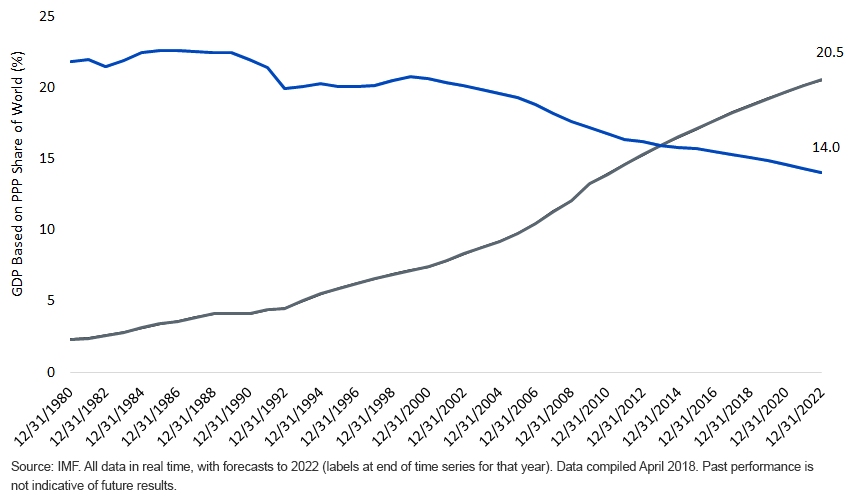
It was only last year that MSCI announced it would be adding Chinese A-shares, companies listed in Shanghai and Shenzhen, to its MSCI Emerging Markets Index. That is late for an economy whose size surpassed the U.S. in 2014, at least on a purchasing power parity basis (see chart below).
China & U.S. Shares of Global Gross Domestic Product
Covering China, Wherever the Listing
While some Chinese companies are only available in Shanghai or Shenzhen, others are listed solely in Hong Kong. Still others have American Depository Receipts (ADRs) or are traded in Singapore.
The WisdomTree ICBCCS S&P China 500 Fund (WCHN) ETF tracks the S&P China 500 Index, before fees and expenses, covering stocks in all those bourses. This index currently holds over 50% in local A-shares. MSCI, by contrast, is only starting to add A-shares securities up to a 5% inclusion factor in 2018, a small starting point. It’s high time China has its own S&P 500, especially if President Xi Jinping has anything to say about it.
Going Out
Deng Xiaoping, ruler of China from 1978 to 1989, famously advised his country to “hide your strength, bide your time.” China’s great goal of the last four decades—development, development, development—was to happen quietly, with fingers crossed that the U.S., Japan and Western Europe wouldn’t get too frightened.
The hiding and biding is over. Xi’s 2017 Davos speech, replete with all the platitudes about smiling outreach, set the template for an acceleration of “Going Out,” Beijing’s euphemistically named colonialism in central Asia, Africa and client states as far as Latin America.
Recall that the big issue for about two minutes in 2015 was Britain’s fence-sitting on joining the Asian Infrastructure Investment Bank (AIIB), China’s answer to the IMF, World Bank and other such supranational bodies. The U.K. held strong for a bit, until fear of missing out caused it to relent and join the infrastructure bank. Development banks have metastasized through the years, and the AIIB is the new kid on the block, so the IMF will try to keep up.
And while U.S. politics splinters into ever-more-hostile factions, Europe is distracted by its own fragile fabric. Britain? Tied up with Brexit. Meanwhile, the Asian hegemon flexes muscle. Look at the three votes against Syrian air strikes: China, Russia and Bolivia, the latter being one one of several South American puppet governments. China is going to do what China wants to do.
Spreading its influence across the world’s largest land mass—and beyond—is the new goal for China, and the IMF is going to help the cause, adding resources for the Belt and Road, as if China needs money. This is the new Marshall Plan, and with the U.S. “donation” to the IMF three times larger than China’s,2 the West is paying for its own relative decline.
Beijing is sitting on a $3.1 trillion foreign exchange reserve fortress, is the global leader in mobile payments, is home of Amazon-esque Alibaba and Tencent, is number two in international patent applications, and on and on.3 And the U.S., Japan, France—all of the usual suspects—are funding the IMF, thus training the Chinese in their industrialization efforts.
Allocate accordingly.
Xi, ruler for life, intends to plant a figurative flag as the global leader of the 21st century. Again, China’s current weight in MSCI ACWI is 3.5%, the same amount as France.4 If the future China looks anything like the U.S. in the 20th century or Britain in the 19th, 3.5% of the pie is off the mark.
Learn more about WCHN.
1Source: MSCI ACWI, as of 12/31/17.
2Source: IMF Members’ Quotas and Voting Power, and IMF Board of Governors, 4/15/18. China’s quota is 6.4% of the total, while the U.S. has the largest quota, at 17.5% of the total.
3Source: Statista, for 2017. Click here for current holdings of WCHN. [links to fund page]
4Source: MSCI, as of 12/31/17.
Important Risks Related to this Article
There are risks associated with investing, including possible loss of principal. Foreign investing involves special risks, such as risk of loss from currency fluctuation or political or economic uncertainty. The Fund focuses its investments in China, including A-shares, which include risk of the RQFII regime and Stock Connect program, thereby increasing the impact of events and developments associated with the region, which can adversely affect performance. Investments in emerging or offshore markets are generally less liquid and less efficient than investments in developed markets and are subject to additional risks, such as risks of adverse governmental regulation and intervention or political developments. The Fund’s exposure to certain sectors may increases its vulnerability to any single economic or regulatory development related to such sector. As this Fund can have a high concentration in some issuers, the Fund can be adversely impacted by changes affecting those issuers. The Fund will be required to include cash as part of its redemption proceeds which introduces additional risks, particularly due to the potential volatility in the Chinese market and market closures. The Fund invests in the securities included in, or representative of, its index regardless of their investment merit and the Fund does not attempt to outperform its index or take defensive positions in declining markets. Due to the investment strategy of this Fund, it may make higher capital gain distributions than other ETFs. Please read the Fund’s prospectus for specific details regarding the Fund’s risk profile.
Categories
About the contributor

Head of Equity Strategy
Jeff Weniger, CFA, has been with WisdomTree since 2017 and serves as the Head of Equities. He shapes the firm’s market outlook through a combination of macroeconomic and fundamental analysis. With more than two decades in investment strategy, Jeff is known for his work on market cycles and valuations. Before joining WisdomTree, Jeff was with BMO Private Bank and BMO Global Asset Management for 11 years. At BMO, he sat on the firm’s Asset Allocation Committee and co-managed ETF model portfolios across the U.S. and Canada. In 2013, at age 32, he became the youngest member of BMO’s Global Investment Forum. When he left BMO to come to WisdomTree, his final role was Director, Senior Strategist in the Office of the CIO in 2017.
Jeff is a frequent television guest on networks such as CNBC, Bloomberg, and Schwab, with regular print appearances in The Wall Street Journal, Barron’s and Reuters. He also appears weekly on the Behind the Markets podcast and is a regular on SiriusXM’s The Business Briefing. On X, Jeff has developed one of the larger followings in financial media. He earned a B.S. in Finance from the University of Florida and an MBA from the University of Notre Dame. He has held the CFA charter since 2006.